


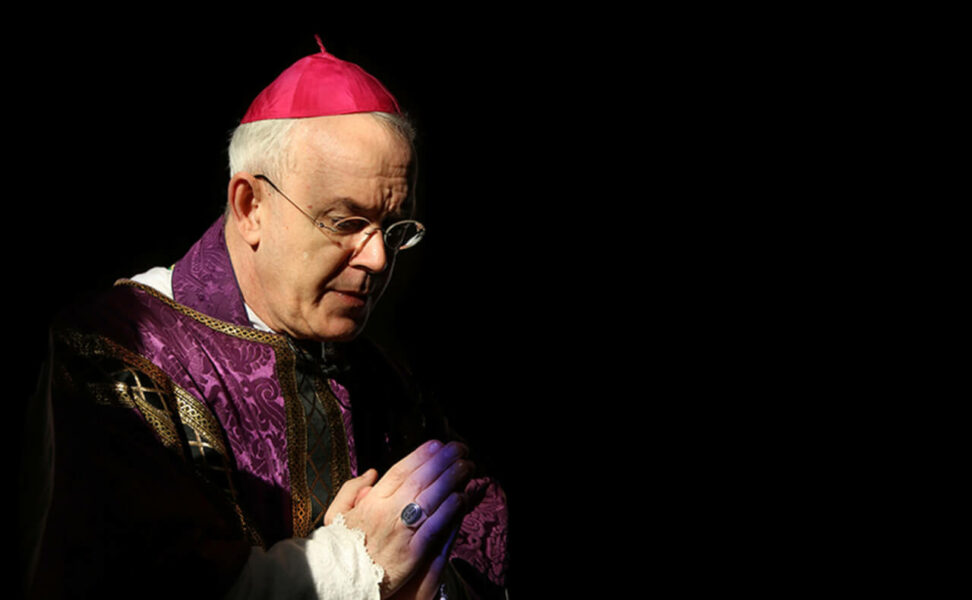
The possible consecration of new bishops by the Priestly Fraternity of Saint Pius X has kept the debate alive ever since that decision was announced regarding the relationship between Rome and the work founded by Archbishop Marcel Lefebvre. In this context, journalist Diane Montagna has published an extensive article by Bishop Athanasius Schneider in which the prelate maintains that the real problem is not primarily juridical, but doctrinal and liturgical.
The full translation of this text is offered below, in which Bishop Schneider analyzes the tensions that have arisen since the Second Vatican Council, the current situation of the FSSPX, and possible ways to resolve the conflict.
The Central Question Regarding the Priestly Fraternity of Saint Pius X
By Bishop Athanasius Schneider
The questions and problems related to the Priestly Fraternity of Saint Pius X (FSSPX) have been the subject of a largely sterile debate for more than fifty years and have now culminated in the announced episcopal consecrations, which have not yet been approved by the Holy See. The discussion has been fueled by emotion—often, literally cum ira et studio—and is frequently carried out by people who lack direct familiarity with the relevant documents or personal experience with the FSSPX. In many cases, their knowledge is superficial and shaped by preconceived judgments. As a result, the debate often resembles a dialogue of the deaf, in which the same arguments are repeated indefinitely without any significant progress.
Moreover, the debate largely evades the central question raised by the FSSPX. This failure stems from a fundamental methodological error and the lack of a fact-based justification regarding the objective doctrinal and liturgical ambiguities that lie at the heart of the controversy. Essentially, the conflict revolves around the question of truth.
1. Vatican II in the Context of the Other Twenty Ecumenical Councils
The first error consists in treating a pastoral council—in this case, the Second Vatican Council—as if it were entirely dogmatic, and in presupposing that all its statements must be considered definitively proposed and binding on all Catholics. Those who act in this way overlook the fact that Paul VI himself stated: “Some ask what authority, what theological qualification the Council intended to give to its teachings, knowing that it avoided issuing solemn dogmatic definitions engaging the infallibility of the ecclesiastical Magisterium. The answer is known by anyone who remembers the conciliar declaration of March 6, 1964, repeated on November 16, 1964: given the pastoral character of the Council, it avoided pronouncing, in an extraordinary manner, dogmas endowed with the note of infallibility” (General Audience, January 12, 1966). This also applies to the two “dogmatic” constitutions of the Council, Dei Verbum and Lumen gentium, since the adjective “dogmatic” has a broader meaning and is not limited to dogmas understood as teachings endowed with infallibility.
Among the other twenty ecumenical councils are numerous declarations and pastoral or disciplinary documents that are no longer applicable today (for example, the decree of the Fourth Lateran Council stating: “If a temporal lord neglects to cleanse his territory of heretical filth, he shall be subject to the bond of excommunication”), as well as non-definitive doctrinal statements (for example, on the matter and form of the sacrament of Holy Orders in the Council of Florence) that were later corrected by the Church’s Magisterium. One cannot absolutize every concrete historical form of ecclesial governance, for doing so would eliminate the necessary distinction between, on the one hand, the immutable and permanent truths of the faith (Depositum Fidei) and, on the other, the various ways in which those truths are transmitted (for example, a pastoral declaration, a non-definitive doctrinal statement, or an ex cathedra definition), each of which possesses a different degree of authority and binding force.
Today, however, in order to be in full communion with the Holy See, it is necessary to accept those statements and teachings of Vatican II that are pastoral and certainly not definitive in their magisterial nature. This raises an important question: why is the unconditional acceptance of the texts of Vatican II presented as a conditio sine qua non for full communion with the Holy See, while there is no comparable requirement regarding the pastoral, disciplinary, or non-definitive teachings of the twenty previous ecumenical councils?
Among the non-definitive teachings of Vatican II are several—particularly those concerning religious freedom, ecumenism, interreligious dialogue, and collegiality—whose formulations are ambiguous and difficult to reconcile with doctrines taught consistently by the Magisterium from the time of the Church Fathers up to the period immediately preceding the Council.
There is also the question of the ritual and doctrinal deficiencies of the Novus Ordo Missae. Such concerns can no longer be dismissed outright, as demonstrated, for example, by the testimony of Archimandrite Boniface Luykx in his book A Wider View of Vatican II: Memories and Analysis of a Council Consultor (Angelico Press, Brooklyn, NY, 2025). The defects of the Novus Ordo Missae remain the subject of serious discussion and cannot simply be overlooked. However, the Holy See is asking the FSSPX to accept not only the validity, but also the legitimacy and goodness of the liturgical reform contained in the Novus Ordo Missae.
2. Two Modern Excesses in the Life of the Church: Legalism and Papocentrism
The resolution of the FSSPX question is hindered not only by a reluctance to honestly confront the underlying doctrinal issues and to acknowledge the existence of doctrinal ambiguities that require correction, but also by an unhealthy mentality that has developed in the Church over the past centuries: namely, the primacy of legalism or juridical positivism, together with an excessive papocentrism that approaches a quasi-divinization of both the office and the person of the Pope.
These modern excesses distort and restrict the life of the Church by subordinating the primacy of the purity and clarity of faith and liturgy to the demands of legalism and papocentrism, a phenomenon foreign to the Church Fathers and the great Tradition. In this exaggerated form of papocentrism, the Pope and his magisterium, even when not strictly dogmatic or definitive, tend to be treated as possessing an absolute and quasi-divine character. The ecclesial climate has often been marked, at least implicitly, by assumptions that approximate such attitudes.
Most commentators on the current controversy surrounding the FSSPX episcopal consecrations remain, often unwittingly, influenced by the excesses of legalism and exaggerated papocentrism that characterize much of contemporary ecclesial life. The law according to which episcopal consecrations performed without papal authorization—or against the expressed will of the Pope—constitute a schismatic act was unknown in the time of the Church Fathers. In fact, this law only came into force during the second millennium. Canon 1387 of the 1983 Code of Canon Law, which prohibits the consecration of a bishop without a pontifical mandate, is classified among the “Offenses against the Sacraments,” and not among the “Offenses against the Faith and the Unity of the Church,” where schism is sanctioned (can. 1364). If episcopal consecration without a pontifical mandate were intrinsically schismatic, it would be placed among the offenses “against the unity of the Church.” The corresponding canon in the 1917 Code was likewise included among the “Offenses in the Administration and Reception of Orders and Other Sacraments” (Title XVI), and not among the “Offenses against the Faith and the Unity of the Church” (Title XI).
3. The Extraordinary State of Crisis, Even of Emergency, in the Church
Since the Second Vatican Council, the Catholic Church has experienced a climate of general ambiguity, vagueness, and uncertainty regarding important doctrines such as the uniqueness of Christ the Redeemer, the uniqueness of the Catholic Church, the divinely instituted monarchical structure of the Church (both at the universal and local levels), and the sacrificial character of the Holy Mass. It is manifestly evident that those who have exercised administrative power in the Holy See over the past decades, and continue to do so today, demand of the FSSPX as a conditio sine qua non for full communion with the Holy See the acceptance of the de facto climate of doctrinal and liturgical ambiguity and relativism, which has reached its culmination in the current and extremely confused synodal process throughout the Church.
Since the Council, with some of the aforementioned ambiguous teachings, a process has been set in motion aimed at establishing, with the authority of the Roman Pontiff, a so-called “Church of Vatican II” or “Conciliar Church.” This tendency, which in our days adopts the new name of “Synodal Church,” basically seeks to become a relativist religion adapted to the world. Attempts to disguise this new tendency toward an ambiguous, relativist, and worldly form of the Catholic Church through a hermeneutic of continuity are dishonest and unconvincing.
4. The FSSPX’s Dilemma of Conscience
The Holy See requires the FSSPX to accept ambiguously formulated and non-definitive doctrines as a conditio sine qua non for full communion with the Holy See and for receiving canonical regularization. Among these are the teachings concerning religious freedom, ecumenism, interreligious dialogue (including, for example, the statement in Lumen Gentium 16 that Muslims, together with Catholics, “adore the one merciful God”), episcopal collegiality (understood in a way that diminishes the divinely instituted monarchical structure of the Church), and the liturgical reforms associated with the Novus Ordo Missae. The Holy See also requires the FSSPX to formally recognize the declarations and teachings of post-conciliar Popes that belong to the so-called authentic and ordinary magisterium. These include, for example, certain statements in Amoris Laetitia that gravely undermine and even contradict divine Revelation; the formal permission of Pope Francis for divorced and remarried persons to receive Holy Communion; and the declaration on blessings for same-sex couples, Fiducia Supplicans.
If one honestly examines the extraordinary crisis that has affected the Church since the Council—together with the ambiguities and doctrinal, liturgical, and pastoral relativism that have accompanied it—then the existence and activity of the FSSPX may be considered, from a long-term perspective and in light of the Church’s two thousand years of history, as a work of divine providence and as a source of help for the Church during a crisis of unprecedented magnitude.
In reading the recent documents issued by the Superior General of the FSSPX, Father Davide Pagliarani, particularly the Declaration of Catholic Faith and his Message to the Fraternity and Its Faithful (attached below), one cannot fail to notice a deeply Catholic spirit, imbued with a true faith in the papal primacy and a filial devotion to the person of the Supreme Pontiff.
The problem facing the FSSPX is not difficult to understand. The Holy See requires the FSSPX to accept, without substantial objections, certain objectively ambiguous and non-definitive teachings of the Second Vatican Council, ambiguous statements of the post-conciliar papal magisterium, and objective doctrinal and ritual defects of the Novus Ordo. However, God has never required the acceptance of doctrines that are unclear or ambiguously formulated, and throughout its history the Church has always acted accordingly.
The FSSPX considers that one of the essential reasons for its existence is to call, with parrhesia, for a return to the absolute clarity and doctrinal purity that the Church has always sought to preserve throughout the centuries. In the past, the Roman Pontiffs endured persecutions, martyrdoms, and even schisms rather than tolerate the slightest ambiguity in the expression of the faith. Among the most notable examples are the rejection of the ambiguous term homoiousios; the rejection of the Henotikon, which, although not formally heretical, undermined the clarity of Christological doctrine and facilitated the spread of Monophysitism; and the rejection of the ambiguous Christological formulations of Pope Honorius I (+638). Several Popes posthumously condemned Honorius I, not for heresy, but for doctrinal ambiguity and for having favored the spread of heresy. Unity is not, in itself, the ultimate criterion of truth. The history of the Church knows numerous situations in which tensions existed between tradition and the effective exercise of ecclesiastical authority.
The mere fact that certain teachings of the Second Vatican Council, together with the liturgical reform, have given rise—and continue to give rise, both in theory and in practice—to a weakening of doctrinal clarity obliges the Pope, following the example of many of his heroic predecessors, to clarify and, when necessary, correct these teachings. This should be done with renewed doctrinal precision and clarity, in such a way that no room remains for ambiguous or erroneous interpretations. In this regard, the following principle, which for a long time guided the Roman Pontiffs, remains more relevant than ever: “Ambiguity can never be tolerated in a Synod (Council), whose principal glory consists, above all, in teaching the truth with clarity and excluding all danger of error” (Pius VI, Auctorem fidei).
The tragedy of the current situation is that the Holy See requires the FSSPX to accept the existing state of doctrinal and liturgical ambiguity as a conditio sine qua non for full communion and canonical regularization. During the Monothelite controversy, when Pope Honorius I adopted an ambiguous position, the holy patriarch Sophronius of Jerusalem sent to Rome his suffragan, Stephen, Bishop of Dora, instructing him to go to the Apostolic See, where the foundations of orthodox doctrine are found, and not to cease praying and pleading until those exercising authority examined and condemned the new error. Bishop Stephen remained in Rome for ten years, persevering in this mission until he witnessed the condemnation of the heresy by Pope Martin I at the Lateran Council of 649. In a certain sense, the FSSPX is performing a similar function today, relentlessly urging the Holy See to put an end to the situation of doctrinal and liturgical ambiguity and uncertainty. The FSSPX has repeatedly declared that it has no other intention than to form the souls entrusted to its pastoral care as good Christians and authentic sons and daughters of the Roman Church. Ultimately, one should be grateful to the FSSPX for this role; future Popes certainly will be.
5. The Pope’s Pastoral Solution to the FSSPX Problem
The Holy See should duly consider the Declaration of Catholic Faith and the Message to the Faithful issued by the Superior General of the FSSPX, and recognize these documents and acts as sufficient and capable of satisfying the minimum conditions for ecclesial communion. An excommunication at the present moment would open a new wound in the Mystical Body of Christ, unnecessary and avoidable.
In light of these documents and acts of the FSSPX, the Pope, with his paternal heart, could make an exception and allow the episcopal consecrations through a truly generous pastoral gesture. By imposing an excommunication on the consecrating and consecrated bishops, the Supreme Pontiff would be implicitly punishing also the faithful of the FSSPX—a part of his flock—who sincerely love and recognize him, but who, due to what they perceive as a genuine dilemma of conscience, see no other alternative than to continue being assisted pastorally by the FSSPX, for whose existence the episcopate remains indispensable, especially for the administration of the sacraments of Holy Orders and Confirmation.
Therefore, solely for the good of souls and the good of the Church, the FSSPX asks that the Supreme Pontiff show understanding, given the current circumstances, regarding its need to have bishops and allow the episcopal consecrations. Unfortunately, despite what it considers an objective dilemma of conscience, the FSSPX is largely characterized as schismatic and proud.
With a spirit of magnanimity, the Supreme Pontiff, as a true father, could extend a bridge to the FSSPX, this portion of his flock, and allow the episcopal consecrations in an exceptional manner to foster a climate in which, through greater mutual trust, a solution to the doctrinal questions and the corresponding juridical provisions may be found patiently and gradually. The Synodal Church of our days should be capable of a similar pastoral breadth and generosity. In light of the numerous generous ecumenical declarations and initiatives of recent decades, it should likewise demonstrate its capacity to address a serious ecclesial problem through dialogue, patience, and understanding within the Catholic Church itself.
Recently, Cardinal Pietro Parolin, Vatican Secretary of State, stated that, with regard to the deviations of the German bishops, the Holy See does not wish the divisions to lead to punitive measures, emphasizing that problems within the Church must be resolved peacefully whenever possible. Why should this same approach not also be applied to the FSSPX, which denies no dogma, recognizes the primacy of the Pope, prays for him, and professes a filial devotion to his person, while retaining only what the Church universally believed and celebrated until the Council? At the same time, the German Synodal Way has promoted clear doctrinal deviations that foster de facto heresies and even blasphemous positions. Why, then, is reconciliation and patient dialogue emphasized in one case, but not in the other?
If this year the Pope were to pronounce an excommunication, a new anathema, against the consecrating and consecrated bishops, it would go down in the history of the Church as an error of excessive pastoral severity. Future generations and future Popes would come to regret it. Why should the Pope today do what future generations might regret tomorrow? Should we not learn from history? Is the Pope not called, as Supreme Pontiff, above all to be a bridge-builder?
Annexes:
- Interview with the Superior General of the Priestly Fraternity of Saint Pius X of February 5, 2026:
https://fsspx.news/en/news/interview-superior-general-priestly-society-saint-pius-x-57064 - Message to the Faithful and Friends of the Priestly Fraternity of Saint Pius X of March 7, 2026:
https://fsspx.org/en/news/episcopal-consecrations-what-fr-pagliarani-told-members-society-saint-pius-x-59250 - Declaration of Catholic Faith Addressed to His Holiness Pope Leo XIV by Fr. Davide Pagliarani, Superior General of the Priestly Fraternity of Saint Pius X, of May 14, 2026:
https://sspx.org/sites/default/files/documents/2026-05-14_declaration_of_catholic_faith_en.pdf