


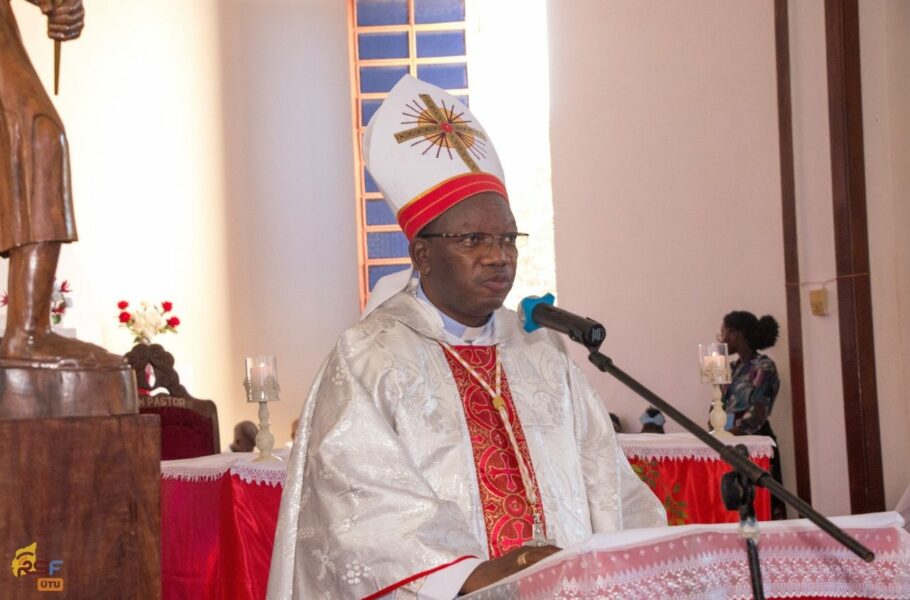
The bishop of Pemba, Mons. António Juliasse Ferreira Sandramo, has warned that the jihadist groups operating in Cabo Delgado province, in northern Mozambique, are seeking to establish an Islamic caliphate in the region. The denunciation comes amid a war that has already left more than 6,300 dead, over a million displaced, and growing persecution against Christian communities.
In statements collected by the pontifical foundation Aid to the Church in Need (ACN), the prelate said the terrorists no longer hide their objectives. “The signs are there. They speak openly of a caliphate. When they find people, when they kidnap victims, that is what they say: that they are working for a caliphate,” he stated.
The violence has hit the Catholic Church particularly hard. According to ACN data, more than 300 Catholics have been killed since the insurgency began in 2017, many of them by beheading, while at least 117 churches and ecclesial buildings have been destroyed.
“They speak openly of a caliphate”
What began as a series of attacks on military and government targets has gradually turned into a campaign of violence that increasingly affects the civilian population and Christian communities.
Mons. Juliasse maintains that the armed groups’ rhetoric leaves fewer and fewer doubts about their intentions.
“When they kidnap people or come into contact with local populations, they speak of creating a caliphate,” explained the bishop, who leads one of the dioceses hardest hit by the violence.
More than 300 Catholics killed and 117 churches destroyed
The persecution of Christians has become one of the most dramatic aspects of the conflict.
Among the destroyed buildings is the historic church of the San Luis de Montfort mission, belonging to the diocese of Pemba. The temple, built in 1946, was set on fire and reduced to ashes at the end of April.
The destruction of churches, schools, pastoral centers, and other ecclesial infrastructure has forced numerous communities to abandon their places of worship and reorganize their religious life under extremely precarious conditions.
Meanwhile, hundreds of thousands of people remain displaced within the country, many of them dependent on humanitarian aid to survive.
Religious coexistence begins to fracture
In addition to physical violence, the bishop warns of a growing social fracture between communities that for decades lived peacefully together.
“What worries me is the discourse of hatred that accompanies all this violence,” he said.
Mons. Juliasse recalled that in many villages in Cabo Delgado it was common for Christians and Muslims to take part in each other’s funerals and family celebrations. However, that coexistence is now beginning to be threatened by radicalization and distrust.
“Religion was one of the elements that facilitated coexistence, but now it is starting to become a factor of division,” he lamented.
“Silence is always dangerous”
The bishop also criticized the scant attention the tragedy of Cabo Delgado receives both inside and outside Mozambique.
“Silence can be interpreted as prudence, but also as a lack of interest,” he warned.
In his view, Mozambican society needs to openly confront the causes of the conflict and debate lasting solutions before the situation deteriorates further.
“We need to talk about what is happening, guide the population, and face this problem together as a nation,” he noted.
The bishops call for dialogue to achieve peace
Although the jihadist threat remains active, the Mozambican Church believes the solution cannot be limited exclusively to a military response.
Mons. Juliasse recalled that the country’s bishops recently published a pastoral letter denouncing the situation and proposing alternative paths to peace.
“I do not believe the military option is the only solution. Mozambique also knows the path of dialogue,” he said.
The prelate stressed that many of the fighters are Mozambican citizens and maintained that any lasting solution must address the deep-rooted causes that have fueled the conflict.
Despite nearly nine years of war, the bishop wished to convey a message of hope to the faithful. “It is a situation that causes us great pain, but we must not lose hope,” he concluded.
The Cabo Delgado crisis remains one of the least-known wars in the world, yet its consequences continue to strike thousands of families every day, as well as a Church that, despite persecution and destruction, keeps its presence alive in one of the regions of Africa hardest hit by Islamist terrorism.