


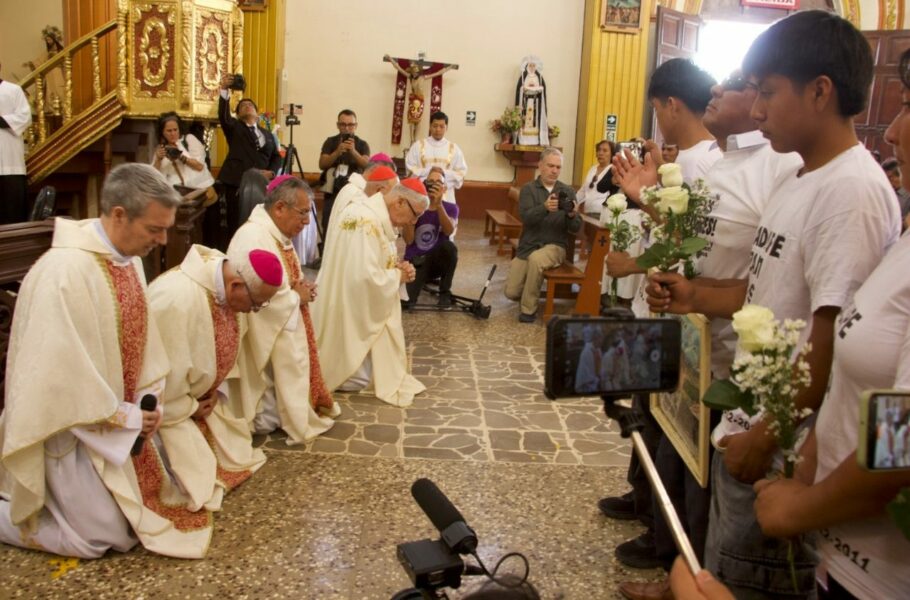
The request for forgiveness by the Peruvian hierarchy in Catacaos, presented as a historic act of reparation toward the victims linked to the Sodalicio case, has become embroiled in fresh controversy following the publication of a serious accusation by La Abeja: the ceremony is said to have also been used as a staged event to obtain footage for a documentary centered on Monsignor Jordi Bertomeu.
The event held at the parish of San Juan Bautista in Catacaos was officially described as a Mass of accompaniment and symbolic reparation for the peasant communities of the Tallán indigenous people. The Peruvian Episcopal Conference stated that the celebration responded to a request submitted by Catacaos residents to Bertomeu and that it was attended by cardinals, archbishops, representatives of civil society, authorities, and members of the diplomatic corps. Vatican News also portrayed the scene as a gesture of reparation, noting that Bertomeu, after two weeks dedicated to a listening channel at the Apostolic Nunciature of Peru, concelebrated the Mass with Cardinals Carlos Castillo and Pedro Barreto and other Peruvian bishops.
The official dimension of the act is clear. What is now being questioned is something else: whether that ceremony was also prepared or exploited as audiovisual material to build Bertomeu’s public image as the protagonist of the Sodalicio case. According to the article signed by Luciano Revoredo in La Abeja, various videos circulated on social media show the presence of a cameraman and an assistant in the front row, as well as several cameras recording the gestures of Bertomeu and the bishops present. The outlet identifies the man with the camera as Salvador del Solar, actor, filmmaker, and former Peruvian prime minister, and states that he was not a parishioner, journalist, or pastoral agent.
The accusation is not limited to Catacaos. La Abeja maintains that during several days of the Sodalicio victims’ listening channel at the Apostolic Nunciature of Peru in Lima, a man with audiovisual equipment was filming and recording who entered and left, as well as interviewing some people as they left the premises. The same article claims that Bertomeu once stepped out to speak with a group of alleged victims and even got into the cameraman’s vehicle.
That detail is especially sensitive because the listening channel was not a minor private activity. The official communiqué of the Apostolic Commissioner stated that between May 4 and 22, 2026, a “First Listening Channel” would be made available at the Apostolic Nunciature in Peru for people who considered themselves victims not properly compensated for physical, sexual, spiritual, conscience, authority, economic, or other abuses attributed to members of the so-called Sodalitium spiritual family.
If what La Abeja reports is confirmed, the problem would no longer be whether the request for forgiveness was timely or not. The problem would be far more serious: victims summoned by a pontifical body, a diplomatic seat of the Holy See, and a public liturgy would have served as a stage to produce images for an audiovisual narrative of clerical self-promotion.
The sequence raises questions that Rome cannot dismiss as a mere media controversy. Who authorized the presence of Salvador del Solar or any other audiovisual team alongside Bertomeu? Was the filming for internal archives, for the press, for a production company, or for a documentary? Were the people who came to the Nunciature informed? Was there express consent from those entering and leaving a victims’ listening channel? Is there authorization from the Holy See to use images of that process in an audiovisual production? Did the apostolic nuncio in Peru know what was happening?
The point is not minor. One thing is to document an institutionally sensitive process. Quite another is to surround victims and bishops with cameras to feed the visual narrative of a commissioner turned central character. The Church can and must ask forgiveness when it has failed. What it cannot do is turn that forgiveness into a scene profitable for the camera.
The Catacaos ceremony had already been questioned for using the liturgy as support for a gesture with strong political and media overtones. InfoVaticana then reported that the problem was not in asking forgiveness, but in doing so “in front of cameras” and within the liturgical action, turning the altar into a stage for a message foreign to the rite. The new accusation aggravates that reading: if there was an audiovisual production behind it, the line between reparation and representation becomes completely blurred.
Bertomeu is not just any priest in this case. He is an official of the Dicastery for the Doctrine of the Faith and the apostolic commissioner in charge of liquidating the institutions linked to the Sodalicio. Precisely for that reason, his public exposure requires more prudence, not less. The greater the authority received, the greater the obligation to separate service to the victims from the construction of a personal image.
The Holy See, the Apostolic Nunciature in Peru, and Bertomeu himself must immediately clarify whether a documentary project existed, who promoted it, who filmed, with what permissions, for what purpose, and where those images are. Because if a Mass of reparation and a listening channel were used to fabricate the heroic profile of the pontifical commissioner, then Catacaos was not merely a debatable ceremony. It was the conversion of others’ pain into filming material.