


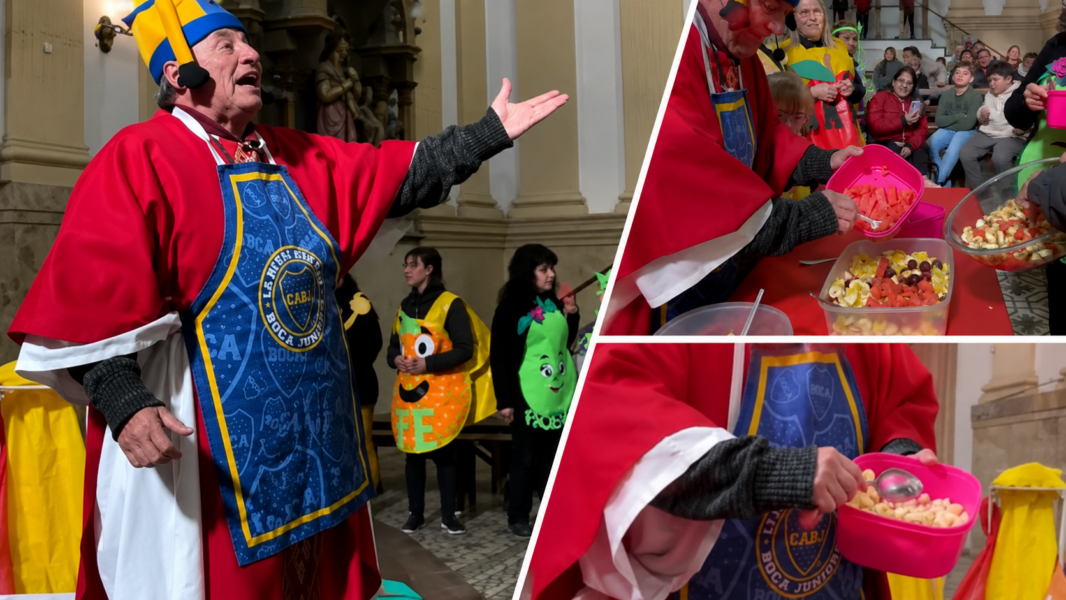
A children’s celebration of Pentecost in the Argentine diocese of Río Cuarto has drawn attention for the way the liturgy was conducted. During the Mass celebrated on May 24 at the parish of Nuestra Señora de la Merced, Father Carlos Costale prepared a fruit salad in front of the faithful while explaining the gifts and fruits of the Holy Spirit to the children present.
The images, later shared on social media and picked up by various Catholic media outlets, show the priest wearing a Boca Juniors club apron and a striking yellow-and-blue hat inspired by the Minions, as he prepared the fruit salad before the congregation. Each ingredient was symbolically linked to a fruit of the Holy Spirit before being distributed among those present.
A catechesis that sparks controversy
According to the initiative’s defenders, the activity aimed to “bring children closer to the meaning of Pentecost through a visual and pedagogical language adapted to their age.”
However, the images once again demonstrate a scene of liturgical abuse caused by the liberties some priests allow themselves during the celebration of Holy Mass. The Argentine blog, Wanderer, described the scene as a “clown show” and publicly raised various questions to the bishop of Río Cuarto, Monsignor Adolfo Uriona, regarding liturgical oversight in the diocese.
The controversy does not revolve solely around a one-off activity. The problem lies in the growing tendency to turn the liturgy into a space for entertainment or amusement with the goal of capturing the attention of attendees, especially the youngest.
Such initiatives ultimately blur the sacred meaning of the Mass and confuse the nature of the Eucharistic celebration.
The words of Leo XIV on the liturgy
Days after the controversy arose in Río Cuarto, Leo XIV reminded priests of the importance of respecting the Church’s liturgical norms:
«I therefore exhort all those called to prepare the celebration of the divine mysteries, in particular the priests who exercise the ministry of liturgical presidency, to always guard that respect for the texts and ordinances of the liturgy which springs from an interior attitude of availability and trust in God, manifesting humility before His greatness and sincere fidelity to ecclesial communion.»
During the general audience, the Pontiff urged the clergy to avoid modifications introduced on personal initiative that could generate confusion among the faithful, also emphasizing that the legitimate development of the liturgy must always remain in continuity with the Church’s tradition and with the essential elements received from it.
A debate that transcends Argentina
The discussion sparked in Río Cuarto reflects a much broader debate that has been present for decades in numerous countries.
While some defend the need to adapt pastoral language to new generations through “creative resources,” others warn of the risk of turning the liturgy into a pedagogical spectacle where the focus shifts away from the Eucharistic mystery toward dynamics, performances, or activities foreign to the rite.
The images of Pentecost in Río Cuarto make clear the extent to which “pastoral creativity” loses the liturgical sense of a rite that does not need “improvisation” to attract the faithful. The Mass does not need to be entertaining to be understood, nor transformed into a spectacle to transmit the faith.