


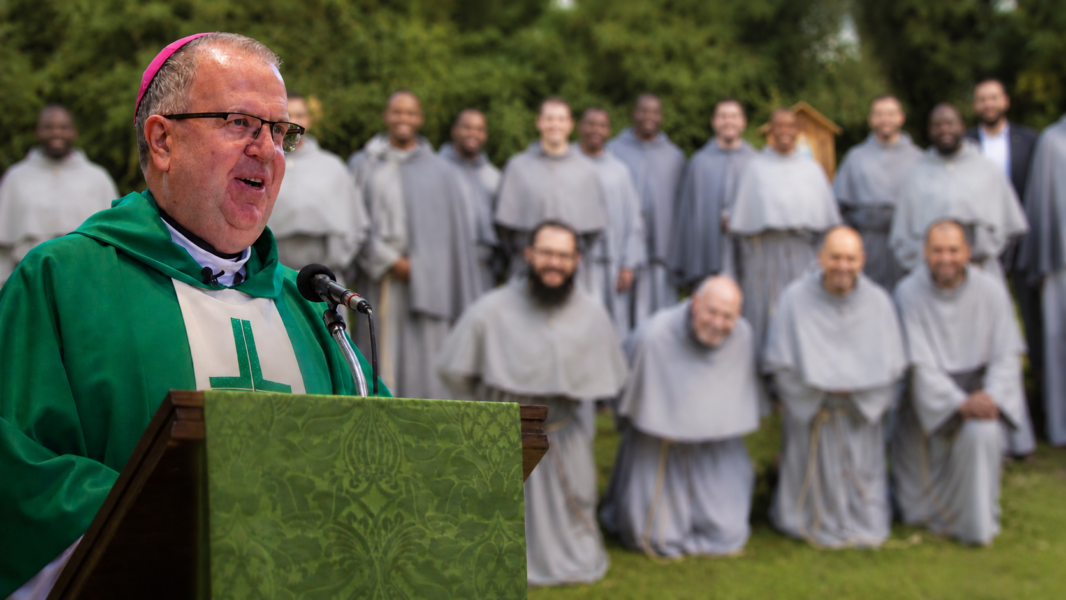
The official disappearance of the Marian Franciscans as a canonical entity last June 1 has left numerous questions unanswered. Although the official explanation offered by the community and by the Diocese of Portsmouth points to practical and canonical difficulties in securing their future, various sources maintain that the story is more complex and that the keys to their disappearance must be sought far from England.
Last week the suppression of this community, born in the United Kingdom and closely linked to the traditional apostolate, was announced. However, new information from Advaticanum suggests that the tensions that arose in Scotland may have played a decisive role in the final outcome.
The Scottish project that never came to fruition
When the Marian Franciscans partially established themselves in the Scottish diocese of Dunkeld in 2022, a new chapter seemed to open for the community. Then-Bishop Stephen Robson had shown his support for the religious and the sisters associated with the institute, even promoting the search for a permanent location.
The plans included the acquisition of properties to house a convent, a monastery, and a chapel that would allow the community to consolidate its presence in Scotland. However, the situation changed radically after the arrival of Bishop Andrew McKenzie.
In February of this year, the diocese announced that the real estate transaction would not receive final approval and that the community would have to leave the diocesan territory. Although an extension was later granted until October 2026, the project that was meant to guarantee the stability of the Marian Franciscans was definitively blocked.
Accusations never publicly explained
According to various sources, diocesan authorities had received criticisms related to the community’s internal life. Among them were alleged attitudes considered excessively rigid by some observers and doubts about the age of certain novices and sisters entering consecrated life.
To date, the Diocese of Dunkeld has not publicly explained whether these issues influenced its decisions or provided details on the reasons that led to the rejection of the projects promoted by the community.
The absence of official explanations has fueled speculation among the faithful and benefactors who for years supported the growth of the Marian Franciscans.
A community that continued to grow
One of the most striking aspects of this case is that the dissolution does not occur in a context of apostolic decline. On the contrary, in recent years the community had stood out for attracting numerous young families, fostering vocations, and promoting an intense sacramental life.
The religious themselves have noted that their apostolates recorded conversions, baptisms, an increase in Marian devotion, and growing participation of the faithful in the life of the Church.
This apparent contradiction between pastoral growth and institutional disappearance has led some observers to question whether the obstacles encountered were truly organizational in nature or whether deeper ecclesial factors hindered the continuity of the project.
The context of Traditionis Custodes
The history of the Marian Franciscans also unfolds in a particularly delicate context for many communities linked to the traditional liturgy.
Following the publication of Traditionis Custodes in 2021, numerous initiatives related to the traditional liturgy have faced greater restrictions and canonical requirements. The Marian Franciscans themselves acknowledged that authorizations to celebrate according to the traditional liturgical books became more limited over the years.
Although there is no evidence that this issue directly caused the dissolution of the community, it does form part of the general framework in which the events unfolded.
An ending that leaves questions
Officially, the Diocese of Portsmouth maintains that the suppression was requested by the community members themselves after a process of discernment regarding their future viability. However, information that has come to light in recent days suggests that the difficulties that arose in Scotland may have deprived the Marian Franciscans of the structure necessary to guarantee their continuity.
With the disappearance of the community, one of the most singular experiences of traditional Catholic apostolate in the United Kingdom over the past decade comes to an end. Nevertheless, questions about the ultimate reasons for its dissolution will likely remain open until the authorities involved provide more detailed explanations.