


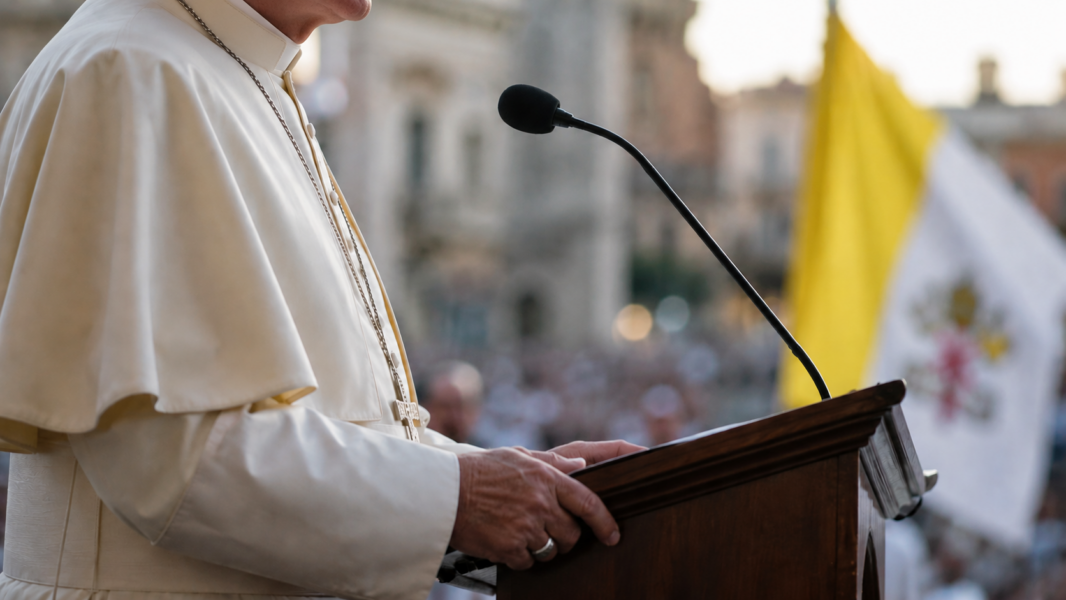
I write this in advance, on purpose. Before León XIV sets foot in Spain in June, before he delivers the speech on immigration that he will deliver, and before that speech produces the effect it will produce. I write it beforehand because what is coming can be foreseen with the same certainty with which a shadow is foreseen once the body and the light are known, and because I want it on record, dated, that the effect will not be a regrettable accident that befalls well-intentioned words, but the precise result of having uttered them where they will be uttered, when they will be uttered, and of remaining silent about what will remain unsaid. It is not prophecy. It is geometry.
He will say things no Catholic can dispute. That the State has the right to order its borders. That the drama originates in the countries of departure and in what the North fails to do for the South. That whoever arrives is a human being and deserves the respect due to his dignity. Three impeccable propositions, all three textbook, all three already pronounced on the return flight from Africa last April. And precisely because they are impeccable, it is worth examining them closely, for there are truths that instruct in one room and condemn in another without a single comma having changed: what changes is not the truth, but who is seated listening to it.
Aristotle described the device twenty-three centuries ago when he defined the enthymeme, the rhetorical syllogism whose force lies not in what the speaker says but in the premise he leaves unsaid and which the listener, diligently, supplies on his own. When the Pope recalls that the migrant “must be treated as a human being and not worse than animals,” he states a truth and, in the same gesture, opens a gap. The gap calls for an unspoken premise: that someone is prepared to treat him worse than a beast. Over the Atlantic, before the world’s press, that premise floats without an address. But the journalists were not asking about the world. They were asking about Spain, about the Canary Islands, about the migratory polarization—said to exist—“also among Catholics.” The question already came with the board drawn. And the Spaniard who listens will not have to strain to give a face to the presumed monster: it will be handed to him ready-made.
The mechanism has an evangelical genealogy and it is best not to evade it. It is the architecture of the Pharisee’s prayer—“God, I thank you that I am not like other men” (Lk 18)—which in a single movement places the speaker on the side of virtue and casts the silent one on the side of vice. Invoking the migrant’s dignity in a polarized setting does exactly that: it situates the one who invokes it in the camp of dignity—an effortless operation, since no one disputes it—and leaves, without naming him, the dissenter in the camp of the person who would treat a man worse than an animal. The proposition is charitable; its yield is not. What Péguy reproached in Kantianism applies here with micrometric cruelty: it has clean hands, but it has no hands. The invocation neither returns nor welcomes anyone, settles not a single case file, arbitrates none of the real dilemma between repatriation and regularization; yet it does stain anyone who dares to raise it.
And this is where ill-conceived piety will attempt to rescue the Pontiff by the shortest route, which is to suppose him naïve: he uttered a beautiful truth, and if one faction turns it to its advantage, the fault is theirs, not his who spoke it. A comfortable absolution. Also an impossible one. For it to be granted, one would have to imagine León XIV ignorant of three things that no one on his throne ignores. That the question was not about the world, but about Spain and its dispute. That he travels in June precisely to the country where that dispute is burning. And that the principle of dignity, in this field, is disputed by no one, so that repeating it adds not an ounce of information and merely redistributes blame. Three ignorances which, taken together, do not portray a distracted shepherd but a man estranged from the office he exercises. And since one does not ascend to the throne of Peter by oversight, the hypothesis of innocence collapses of its own accord. The other remains.
It is reinforced by what ancient rhetoric called the argument from silence. Whoever feared the misuse of his phrase had at hand the phrase that would conjure it away, and it cost him only a subordinate clause: that human dignity does not decide permanence, that recognizing the person is not recognizing the right to stay, that between humane return and unordered reception lies an entire world. He did not say it. He could have disarmed the misunderstanding with twelve words and chose not to spend them. The premise that would have neutralized the effect is, if one looks closely, the only one missing from a speech that said everything else. A silence so exact is not an oversight. It is a blueprint.
I am not speaking of malice, which is a coarse word and, moreover, confesses itself. I am speaking of calculation, which is finer and prays. The effect—absolving one shore of the board, staining the other with a cruelty it has not proposed—will not be the mishap the speaker later deplores from the heaven of his good faith. It will be, with all the probability that the intelligence of the figure imposes, what was sought by choosing this hall, this eve, and this country, and by reserving the precise silence that leaves the truth fallen into the hands of those who already know what to do with it. No one, it should be said, is calling for anyone to be drowned at sea; no public voice in Spain is doing so. That is the refinement of the device: to fabricate an adversary who does not exist so that the one who does exist is, by proximity, smeared with his invented monstrosity.
Thus León XIV will be irreproachable in every word he utters. He will be so, above all, in the one he does not utter. And those who leave that Mass convinced that Heaven has ruled in their favor will have been absolved, yes, but by a tribunal that was not God’s, but that of the one who knew with an artilleryman’s precision where the stone would fall when he released it. I write this now, in advance, so that when it happens no one can call it a surprise. Nor paranoia. Only the anticipated memory of a mechanism that the interested party himself knows better than I do.