


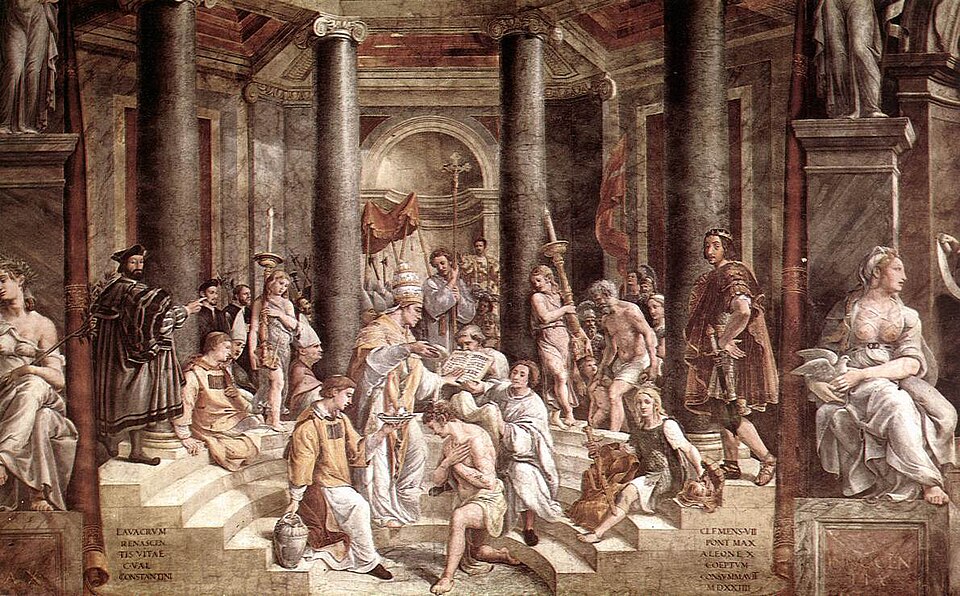
This November. At the latest meeting of the Italian bishops, their president, Cardinal Matteo Zuppi, made a statement that many found shocking. He declared, emphatically, that “Christendom has ended”. The surprise, however, should not be so overwhelming: Pope Francis himself had been repeating the same idea since 2014, when he stated that “we are no longer in Christendom.”
For those who confuse Christendom with Christianity, as if the two words meant the same thing, such declarations may sound somewhat apocalyptic: are the highest representatives of the Catholic Church announcing the end of their own religion? Are we witnessing today, in real time, the figure Nietzsche described in the final pages of his Thus Spoke Zarathustra: the figure of the “last pope,” a pontiff who would proclaim the death of God?
The surprise (and the fears of that Nietzschean conclusion) are somewhat tempered if one continues listening to Zuppi: “Christendom has ended… but Christianity has not,” the cardinal clarified. This same idea undoubtedly inspired Pope Francis whenever he made similar statements. But what is the difference between Christendom and Christianity that leads such high-ranking prelates to establish this dichotomy—one ending, the other enduring?
To put it briefly, let us think of Christianity as a religious faith: belief in Jesus as the Son of God, with His teachings, His sacraments, His communities of believers. Christendom, by contrast, would be the name of a civilization: one in which Christian principles shape not only the private lives of certain individuals, but also the laws, institutions, art, and culture of an entire society. Christianity can certainly exist without Christendom—as it did during its first three centuries, and still does wherever it remains a minority religion. Likewise, within Christendom—in a civilization marked by Christianity—individuals who are not Christians, who do not hold the Christian faith—Jews, Buddhists, atheists, agnostics—can certainly live; but all of them live in a society where Christian inspiration organizes coexistence.
According to Zuppi, Pope Francis, and many others, however, the West today is no longer such a society. Philosopher Chantal Delsol explained this in her book The End of Christendom (2021): it is enough to look at the legislation of nearly all Western countries—where abortion, euthanasia, and transgender laws are advancing—for it to become ridiculous to continue thinking that we live in “a civilization marked by Christian principles.” A new era has begun among us: the post-Christian era. What consequences should Christians draw from this?
Three Responses to the End of Christendom
Here we might say that responses fall into three major groups.
The first group consists of those Christians who rejoice at the end of Christendom, because it will make us more “authentic” in our faith. These are Christians who know that, to achieve this goal, they can rely on their private schools, their parishes, their ecclesial groups, where they can live out that “authenticity.” It is a bourgeois Christianity that, deep down, is glad not to have to deal with the inconveniences that always come with implanting Christian principles in a (Christian) society: it is much simpler to settle for implanting them in one’s family or neighborhood.
The second group includes Christians who also celebrate the end of Christendom, but for very different reasons from the bourgeois ones just described. We are now thinking of progressive, even woke, Christians. For them, the old Christian civilization (that of Constantine, the Catholic Monarchs, so many centuries of Europe) always caused them shame: it was so authoritarian, so patriarchal, so typical of lords! What a relief to finally be rid of it, what joy in its end, and how pleasant it is now to opt for a new, more “inclusive,” more “tolerant” civilization, where Christianity is merely a personal preference, like collecting stamps or practicing yoga; even if the common principles have a certain Christian, loving, “soft” flavor: empathy, tolerance, non-discrimination… (Allow me to note, if only in parentheses, that the problem, of course, is what this new woke civilization also imposes, behind its affectionate words: its dogmas about sex, about abortion, about politically correct language. Only, for these woke Christians, this imposition feels much more agreeable than the old one.)
Finally, there is a third group: those of us who do not rejoice, by any means, at the end of Christendom. And not because we long for some old, perfect Christian civilization—something that surely never existed—but because we know that a civilization inspired by Christian principles, however imperfect, is far preferable to the alternatives. Both the internal ones (a new woke civilization) and those coming from outside (an Islamic civilization).
Moreover, we believe that rebuilding the battered (but not entirely collapsed) edifice of Christendom is the best thing we can do to shelter Christianity within it.
Why Christendom Remains Necessary
Why? First, because Christendom has not been an obstacle to Christianity, as the group of “progressive” Christians thinks, but has in fact been its greatest protection. For seventeen centuries it ensured that children were born in Christian homes, educated in schools where the Gospel was taught, celebrated in festivals centered on Christianity, and raised in societies where churches were not clandestine but an option available to all. The transmission of faith from generation to generation does not occur in a vacuum: it is aided by an environment that resonates with Christ. As Cardinal Jean Daniélou said sixty years ago in a debate on these matters with Jean-Pierre Jossua: the main beneficiaries in a Christian civilization, where Christianity is easily accessible to all, are the poor; that is, those who do not have the time, resources, or access to seek it on their own.
The second reason why many of us favor a Christian civilization, and not merely a Christian faith, is perhaps clearer: Christianity was never merely a set of private beliefs about the afterlife. From the beginning, it had radical implications for how this world should be organized: the dignity of every human being, objective truth above the whims of power, the necessity of forgiveness. And all of this was implemented when Constantine prohibited infanticide, crucifixions, and gladiatorial games. In short, all of this moved from the faith of a small parish group (or a catacomb) to laws, customs, and (new) festivities. It passed into the public sphere. Into a civilization. Into what shapes lives and gives them a sense of living.
Therefore, if Christianity were to renounce Christendom, as the bourgeois and the woke desire, it would not become purer or more authentic. It would become more irrelevant and less faithful to its vocation.
That is why some of us still believe that the battle for Christendom has not ended. For we know that, when it truly ends, Christianity will discover how much it needed it.
Rebuilding the Ruins
And that is why, although fewer and fewer remnants of a Christian civilization remain around us—and, consequently, we understand Zuppi, Francis, or Delsol when they declare it already finished—we are nevertheless willing to rebuild it not only in our parishes, our private schools, or our yoga groups, but also in our laws, our cultural creations, and our marks of identity. The ancient Christian city we once inhabited has largely been reduced to rubble, yes; but we still have stones, plans, and the will to contribute to its restoration. Was not that also the word, restauratio (Hispaniae), used by our ancestors when another civilization seemed to have invaded the entire Iberian Peninsula? Our situation is no more unsettling than what they might have felt.
And they succeeded.
Originally published in the journal of the Royal Confraternity of Silence and Holy Cross of Oviedo.