


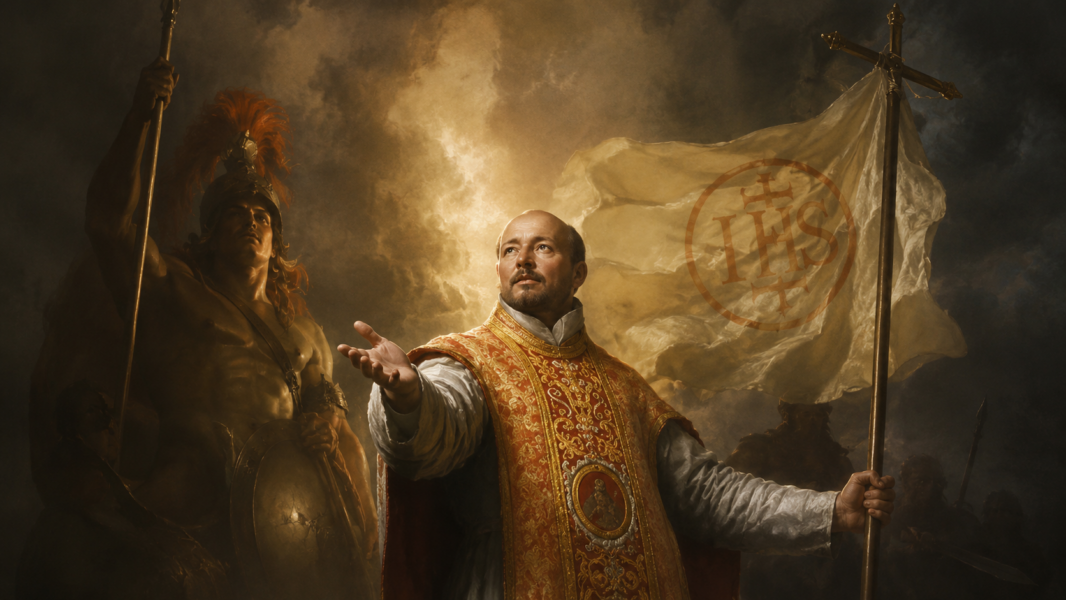
“Before Eden existed there was a war, a rebellion that left consequences we cannot forget. The prince of the angels rebelled against God and the battle has not ended. God has an enemy and so do we. Man was born into a world at war”.
Antonio José Gómez Mir, Nosotros. Palestra ascética para hombres (2025).
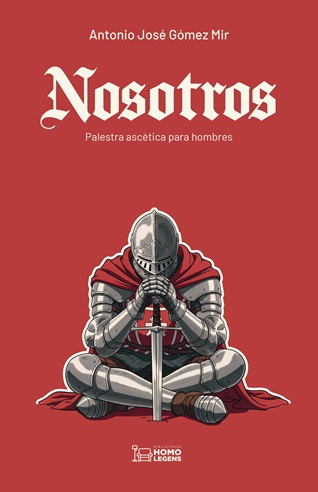
Nosotros. Palestra ascética para hombres (2025) is a book that was born, in the parish of Sant Jordi de Vallcarca in Barcelona, from Father Antonio José Gómez Mir’s deeply personal commitment to a very specific catechetical pastoral approach… This Catalan priest realized the need to respond to a long process of infantilization and feminization of the male that has taken place in recent decades, not only in society at large, but also within the Church itself. Thus, “Nosotros was born with the vocation of answering this disorientation of the Catholic man in the modern world and in the Church.”
The orphanhood caused by the absence of models of the virtuous “man” (hero, knight, martyr, monk, father) has been generating a weak, pusillanimous, and emasculating Christianity that makes it, in the author’s words, “not difficult for us to imagine little old ladies praying the rosary, but our imagination can no longer conceive of the Christian knight.”
It is “a book of Catholic spirituality and asceticism for men” that takes shape in the warmth of the living word, ever incandescent—that is, through a series of conferences and catecheses for young people, available on Father’s remarkable YouTube channel: Stat Crux. And I say “in the warmth” deliberately, because it becomes clear throughout the book that man is made of a material of a certain ductility (at least in two senses: virtue and vice). Faith will be refined in the sun, just as the virtues will be refined in a forge of the will that requires the concurrence of Man (in his relationship with the “other”) and, above all, of Grace. Hence, invoking the passage from Proverbs 27:17, Gómez Mir tells us: “Iron sharpens iron; so a man sharpens the countenance of his friend.”
Palestra means “school of combat,” and “the ascetic struggle is the foundation for living this call to a strong conception of the Christian faith.” The goal is, in the context of a schizoid hyperconsumerism and a rampant nihilism, to “virilize our life through asceticism in order to overcome the effeminacy of a sick will.”
Invested with a concrete dignity…
According to Old Testament tradition, our dignity is already inscribed in our very nature: “So God created humankind in his image, in the image of God he created them; male and female he created them. God blessed them, and God said to them, ‘Be fruitful and multiply’” (Gn 1:27-28). We have been created male and female by the Creator “in his image”; therefore, there must be an internal coherence in the created being.
Just as Mary, the perfect image of femininity, is “the handmaid of the Lord,” the Church is the bride of Jesus Christ. Likewise, Joseph, the biblical archetype of virility, acted with scarcely a word. In him lies that precondition for every man to follow Jesus Christ: “one must be a true man to serve Christ,” says Gómez Mir. And for that it is necessary to break disordered affections and idolatries—that is, to strip off the old man.
Unfortunately, “the anthropological disorientation that characterizes contemporary society and culture has contributed to the breakdown of both the family and society, evident in a tendency to cancel the inherent differences between man and woman.” You already know what Ernst Jünger said: “What is dangerous is not the uncultured man, but the man deformed by culture.” A culture of non-differentiation. Against this stands a “truth of being men.” A perfect coherence between being a man and the very source of Being, namely, God. Nosotros proposes to “recover Christian anthropology, which sees sexuality as a fundamental element of personality, constituting a unique manifestation of being, of feeling, of expressing, and of living human love.”
This is why our Promethean dreams of transcending the human condition could, at best, lead us only to madness or, what amounts to the same thing, to the loss of sanity… As is well known, sanity comes from the Latin cordis (heart). Aristotle philosophically defended a theory called “cardiocentrism.” For him, phronesis (unlike the abstract notion of episteme) is the virtue of prudence that resides in the heart and must guide human action. Today, however, we live unhinged, outside all sanity; we rebel against what is most intimate in our being, that which invests us with a concrete, intransferable, and inseparable dignity.
And in a world where we experience the “crisis of virility” born of narrow-mindedness and hybris, Nosotros bets on a path of virility in Christ, “a virility that is true Christian virtue,” for, as Saint Paul says: “Keep alert, stand firm in your faith; be courageous, be strong. Let all that you do be done in love” (1 Cor 16:13-14).
Embracing our most intimate being must lead us to the correct discernment of our vocation (interwoven with our biological sex): “It is God,” Father Gómez Mir tells us, “who tells us what he wants from us (…). One does not choose one’s identity, one’s being who one is. It is given by God (…). We must understand vocation as direction, as the sense of a goal. And then we must also understand mission as the meaning of day-to-day life (…). Vocation fills our life with meaning and allows us to assume it as a most personal mission. All events and happenings suddenly fall into their true place.”
Christ: Ecce Homo
Now, the problem of the apparent “non-appearance” of Man (with a capital M) in the history of humanity is one that has accompanied us since classical antiquity…
It is said that Diogenes of Sinope, a Greek thinker of the fourth century B.C. and an exponent of the Cynic philosophical school, lived much of his life in opulent Athens under extremely austere conditions (to the point of sleeping in a jar; hence Diogenes syndrome) and used the sting of provocation to criticize the hypocrisy of Athenian society. In that context arises the famous anecdote of the lamp: Diogenes walked the streets of the city in broad daylight saying, “I am looking for a man”… Obviously, the phrase did not refer to the literal search for some random “someone,” but to the difficulty of finding a truly upright, honest, and virtuous human being. We would have to wait four hundred years for Jesus of Nazareth, presented by Pontius Pilate before the “enraged crowd,” to arrive at the man Diogenes longed to find: Ecce Homo, behold the Man…
That man of flesh and blood, person of the Trinitarian image of the Christian God, was, is, and will always be—since human history cannot but be Christocentric—the model of virtus par excellence, the “just one.” Christendom, like the colorful garden of delights of Bosch, has produced fruits of every shape and color; God has made use of ordinary men who, nevertheless, turned the ordinary into something extraordinary by emptying themselves and being inflamed with the amor Dei: Saint Stephen, Saint George of Cappadocia, Saint Anthony the Abbot, Constantine the Great, Charlemagne, Saint Bernard of Clairvaux, Rodrigo Díaz de Vivar the Cid, Saint Ignatius of Loyola, etc. Be that as it may, the book Nosotros poses a question and an answer that simultaneously challenge us: “What was the model of man in traditional society? The model was the warrior, the martyr, the monk, the hero, the knight (…). The Church, in the last century, has also harmed that masculinity.” It is the work of God in man that elevates his fallen nature through Grace.
Now, regarding this last point, if I may offer a constructive critique of the book, I would say that Father Gómez Mir relies excessively on contemporary references in attempting to “update” the magisterium (Dorothy Sayers, C. S. Lewis, John Senior, John Eldredge, Thoreau, Robert Redeker, R. R. Reno, Viktor Frankl), thereby missing the opportunity to delve deeper into the great figures of Christendom mentioned above. Proof of this is that even in his chapter “Heroes and Saints, Archetypes for Education,” he falls into a certain “presentism” by citing Heidegger, Nietzsche, Tocqueville, Huizinga, Chesterton, Scheler, and Redeker more than Sacred Scripture, the Fathers, the magisterium of the Church, and, ultimately, the most fruitful Catholic Tradition stricto sensu.
However, there is an irreversible caesura in human inner history between the Christ of the New Testament and classical antiquity. In Mediterranean antiquity the model of the virtuous man was Achilles, the “hero.” Pagan strength made flesh, the man who longs for eternity as a projection of himself. With the New Testament, “Jesus is the new model of man. No longer is it Achilles. Why? Because Jesus is the one who attains fullness by giving his life out of love. He is the new model of masculinity—not a masculinity that seeks itself and its own glory like Achilles, but one that seeks the glory of God, the will of God.”
For this reason, Father Raniero Cantalamessa, in his Good Friday homily of April 2, 2010, following René Girard, was able to say: “Jesus Christ unmasks and breaks the mechanism of the scapegoat that sacralizes violence, making himself the innocent victim of all violence. Christ did not come with the blood of another, but with his own. He did not place his own sins on the shoulders of others—men or animals—but placed the sins of others on his own shoulders (…). In Christ it is God who becomes the victim (…). No longer is it man who offers sacrifices to God, but God who ‘sacrifices’ himself for man (…). The sacrifice of Christ contains a formidable message for today’s world. It cries out to the world that violence is an archaic residue (…). In almost all ancient myths the victim is the vanquished and the executioner the victor. Jesus changed the sign of victory. He inaugurated a new type of victory (…). Victor quia victima, victor because victim, thus Augustine defines the Jesus of the cross. The modern value of defending victims, the weak, and threatened life was born on the soil of Christianity; it is a late fruit of the revolution carried out by Christ.”
The Spirit that Jesus Christ brings into the world, that manifests God’s love for man in his weakness, in his sins, in his corruption, is the one that opens to us the possibility of being another Christ. Only by feeling loved in our poverty can we be vehicles of this love. Jesus Christ is the propitiatory victim of the iniquity of the human race, and as Christians we are called to imitate him—that is, to holiness.
This is why Father Gómez Mir never tires of repeating the same idea: “The most violent option for a man, the most heterodox for the modern world, is to be Catholic,” something that resonates, apocryphally or not, with Michel Foucault (though in a radically different sense): “One must be a hero to confront the morality of the age.”
Ecce Ego: the death drive of man closed in the “I”
Another recurring idea in the book is how “the nothing nothings” (Das Nichts nichtet), in Martin Heidegger’s expression, when man seeks himself. Gómez Mir draws on John Senior’s suggestive quotation: “We must work very hard to restore, first in ourselves and then by influence in others, the opposite of that furious search for pleasure that culminates in the real desire for horror and the pleasure of death.”
And we are not discovering fire if we say that we live wrapped in a death-driven culture, inasmuch as it is hedonistic. Our author offers us a precise photograph of the present world: “The postmodern world offers us a model of man who is individualistic and selfish, the man of liberal society, who is strictly a producer and a consumer, and sometimes not even a producer, because our society is content for us to be consumers (…). In the book of Exodus we see the Israelites enslaved, as an image of this postmodern man enslaved.” This affirmation of the “I,” Ecce Ego, is the inverted image of Christ as the Lamb of God.
The experience of the infinite dissatisfaction of the pleasures of the flesh and the misuse of a freedom reduced to license throws us into that attractive and dark Nothing that ends in the absolute absence of meaning. The culture of death is the shadowy face of that unbridled search for pleasure that continually haunts us (discentered from that center of sanity): abortion and euthanasia, OnlyFans and the porn industry, gender transition and pharmacologization, the gore and the spectacle, the aestheticization of violence and terrorism, etc.
The Italian philosopher Diego Fusaro—whom I personally admire—in his essay The New Erotic Order: In Praise of Love and the Family (2022), has recently dwelt on this when speaking of a “mortal hedonism” that was fatally consummated with May ’68.
Regarding the film Salò, or the 120 Days of Sodom (1975) by his compatriot Pier Paolo Pasolini, Fusaro accounts for the close link between the search for self-referential pleasure and nihilism: “Unlimited and self-referential enjoyment, now without limit or measure, dominates uncontrollably across our entire horizon and translates punctually into Todestrieb, the ‘death drive.’ The villa where Pasolini’s story unfolds, articulated in circles reminiscent of Dante’s geography of Hell, becomes for the victims the place of the live-flesh experimentation of a strategy of unbridled perversion: enjoyment pushed to its extreme consequences transforms, without continuity, into death. Hyper-hedonistic pleasure, as an end in itself (…), becomes a macabre mortal ritual, a nihilistic practice that, far from emancipating the lovers, dissolves them into nothingness. Sadistic tortures, humiliations of every kind, coprophagic practices, murder as an end in itself, and other barbarities succeed one another in the villa of Salò (…). To promote the apotheosis of plus-enjoyment without deferral and self-referential, the civilization of consumption must, at the same time, ‘kill’ the figures of authentically relational and gift-giving love. In one scene, a girl submerged in a bathtub of excrement desperately cries out—taking up the Gospel passage from Saint Mark—‘My God, my God, why have you forsaken us?’ The globocracy of the omni-commodification of the world submerges all humanity in filth.”
Immersed in such a desolate scenario, in which, Dostoevskianly, if God does not exist everything is permitted, in a world where we have verified—by the facts—that pleasure without limits degenerates into fascination with the dark, the violent, or the destructive, how can we not lose hope? How can we believe today in a path of ascent and imitation of Christ? How can we be ready for battle?
Father Gómez Mir offers us four fundamental perennial truths:
- We were created to praise, serve, and do the will of God.
- We start from the fact that we are fallen beings because of original sin.
- We are called to lead a combat that we call the ascetic struggle.
- There is a supernatural help to master that old man and transform him into a new man: the grace that Jesus Christ, our Lord, won for us by dying on the cross and rising again.
Ascetic struggle: the battlefield of eschatological combat
We enter the core of the book… The eschatological combat is not an ahistorical battle between the rebellious demonic hosts and the hosts of God; nor is it a battle between eternal and uncreated forces of Good and Evil as poles of a cosmic tension (as the Manicheans believed); nor is it a battle that will take place solely and exclusively at the end of time; rather, it is a combat being waged every day within us, in every thought, in every decision, in every act. “Man was born into a world at war.”
How whimsical destiny is, isn’t it? A priest, pastor of the Church of Sant Jordi, exhorting us to combat… And he does so from the triad Job–Saint Paul–Saint Ignatius of Loyola.
i) Through Job, he notes that the life of man is combat: “Job asked rhetorically: ‘Are not the days of man’s life on earth a warfare?’”;
ii) through the meditation on the “two standards” of Saint Ignatius of Loyola, he defines the protagonists of the combat: “Saint Ignatius tells us that Christ calls and wants us all under his banner. Lucifer, on the contrary, wants us under his. Under which banner are we fighting? (…). The two camps that face each other, says Saint Ignatius, are Jerusalem and Babylon”;
iii) through Saint Paul’s Epistle to the Ephesians, he specifies who the real enemy is and how and with what weapons it is necessary to fight him:
“Be strong in the Lord and in the strength of his power. Put on the whole armor of God, so that you may be able to stand against the wiles of the devil, for our struggle is not against enemies of blood and flesh, but against the rulers, against the authorities, against the cosmic powers of this present darkness, against the spiritual forces of evil in the heavenly places (…). Therefore take up the whole armor of God, so that you may be able to withstand on that evil day, and having done everything, to stand firm. Stand therefore, and fasten the belt of truth around your waist, and put on the breastplate of righteousness. As shoes for your feet put on whatever will make you ready to proclaim the gospel of peace. With all of these, take the shield of faith, with which you will be able to quench all the flaming arrows of the evil one. Take the helmet of salvation, and the sword of the Spirit, which is the word of God. Pray in the Spirit at all times in every prayer and supplication. To that end keep alert and always persevere in supplication for all the saints.”
Clearer than water… Truth, righteousness, readiness, faith, salvation, and spirit, “always in prayer and supplication.” If the battle were only against the flesh, we would need neither God nor the Holy Spirit, nor any prayer or supplication; we would not be Catholics—we would suffice with being Stoics (mortification of the body, fasting, abstinence). To recognize that the true enemy is the “evil spirits” is to recognize both our smallness and fragility and the need for help, because, as Father Gómez Mir strives to emphasize in his book: “We are not voluntarists. We are Christians. Man without the grace of Christ cannot attain this mastery. He could attain a relative moral mastery (…). The means are prayer, reading the Word of God, frequent recourse to the sacraments, and mortification.”
Precisely, this act of self-recognition of smallness, of asking for help (in prayer and supplication) to combat within us those “evil spirits” that want to subject and subjugate us with their intoxicating light, and of making use of the “armor of God,” requires that we set out. And it is the Spirit who acts in and with us. Where, then, should we go out to meet him, you may ask? In the Word of God and in the body and blood of Christ that every Sunday open like a seed in our hearts (those where sanity and the sense of mission reside): “At Mass we stand to listen to the word of God. This standing is like the proper gesture of a militia waiting to hear the word of the one who is its captain, as Saint Ignatius of Loyola would say, in order to go out to battle.”
Written on Pentecost Sunday, May 2026.