


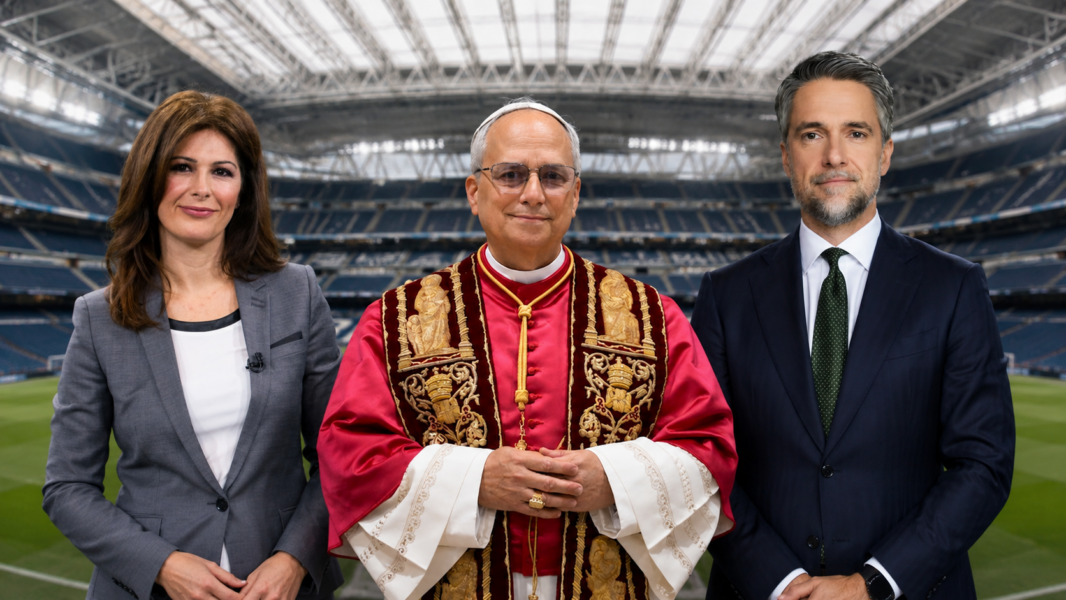
As more details emerge about the visit of Leo XIV to Spain, it becomes increasingly difficult to ignore the uncomfortable feeling of witnessing the preparation of a major institutional, media and cultural event in which the specifically religious dimension is relegated to the background. Not because the Pope has ceased to be the Successor of Peter, but because those who organize, present and frame the events seem determined to turn his presence into a cross-cutting event suitable for all audiences, carefully integrated into the codes of official Spain.
The choice of journalists Carlos Franganillo and Lara Siscar to host the meeting that will bring the Pontiff together with representatives of culture, education, business and sport would not be particularly significant if it were an isolated decision. However, it adds to a long list of names that point in a very specific direction. Alongside them will appear Antonio Banderas, Rozalén, Sara Baras, Carolina Marín, Teresa Perales, the leaders of UGT and CCOO, representatives of employers’ associations and various figures regularly seen in Spain’s media and institutional ecosystem. The result seems less like a pastoral visit than a grand staging of social consensus around the figure of the Pope.
No one disputes that the Pontiff should engage with the worlds of culture, business, sport or politics. In fact, the Church has always sought to be present wherever human life unfolds. What is striking is that, when one looks at the overall programming and the profiles selected to headline the most visible events, a very particular image of Spain emerges: the televisual, institutional and culturally standardized Spain, the same one that usually occupies talk shows, major forums and spaces of public representation.
The problem is not the presence of these names. The problem is the absence of others. It is hard to find in the main showcase of the visit any visible references to the realities that sustain the daily life of the Church: families, apostolic movements, pro-life associations, religious communities, Catholic educators or the many evangelizing initiatives that work quietly away from the spotlight. It gives the impression that, in order to present the Pope to Spanish society, it has been considered more important to surround him with recognizable celebrities than to show the concrete face of living Catholicism.
This trend cannot be separated from the political context in which the visit is taking place. For years, Pedro Sánchez’s government has demonstrated a notable ability to integrate into its institutional narrative symbols and figures that, in principle, do not form part of its own ideological project. The Crown, the Armed Forces or certain religious traditions have been used at different moments as elements of legitimization and public normalization. The figure of the Pope carries even greater value: it represents a global moral authority whose image conveys respectability, moderation and international prestige.
And it is evident that some political, media and cultural sectors are not seeing in Leo XIV an extraordinary opportunity to project an image of harmony that hardly corresponds to reality. Because while grand stages of dialogue and understanding are being prepared, policies remain fully in force that clash head-on with fundamental principles of Catholic doctrine on issues such as life, family, education or the very conception of the human person.
The question is not whether the Pope should meet with representatives of civil society. The question is what message is conveyed when an apostolic visit ends up wrapped in an aesthetic that resembles more a festival or a ceremony of institutional prestige than a call to conversion, to truth and to an encounter with Christ. There is a substantial difference between engaging with the world and allowing oneself to be absorbed by its categories.
The Church does not need to turn every papal visit into a spectacle to prove its relevance. Nor does it need validation from talk shows or cultural elites to justify its presence in society. Its strength has always resided in something much deeper: the capacity to proclaim the Gospel even when it proves uncomfortable for the powerful, for the media and for prevailing fashions.
When Leo XIV arrives in Spain, millions of Catholics will not be expecting a gala. They will be expecting to hear the voice of the Successor of Peter. And it would be a pity if, amid so many spotlights, presenters, celebrities and carefully designed stage sets, that were precisely the voice heard the least.