


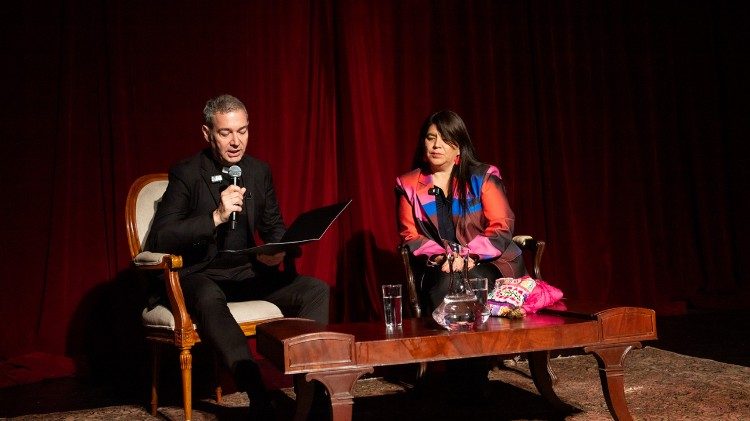
The controversy surrounding the complaint made public against Peruvian priest Omar Sánchez has added a new chapter following the release of a statement by the program Gatos por Liebre, from Origen Xtream.
The statement comes just days after the interview given by Nicolás Arosemena and the information released by Epicentro TV and journalist Paola Ugaz regarding an alleged canonical complaint against the priest. Far from clarifying the situation, the latest statements have brought to light a series of contradictions affecting the very core of the accusation.
Does a complaint exist or not in the Holy See?
The main contradiction pointed out by Gatos por Liebre concerns the very existence of a complaint before the Dicastery for the Doctrine of the Faith.
According to the statement, Jordi Bertomeu would have publicly stated in an interview given to Rosa María Palacios that there is no complaint against Omar Sánchez in that dicastery. However, Epicentro TV maintains that there is currently an ongoing complaint in the Holy See.
The apparent incompatibility between both versions has fueled new doubts about the actual status of the case. If the complaint is being processed, it is difficult to reconcile that situation with the claim that there is no case in the Dicastery for the Doctrine of the Faith. If, on the other hand, there is no complaint at all, one of the main elements on which the controversy of recent weeks has been built would be called into question.
Was the complaint withdrawn or is it still under review?
Another point of conflict revolves around the very existence and status of the complaint.
According to the outlet, in various public statements journalist Paola Ugaz would have maintained that the complaint filed against Omar Sánchez had been withdrawn. However, Epicentro TV later claimed that there is currently an ongoing complaint before the Holy See.
The discrepancy has led to a question that remains without a clear answer: whether the complaint was indeed withdrawn or whether it continues to be processed by ecclesiastical authorities.
The issue is not minor, as it directly affects the foundation of the information released in recent weeks and the credibility of the various versions offered publicly.
The controversy over the identity of the alleged complainant
Another element that has generated new doubts concerns the documentation shown during the report.
Origen Xtream maintains that one of the signatures partially displayed on screen would have been recognized by Nicolás Arosemena Spitzer —alleged victim of Father Omar— as that of his own mother. According to that version, Arosemena would have publicly denied that she filed any complaint against Father Omar Sánchez.
Based on that circumstance, the program’s producers have called for the full signature of the displayed document to be shown in order to definitively clarify the identity of the person named in the complaint.
Omar Sánchez claims he has not been notified
According to the information released, Omar Sánchez has reiterated that he will continue to follow the instructions of his ecclesiastical authorities and that, to date, he has not received any official notification from any dicastery of the Holy See regarding a complaint against him.
This statement adds a new element of uncertainty to the case, especially amid the conflicting versions regarding the existence and status of a possible canonical proceeding.
A case that goes beyond the specific complaint
Beyond the specific complaint against Omar Sánchez, the episode has ultimately opened a broader debate on the methods used in certain ecclesiastical investigations, the media treatment of accusations, and the need to rigorously verify the documentation presented before spreading accusations of enormous gravity.
For now, far from being clarified, the situation appears to have entered a new phase marked by opposing versions, questioned documents, and a growing demand for transparency regarding the origin and authenticity of the complaints that have fueled the controversy.