


By Fr. Paul D. Scalia
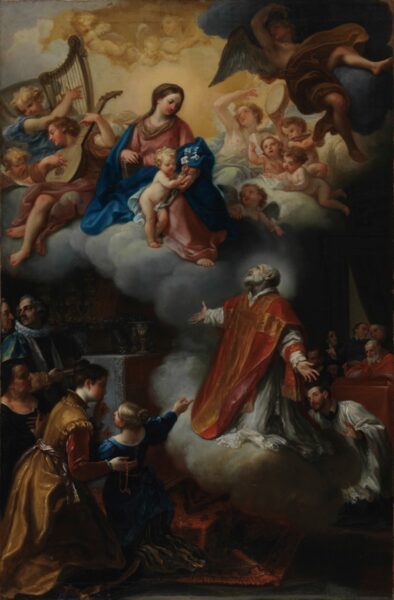
Philip Neri had the custom of rising late at night or in the early hours of the morning to make his way through the sleeping city of Rome, outside the city walls, to the Basilica of St. Sebastian. There he would descend beneath the church, into the ancient catacombs, where the first Christians of Rome gathered for Mass, where so many martyrs slept. In that sacred place he would spend time in prayer.
On one of those occasions, the Apostle of Rome went to those catacombs on the vigil of Pentecost. While he prayed, the Holy Spirit appeared to him as a ball of fire that entered through his mouth and settled in his heart. He felt his heart expand. From that moment on, as people would later testify, a mysterious but perceptible warmth emanated from his heart—in fact, a fire. After his death, an autopsy revealed that two ribs had broken to form an arch, in order to accommodate the enlarged heart.
It is fitting that the feast of St. Philip Neri (May 26, this Tuesday) often falls so close to Pentecost. For his experience in the catacombs is a great lesson on how we are to receive the Spirit on this day. As with every miracle, his encounter with the Holy Spirit reveals in an extraordinary way what should be ordinary for every Catholic. And, lest we think St. Philip’s experience was strange, we should remember that we often pray for the same thing: Come, Holy Spirit, fill the hearts of your faithful and kindle in them the fire of your love.
That is to say, heartburn and broken ribs.
First, the heartburn. That the Spirit settles in the heart—the center of love—tells us much about Who He is and what He does. The Holy Spirit is the Love of God. That is not merely a pious saying, but a profound theological truth. Nor is the Holy Spirit merely the love that comes from God. He is the love of God; that is, the love within God, between the Father and the Son, the love that has existed from all eternity. He is the Person whom St. John Paul II called the “uncreated Love-Gift.”
As the Person who is Love, the Spirit is given to us so that we may love. For “the love of God has been poured into our hearts by the Holy Spirit who has been given to us.” (Romans 5:5) All His gifts and graces are granted to us so that we may be perfected in love. All His fruits are, ultimately, the effects of love. The Holy Spirit works holiness, which is perfection in love.
Moreover, the image of fire reveals how this Person carries out His work of love within us. The Holy Spirit is like fire, a love that purifies, enlightens, and energizes. He purifies our hearts from lesser loves that hold us back. He enlightens our hearts to know God, to know ourselves, and to know how to love. He empowers us to love others with God’s own love.
To those around him, the warmth radiating from St. Philip’s heart manifested the love of God within him. Once again, this extraordinary event reveals what should be normative. Our union with the Spirit should produce in us a warmth that radiates to others through our words and actions. Indeed, what is most surprising is not that the warmth of the Spirit was manifested through St. Philip Neri, but that it is not so evident in us.
Second, the broken ribs. Now, it should be noted that this injury did not prevent Philip’s life. He led a very active apostolic life for fifty years after the incident. Obviously, there was some pain involved in this gift of the Spirit. But we should think of it as the “gentle violence” of the Spirit of which St. Francis de Sales speaks. Or as a healthy correction, just as we ask the Spirit in today’s Sequence: “Bend the stubborn heart and will.”
In short, to receive the Spirit, something within us must yield. Usually, we want to force God into our lives, to make Him work for us. But the Spirit does not fit into our worldly lives. He is not, so to speak, designed for that. Rather, like a rushing wind that brings fresh air but sometimes also upsets things, He dislocates aspects of our lives so that there may be more room for Him to act.
The point is that there is nothing convenient or comfortable—in the world’s sense—about the Spirit. He comes, not to continue our lives as they are, but to live within us and reproduce the life of Christ in us. That requires a change on our part. Indeed, even the consolation He brings surpasses the world’s understanding; it does not fit into the world’s estimation of comfort. Life according to the Spirit requires the unconditional willingness to change.
Our Lord tells us that the Father “does not give the Spirit by measure.” (John 3:34) Truly, He is not stingy. But we are. We place barriers and obstacles to the increase of His love within us. Or we want His gifts of grace for our personal projects, not to grow in Him.
For this feast and this gift of the Spirit to be effective, we must allow Him to burn us and dislocate us. May He purify our hearts with His fire of love and move them where He needs them to be.
About the author
Fr. Paul Scalia is a priest of the Diocese of Arlington, VA, where he serves as Episcopal Vicar for Clergy and Pastor of Saint James in Falls Church. He is the author of That Nothing May Be Lost: Reflections on Catholic Doctrine and Devotion and editor of Sermons in Times of Crisis: Twelve Homilies to Stir Your Soul.