


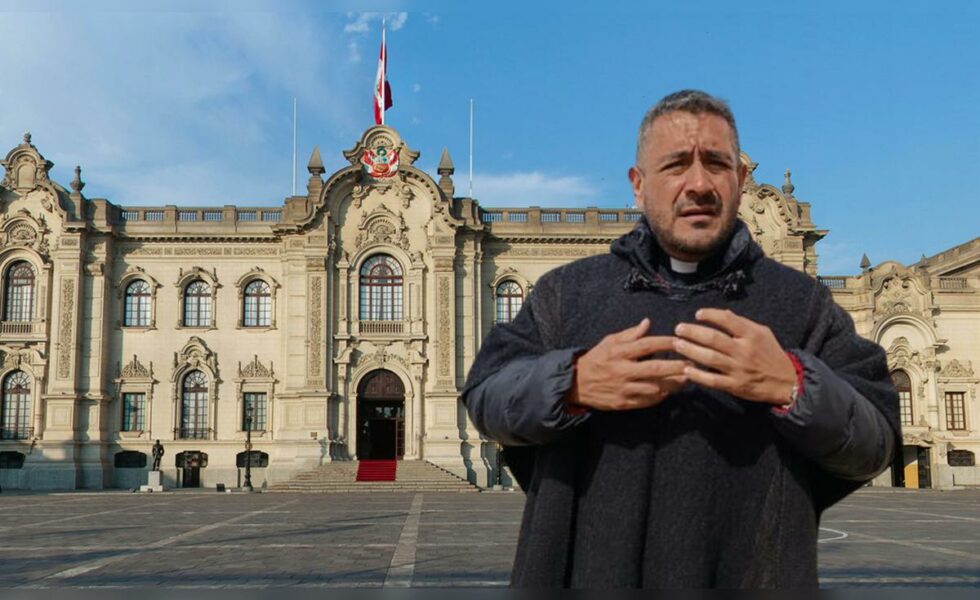
The emergence of Luis Alejandro Bazalar García as confessor and spiritual guide to Peruvian presidential candidate Roberto Sánchez has once again brought into the spotlight a case that, ten years ago, pitted the conclusions of civil and canonical justice against each other. The recent disclosure of his role within the candidate’s closest circle from Juntos por el Perú prompted the Archdiocese of Ayacucho to publicly recall the ecclesiastical sanction still in force against the former priest.
Bazalar is part of Roberto Sánchez’s innermost circle; the candidate of Juntos por el Perú will contest the presidential runoff on 7 June. A television report identified him as one of the presidential hopeful’s trusted collaborators, while he presents himself as Sánchez’s spiritual director and confessor.
The communiqué from the Archdiocese of Ayacucho
The controversy was reignited on 27 May when the Metropolitan Archdiocese of Ayacucho issued a statement signed by Archbishop Salvador Piñeiro.
The document recalls that the then-Congregation for the Doctrine of the Faith issued a decree on 10 July 2015 dismissing Luis Bazalar from the clerical state. According to the text, the Vatican body concluded there was “sufficient moral certainty” regarding the facts investigated in the canonical procedure.
The archdiocese further clarified that the sanction entails the loss of the rights and obligations proper to the clerical state and the prohibition of exercising priestly ministry, except for the exceptions provided by canon law in situations of danger of death.
The conviction and subsequent acquittal
The case received wide coverage in Peru between 2015 and 2016.
In the first instance, the Superior Court of Justice of Ayacucho sentenced Bazalar to eight years in prison for crimes against sexual freedom in the form of the seduction of a 17-year-old seminarian. The sentence also included other charges related to injuries.
Months later, the Supreme Court of Justice annulled the conviction and acquitted the priest of all charges. The court held that there was insufficient evidence to rebut the presumption of innocence and ordered the definitive closure of the case.
The ruling also ordered the cancellation of the criminal, judicial and police records arising from the case. Among the arguments set out in the acquittal were the contradictions observed in the complainant’s statements and the assessment that Bazalar had acted in his capacity as the young man’s spiritual guide.
The canonical process followed a different path
The judicial acquittal did not alter the decision taken by the Holy See.
While the civil jurisdiction closed the case, the canonical sanction remained in force. In the years that followed, Bazalar undertook various initiatives to persuade Rome to review the file.
In interviews and public writings he maintained that he had been acquitted by the Peruvian courts and called for that circumstance to be taken into account by ecclesiastical authorities. He also claimed to have travelled to Rome on several occasions to submit documentation and request the reopening of his case.
In a 2016 letter addressed to the Pope, the former priest stated that he had proved his innocence before the civil courts and asked to be allowed to return to priestly ministry. However, the decision adopted by the Congregation for the Doctrine of the Faith was not modified.
From ecclesiastical conflict to political activity
Over the years, Bazalar’s public presence ceased to focus exclusively on defending his canonical situation.
During Peru’s 2023 political crisis he took an active part in demonstrations against the government of Dina Boluarte and gave interviews in which he expressed increasingly defined political positions. In them he defended the convening of a Constituent Assembly, expressed admiration for Hugo Chávez, showed support for then-Venezuelan President Nicolás Maduro and even raised the possibility of entering Peruvian politics directly if social movements and indigenous communities so requested.
In those same statements he maintained that he had evolved ideologically over the years and linked his personal experience to the need to promote profound changes in the country’s political structure.
From the lay state to the presidential campaign
A decade after leaving the priesthood, Bazalar has returned to the public eye through the presidential campaign.
In addition to presenting himself as Roberto Sánchez’s spiritual director, he has taken part in events linked to the candidacy and has been identified by Peruvian media as one of the members of Sánchez’s inner circle. He also delivered the blessing at one of the candidate’s campaign events and has appeared in media outlets close to his political environment.