


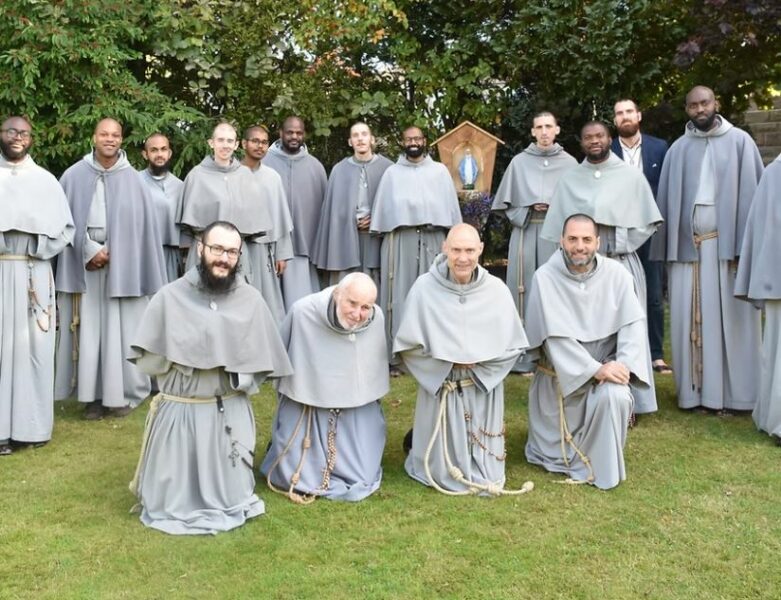
Another traditional-sensitivity community will officially cease to exist in the Catholic Church as of next June 1. The Marian Franciscans, known in the United Kingdom for their Franciscan-Marian spirituality, their digital apostolate and the celebration of the traditional liturgy, will be dissolved after the Bishop of Portsmouth, the Most Rev. Philip Egan, approved the petition submitted by the friars themselves.
The decision affects the Association of the Family of Mary Immaculate and St. Francis, a community inspired by the spirituality of St. Maximilian Maria Kolbe and characterized by a marked Marian devotion, traditional Franciscan life and a missionary orientation. Although the dissolution has been formally requested by the religious themselves after a period of discernment, the news once again brings to the table the delicate situation facing various realities linked to the traditional world in Western Europe.
A deeply Marian and Franciscan spirituality
The Marian Franciscans develop their religious life around six fundamental pillars: prayer, poverty, penance, study, Marian apostolate and missionary spirit. The friars profess the evangelical counsels of chastity, poverty and obedience, in addition to a specific vow of consecration to the Virgin Mary.
Inspired by figures such as St. Francis of Assisi, St. Clare, St. Maximilian Kolbe and St. Pio of Pietrelcina, the religious have sought during these years to combine an austere conventual life with a strong evangelizing impulse. Their mission, they explain, consists in proclaiming the Gospel through devotion to the Immaculate “for the greater glory of God and the salvation of souls.”
This markedly Marian and traditional identity enabled them to consolidate a stable presence in certain English Catholic circles, especially among the faithful drawn to classical Franciscan spirituality and the traditional liturgy.
The traditional liturgy as part of their apostolate
The Marian Franciscans are especially known for celebrating both the traditional Latin liturgy and the ordinary form of the Roman rite. Precisely this coexistence between the two liturgical forms allowed them to attract faithful of diverse profiles within the diocese.
Alongside ordinary pastoral work, the community has also developed a notably active digital apostolate, inspired by the evangelizing model of St. Maximilian Kolbe, convinced that all possible means should be placed at the service of spreading the faith.
In recent years, the friars promoted conferences, publications and online programs such as Tea With Mary, a weekly space dedicated to doctrinal formation and the promotion of Marian spirituality. With this they sought to respond to a public increasingly interested in traditional Catholic content disseminated via the internet.
The friars will join another association
In the statement issued by the Diocese of Portsmouth, Bishop Philip Egan explained that the religious intend to join another association with a similar charism in the near future and to move in the coming months.
For more than a decade, the community has carried out its work mainly in Portsmouth and, more recently, also in the Scottish Diocese of Dunkeld. Both dioceses are now working together to organize the practical aspects of this transition and to ensure the continuity of pastoral care for the faithful linked to the community.
They will continue to celebrate Mass temporarily
Although the association will disappear legally from June onward, the bishop has temporarily authorized the priests linked to the diocese to continue celebrating Mass, administering the sacraments and maintaining devotions in several parishes previously served by the friars.
Among them are St. Agatha’s in Portsmouth, St. Joseph’s in Copnor and St. Thomas More’s in Iford. In this way, the diocese seeks to avoid a sudden interruption of the liturgical and pastoral life that the community had been sustaining for years.
Bishop Egan acknowledged in his statement that the news will cause sadness and concern among numerous faithful who for a long time found spiritual support in the Marian Franciscans. At the same time, he publicly thanked the work carried out by the religious and asked for prayers both for the friars and for the people pastorally accompanied by them.
For the moment, no details have been given about the specific association the religious will join or about the definitive future of their apostolates. However, the upcoming legal disappearance of the Marian Franciscans once again reflects the difficulties facing several traditional communities in Europe, even those that maintain apostolic activity, stable liturgical life and a presence among young faithful.