


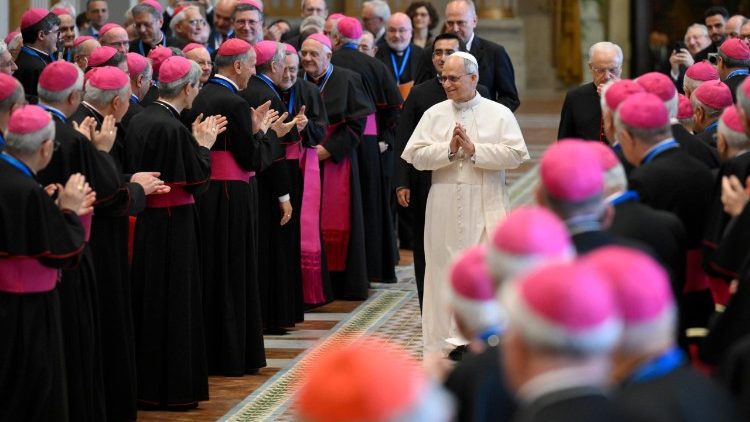
Pope Leo XIV closed this Thursday the 82nd General Assembly of the Italian Episcopal Conference (CEI) with a wide-ranging address focused on evangelization, the transmission of the faith, and the pastoral challenges facing the Church in an increasingly secularized society. Before the Italian bishops, the Pontiff called for a Church less concerned with preserving structures and more centered on proclaiming Christ with clarity and authenticity.
During his speech in the New Synod Hall, the Pope acknowledged the difficulties many Christian communities are experiencing, marked by fatigue, social fragmentation, and the challenge of passing on the faith to new generations. However, he urged the bishops not to fall into a pessimistic outlook or limit themselves to analyzing negative statistics.
Below are the full words of Leo XIV:
Dear brothers in the episcopate, good morning!
Thank you, Eminence, for the words you addressed to me. A cordial greeting to all those who have been elected to serve in the Episcopal Conference, in particular the Vice-President, and to each one of you. Through you, I wish to express my affection to all the Churches in Italy, to the priests, to the deacons, to the consecrated persons, to the families, to the catechists, to the educators, to the young, to the elderly, to the poor, to the sick, to all those who live the faith in the simplicity of daily life and to those who, perhaps without knowing it, carry in their hearts a thirst for God.
This is what we have the grace to witness in various ways, even in a time like ours, marked by complexity. I experienced it directly during my recent visits to Pompeii, Naples, and Acerra. Many signs speak to us of fatigue, fragmentation, and loneliness. In our communities, we can sometimes perceive the difficulty of transmitting the faith, the difficulty of involving new generations. But the Gospel awakens us. Jesus, looking at the crowds, does not see a problem to solve; He sees a harvest, the field of God: “The harvest is abundant, but the laborers are few; so ask the master of the harvest to send out laborers for his harvest” (Lk 10:2). Tireless sower, God goes out each day into the world and generously scatters in hearts the desire for the infinite, for a full life, for a salvation that liberates. Yes, thanks be to God, the harvest is plentiful. Our first task is this: to make the Lord’s gaze our own. Not merely to lament hardened soil or to stop at statistical data, but to know how to see, with the eyes of the Risen One, the harvest that God Himself is preparing for us.
Dear brothers, may the Holy Spirit grant us hearts burning with the impulse of Christ and raise up many holy laborers to work with us.
With this gaze, then, the priority is the Gospel: Saint Francis of Assisi tells us so, eight hundred years after his passage to Heaven; the Evangelii nuntiandi of Saint Paul VI and the Evangelii gaudium of Pope Francis remind us of it. For it is from the Gospel that faith is born, as a living encounter with Christ, dead and risen, present in His Church. Today, in the context in which we are called to act, confronting other perspectives of life and unprecedented anthropological challenges, placing the Gospel once again at the center is the gift that gives enthusiasm to our life as bishops and the urgency that drives us.
We are therefore called to ask ourselves: what face of God do we allow to shine through in preaching, in catechesis, in the liturgy, in charity, in the life of our communities? In what way do we foster the encounter with Christ, and what does it mean today, for us and for our Churches, to initiate others into the Christian life? These are questions that, as pastors, we must always ask ourselves, never taking them for granted.
Here, then, is the renewed attention to Christian initiation, which cannot be thought of merely as preparation for the Sacraments. It is the “womb” in which a community begets faith and introduces others into paschal life, into communion with the Lord, into ecclesial fraternity. It is a matter of rediscovering Baptism as a living and existential reality; and “it is not possible to fully understand Baptism except within Christian Initiation, that is, the journey through which the Lord, through the ministry of the Church and the gift of the Spirit, introduces us into paschal faith and inserts us into trinitarian and ecclesial communion” (Final Document of the XVI Assembly of the Synod of Bishops, 24). This emphasis of the most recent Assembly of the Synod of Bishops is very important, because it places the path opened by Baptism within a Church that believes, celebrates, accompanies, and begets. A Church that, while rejoicing with wonder at young and adult catechumens, is then able to sustain their perseverance after the initial impulse.
Faith is transmitted and grows where there are living and welcoming communities, capable of praying and listening; communities in which the Word of God does not remain on the margins but illuminates decisions; where the Eucharist is truly source and summit; where the poor are not external recipients of a service but brothers and sisters in whom the Lord speaks to us; where young people are faces, voices, and stories with whom to dialogue; where families are not left alone and wounds are not hidden but brought before the Lord with humility; where faith becomes effective commitment in society, in politics, in culture.
Precisely for this reason, we bishops are called to a profound listening: to listen to the Word of God, to listen to the People of God, and therefore to listen to the signs of the times, to listen also to what calls our pastoral customs into question. Where listening is genuine, the community does not close in on itself but becomes a place of discernment and mission and, for this reason, knows how to renew itself.
This is the meaning of the Synodal Path that you have brought to completion and which, as you have emphasized, must now become a permanent style. The Second Vatican Council reminded us that it pleased God to sanctify and save human beings not separately and without any bond among them, but by constituting them as a people who would acknowledge Him in truth and serve Him in holiness (cf. Dogmatic Constitution Lumen gentium, 9). A synodal Church is one in which each person, according to their own vocation, can offer the gift received from the Spirit for the common edification. Participation, therefore, is not a concession: it is a requirement of communion and mission and, for this reason, must become method, responsibility, verification, in the involvement of the various charisms and ministries and in respect for the proper task of the bishop. The Synthesis Document of the Synodal Path of the Churches in Italy recalls the value of participatory bodies as places in which the discernment of communities can take concrete form. It is not enough, however, for these instruments to exist; it is necessary to verify that they truly function.
In this process, the various structures of the CEI are called to continue carrying out their service of communion, coordination, discernment, and support for the Churches in Italy. Precisely because it has this role, the organization of the Episcopal Conference must be shaped in light of the demands of the mission and changing historical conditions. It is not a matter of imitating external organizational models or reducing everything to administrative efficiency, but of asking what physiognomy today helps pastors and local Churches to better proclaim the Gospel, to walk together, and to make effective, ordered, and fruitful participation possible. When lived in the Spirit, this verification does not weaken communion but purifies it.
Dear brothers, the Lord does not ask us to measure the fruitfulness of the Church by the criteria of numbers, visibility, or influence. “When we look with the eyes of God, we discover that He has chosen the way of littleness to come down among us. […] This logic of littleness is the true strength of the Church. Indeed, it does not reside in its resources or in its structures, nor do the fruits of its mission derive from numerical consensus, economic power, or social relevance. The Church, on the contrary, lives by the light of the Lamb and, gathered around Him, is impelled along the paths of the world by the power of the Holy Spirit” (Address at the Prayer Meeting, Istanbul, 28 November 2025).
Let us have the courage of what is essential! The courage of communities less concerned with preserving everything and more free to proclaim Christ. The courage of a catechesis that is a path of initiation and ongoing formation in the Christian life. The courage of welcoming and missionary parishes in which families meet again and are renewed with the sap of the Gospel. The courage of living participatory bodies. The courage to listen to young people without taming their questions. The courage to let ourselves be evangelized by the poor. The courage of a national structure increasingly at the service of the missionary communion of the Churches in Italy. A people is begotten by mothers and fathers in the faith, by communities that know how to say, with life even before with words: “We have found the Messiah” (Jn 1:41). Italy needs this witness.
I entrust your journey to the Virgin Mary, Mother of the Church. She welcomed the gift, guarded the Word, walked with the disciples, and awaited the Spirit in the Upper Room. May she help you to be “rooted and built up in Him, firm in the faith” (Col 2:7), to guard what is essential, to beget in faith, to walk with the People of God, and to recognize the voice of the Lord who still calls, consoles, and sends.
I accompany you with my blessing. Thank you!