


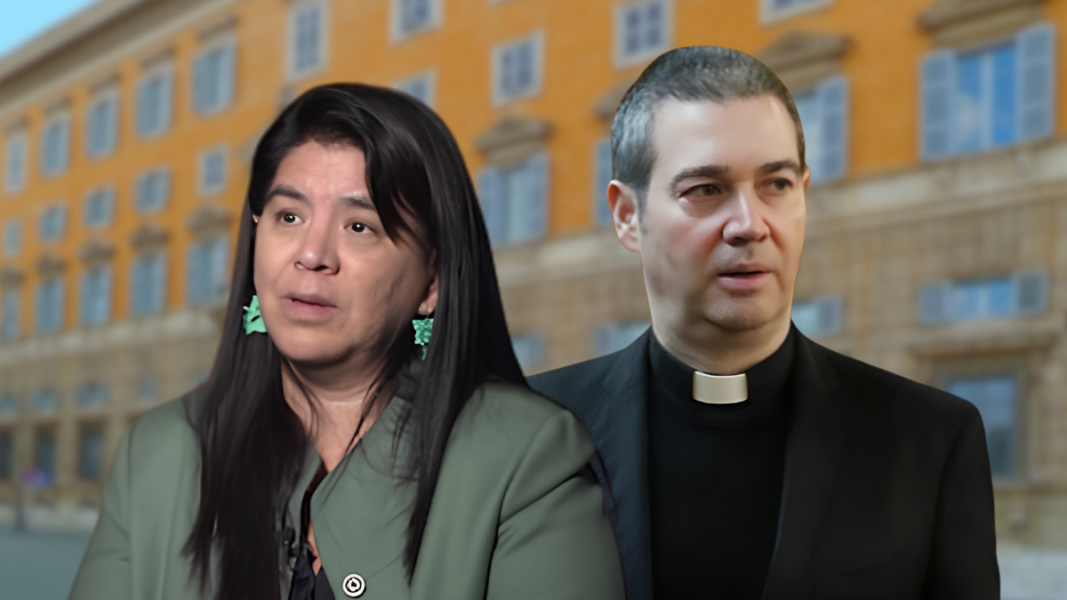
On April 6, Father Omar Sánchez dared to do something that, in the current Peruvian Vatican ecosystem, has become reckless: publicly criticize the management of Mons. Jordi Bertomeu as Apostolic Commissioner for the Sodalicio de Vida Cristiana. Twenty-two days later, on April 28, the journalist (personal friend and in pectore spokesperson for Bertomeu) Paola Ugaz published an extensive report on Epicentro TV accusing the priest of sexual abuse against a young man identified in the text as “Rafael,” an alleged vulnerable victim, based on a complaint signed in 2023 and supposedly submitted to the Congregation for the Doctrine of the Faith.
There is only one problem with that report, and it is one that admits no nuance: the complaint is false, the so-called “Rafael” does not exist, and the person whom the pixelated photographs were meant to identify as the victim has come forward to dismantle the entire dossier in a public interview in which he shows his face, his full name, and both surnames.
The alleged “Rafael” speaks
His name is Nicolás Arosemena Jiménez Pitzer. He is 36 years old, has lived in Spain for nearly six years, is operations manager for a group of restaurants specializing in gluten-free cuisine, is getting married next year, and, according to his statements, expects to become a father soon. He is 1.90 m tall. He belongs to a well-known family in Peru: son of an ambassador, grandson of a Minister of Justice, nephew of former Minister of Transport Luis Chang, and a direct descendant of a President of the Republic. Hardly the profile of a “vulnerable person” that Ugaz’s report needed to construct.
In an interview with the Peruvian program Gatos por Liebre, Arosemena has confirmed the operation point by point:
First, that he is, indeed, the person appearing in the two photographs with Father Omar reproduced with blurred faces in the report. One of them, he says, corresponds to an ordinary moment during the pandemic, when he and three other volunteers took turns sleeping in the room next to the priest’s to manage the household’s health logistics. The other, a joke dressed as an acolyte alongside a foreign volunteer. Both photographs that he himself had posted on his personal Instagram and which the journalist, it appears, simply used to illustrate an accusation.
Second, that he lived at the Casa de las Bienaventuranzas for seventeen months, entirely voluntarily, at the age of 29–30, arriving on his own initiative after hearing a homily by Father Omar while residing in another parish. He was not admitted, not institutionalized, not in rehabilitation. He was an adult volunteer who handled the adult area and the neighborhood soup kitchens during the pandemic. He still has the logo of the Asociación de las Bienaventuranzas and the word family tattooed on his body.
Third, that he never, at any time, signed any complaint against Father Omar. He neither filed it, nor withdrew it, nor had any knowledge of its existence until a school friend sent him the link to the report. The signature on the document that Paola Ugaz presents as evidence, Arosemena says without hesitation, is his mother’s, affixed in 2023, behind his back, while he was living in Greece managing his own restaurant.
Fourth, that Paola Ugaz never contacted him. Never. Despite claiming in her report that it was the result of several months of investigation, the journalist did not consider it necessary to verify with the alleged victim whether the facts were true, whether he wished to comment, or even whether he was still alive. Arosemena says he had never heard of Ugaz in his life until two weeks ago.
“I never filed any complaint. That signature is not mine. I don’t know Miss Ugaz even from a dogfight. If she does not retract, I will have to face her in court,” he declares in the interview, announcing legal action for defamation.
The phantom dossier and the Congregation for the Doctrine of the Faith
Epicentro’s report claims that the complaint would have been submitted to the Dicastery for the Doctrine of the Faith. If this is true—and everything suggests it is, because it is the kind of detail that a militant report does not invent for the simple reason that the canonical lever is the real objective of the operation—then we are facing something of considerable gravity: a canonical case against a priest, in the competent Congregation, based on a complaint that the alleged victim does not know about, did not sign, and has publicly dismantled.
It is then that the question arises: Who sent that dossier to the Congregation for the Doctrine of the Faith? Through what channel? Who presented it as credible? And what role has Mons. Jordi Bertomeu played in that process, whose operational proximity to Paola Ugaz has been public and constant since the days of the Sodalicio?
The key to the drawer
Here lies the key to the method; without it, nothing of what has been happening in recent months makes sense. Mons. Bertomeu does not fabricate complaints out of thin air. What everything indicates he does is something more subtle and, in canonical terms, considerably more serious: he has access to the drawer. To the archive. To the files that sleep in the curias and dicasteries, to the complaints that were once filed and withdrawn, to the pastoral consultations that never became cases, to the rumors that some diligent chancellor put in writing five, eight, or ten years ago and that no one ever opened again.
Every priest with a long ministerial life accumulates in some ecclesiastical drawer papers that can be reread in a twisted key. A conversation with an adult that one day turned into a complaint with no follow-up. A complaint filed by a family member in a moment of tension and archived for inconsistency. A photo, a message, a pastoral visit misinterpreted. In the vast majority of cases, those papers remain where they should remain: archived, inert, never becoming a case because there was no case.
The method deployed against Father Omar (coinciding with several previous cases) consists precisely in knowing where those papers are and being able to activate them selectively. When an inconvenient canon lawyer—think of Coronado—becomes troublesome, an old file about an encounter with an adult that had been dormant for years suddenly appears. When a critical priest raises his voice, a maternal complaint withdrawn three years earlier surfaces out of nowhere. The papers are taken out of the drawer at the precise moment, handed to the friendly media outlet, and published as if they were the findings of a journalistic investigation that in reality never existed.
That is the difference between ordinary slander and ecclesiastical camorrismo. The latter has access to an archive that no one who is not a judge in the case should have operational access to, controls the timing—twenty-two days between the criticism and the publication—and has the pen of a journalist who for years has functioned as its natural loudspeaker.
Twenty-two days: the perfect symmetry
The time between Father Omar’s criticism of Bertomeu and the publication of Ugaz’s report is twenty-two days. For anyone familiar with the real timelines of a serious journalistic investigation into ecclesiastical abuse—cross-checking sources, locating the alleged victim, attempting to contact the accused, documentary verification, legal advice prior to publication—twenty-two days is not the time of an investigation. It is the time of an activation.
The dossier, let us remember, dates from 2023. It had apparently been dormant in some drawer for three years. Until Father Omar raised his voice against the Apostolic Commissioner. Then the drawer opened, the document came out, and the journalist who has acted for years as the habitual media interlocutor of Bertomeu himself published the piece.
The method, exposed
The method consists of three moves. In the first, the priest, religious, layperson, or media outlet critical of the Apostolic Commissioner’s management is identified. In the second, an old paper susceptible of being reread as a complaint is located in the archive: an archived grievance, a third-party signature, a reinterpreted testimony, a recontextualized photograph, a chat taken out of context. In the third, it is published through the friendly media outlet, without verification with the alleged victim, without any real right of reply, with the presumption of canonical gravity as a guarantee of impact. The complaint, moreover, escalates: from the media to the Congregation for the Doctrine of the Faith, where the mere existence of the file is enough to mark the priest for years.
Father Omar has had the good fortune—and it is a statistically exceptional fortune—that the alleged victim is a thirty-six-year-old adult with an influential family, resident in Europe, with his own resources and an elementary sense of decency that has led him to come forward. Most priests subjected to this method do not have that fortune. Most face alleged victims who cannot be located, files they cannot verify, journalists who do not respond to replies, and a canonical system that, in case of doubt, suspends, transfers, or sanctions.
InfoVaticana, on the horizon
This outlet has its own reasons for knowing the method. We know, from information circulating in circles close to the Apostolic Commissioner, that Bertomeu has moved to try to name specific members of InfoVaticana’s editorial board in the pages of El País, not hesitating to do something as serious as instrumentalizing for that purpose real victims of the Sodalicio whose pain would deserve infinitely more respectful treatment than serving as ammunition to be hurled against inconvenient media outlets. So far, he has not dared to excommunicate us. So far.
But the logic is the same as the one deployed against Father Omar, against the Peruvian priests and laypeople who have dared to disagree with the Commissioner’s management, and against anyone who has had the temerity to demand accountability for a process—the Sodalicio one—whose resolution has left fundamental questions unanswered. The logic is: if you go after Bertomeu, he will build a case against you.
The real victims, the big losers
The most painful aspect of all this is what this way of operating does to the real victims of ecclesiastical abuse. Every fabricated file, every instrumentalized complaint, every militant report that collapses at the first confrontation with reality, devalues the authentic victims. It devalues all the serious work of protecting minors that the Church, with difficulty and with delay, has tried to build over the last twenty years.
When an Apostolic Commissioner and his allied journalist fabricate a case to neutralize a critic, they do not only harm the accused priest. They harm every victim who, tomorrow, arrives at a canonical office or a serious newsroom with a genuine file and encounters the weary gaze of someone who has already seen too many fabrications.