


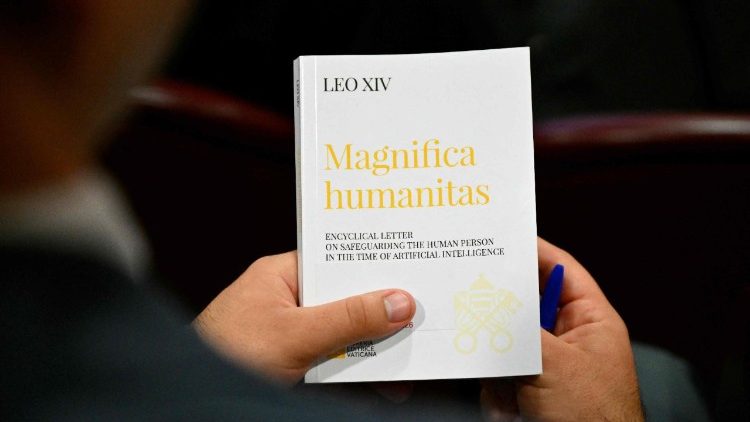
Magnifica Humanitas, published this Monday, is a long, ambitious text that is honestly difficult to summarize. The reason is not so much its doctrinal density—though it has that, especially when Leo XIV draws on Thomas, Augustine, or the Council—but rather its thematic breadth. The encyclical presents itself as a reflection on the anthropological disruption caused by artificial intelligence, and it opens with two powerful biblical images—Babel and the rebuilding of Jerusalem with Nehemiah—that promised a unifying thread. But as the paragraphs advance, the reader discovers that the text opens multiple fronts: the technocratic paradigm, transhumanism, the labor question of the 21st century, cryptocurrencies, the family, education, minors and screens, GDP, migration, nuclear deterrence, weapons algorithms, 15th-century papal bulls, investigative journalism on abuses, data colonialism, structural indebtedness, just war, “situated anthropocentrism,” and a long etcetera.
If one is to critique the encyclical—and that is the task here—it is worth beginning by acknowledging that Magnifica Humanitas speaks about everything. And when a magisterial document speaks about everything, it runs the risk of not speaking fully about anything. Its unity is tenuously sustained by the initial metaphor of the two cities—Babel versus Jerusalem—but between the two the Pope intersperses a mosaic of themes only partially connected to the anthropological question announced in the title. Some chapters are genuine manifestos in themselves—the fifth, on war, could have been an encyclical on its own—and other passages seem like interpolations that take the opportunity to establish magisterial teaching on issues that had long awaited a papal intervention of encyclical rank.
To illustrate the thematic dispersion, we offer the reader ten literal excerpts that show the enormous variety of subjects addressed in a single document. Each one, on its own, could warrant an entire encyclical. That they all appear in Magnifica Humanitas says much about the difficulties of constructing a unified text when one wants to say everything at once.
1. On artificial intelligence developers (n. 98)
“Modern artificial intelligences are more ‘cultivated’ than ‘built’: developers do not directly design every detail, but rather create an architecture on which the AI ‘grows.’ Consequently, the fundamental scientific aspects—such as the internal representations and computational processes of these systems—remain unknown.”
2. On Gross Domestic Product as an obsolete indicator (n. 159)
“There is a recognized need to move beyond current parameters for measuring the degree of development—anchored for more than eighty years in the concept of Gross Domestic Product—which systematically overlook essential aspects of the general well-being of people and the environment. […] The development of parameters and metrics complementary to GDP is decisive for improving the baseline data used to conduct analyses, make political decisions, and shape economic policy.”
3. On 15th-century papal bulls and the request for forgiveness for slavery (n. 176 and note 174)
“It was not until the 19th century that a formal, absolute, and universal condemnation of slavery was found, particularly with Leo XIII. […] although, in eighteen centuries, the total incompatibility of slavery with that dignity had not been officially made explicit. This is a wound in Christian memory from which we cannot consider ourselves detached. […] Therefore, in the name of the Church, I sincerely ask for forgiveness.”
And in the footnote:
“As in the Bulls Sicut dudum (January 13, 1435) and Etsi suscepti (January 9, 1442) of Eugene IV, and in the Bulls Dum diversas (June 18, 1452) and Romanus Pontifex (January 8, 1455) of Nicholas V.”
4. On mobile phones in the hands of adolescents (n. 141)
“In recent years, psychological and psychiatric literature has increasingly documented how early and unsupervised exposure to digital devices and social networks can negatively affect sleep, attention, emotional regulation, and relationships […]. Having a personal mobile phone too early and using it without adult supervision can heighten vulnerability and foster addictions in young people, exposing them to dynamics of isolation, bullying, and cyberbullying, as well as pressure to share intimate images or sensitive data.”
5. On cryptocurrencies (n. 160)
“Finance has gained increasing importance in recent years and has undergone significant innovation, even after the introduction of cryptocurrencies. The reflections and guidelines contained in the Magisterium of my Predecessors, particularly in their Encyclicals, have highlighted the functioning of financial intermediation ‘whose operations, having become detached from appropriate anthropological and moral foundations, have not only produced evident abuses and injustices, but have also proven capable of creating systemic crises worldwide.’”
6. On moving beyond the just war doctrine (n. 192)
“Today more than ever it is important to reiterate the overcoming of the theory of ‘just war,’ too often invoked to justify any war, without prejudice to the right to legitimate defense, understood in the strictest sense. Humanity possesses far more effective instruments capable of promoting human life to address conflicts, such as dialogue, diplomacy, and forgiveness.”
7. On nuclear deterrence as a “mistaken belief” (n. 194)
“In this context, the entry into force in 2021 of the Treaty on the Prohibition of Nuclear Weapons, supported by more than seventy countries, represents an important signal, but it risks remaining largely symbolic, since the major nuclear powers have not joined it. Thus, the mistaken belief has spread that nuclear deterrence is an indispensable condition for security, fueling a new and difficult-to-control arms race.”
8. On weapons algorithms and “artificial moral agents” (n. 198)
“Sometimes people speak of ‘artificial moral agents,’ as if a machine could guarantee, with greater consistency than a human being, the distinction between good and evil. But moral judgment cannot be reduced to a calculation: it involves conscience, personal responsibility, and recognition of the other as a person. Therefore, it is not licit to entrust lethal or, in any case, irreversible decisions to artificial systems. There is no algorithm that can make war morally acceptable.”
9. On “data colonialism” and the new rare earths (n. 178)
“Colonialism today wears a new face. It not only dominates bodies but appropriates data, transforming personal lives into exploitable information. Entire territories, especially those with less geopolitical relevance and greater structural fragility, are now traversed by a new logic of extraction: that of health flows, epidemiological profiles, genetic maps, and demographic data. These are the new ‘rare earths’ of power.”
10. On gratitude for investigative journalism on abuses in the Church (n. 138)
“We have witnessed, with shame, the arduous discovery of painful truths even about members of the Church and ecclesial realities. In particular, some journalists committed to the truth have played a fundamental role in bringing injustices and abuses to light. To them I would like to reiterate the words of Pope Francis when addressing Vatican journalists: ‘I also thank you for what you make known about what is not working in the Church, for helping us not to sweep things under the rug, and for giving voice to the victims of abuse.’”