


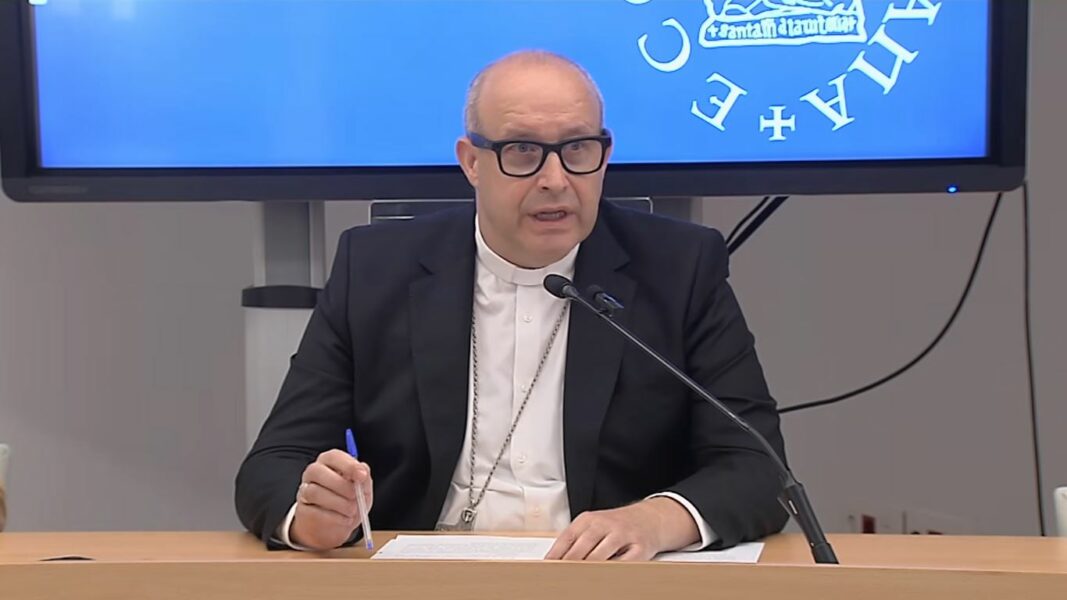
Bishop José Antonio Satué of Málaga appeared before the media this Friday, just three days before the start of the trial against the priest from Vélez-Málaga accused of sexually assaulting four women over several years. The proceedings will begin on Monday at the Provincial Court of Málaga, and the priest faces a request for 72 years in prison.
In a carefully prepared statement, Satué sought to convey an image of cooperation with the justice system and closeness to the victims, while attempting to distance the diocese from any accusations of cover-up or negligence.
“I ask for forgiveness on behalf of the Church to all those who, in this and other similar situations, have not found in the Church the understanding and support they should have received,” the bishop stated.
The diocese denies having looked the other way
One of the central points of the trial will be determining whether the Diocese of Málaga bears subsidiary civil liability in the case. On this matter, Satué made clear the position of the diocesan defense.
“Our lawyers will argue that the Diocese of Málaga should not be held liable for such responsibility,” he stated, arguing that the diocese “has neither facilitated nor encouraged nor looked the other way when the serious accusations became known.”
The bishop’s statements come after months of questions about how the diocese acted once the first indications against the priest began to emerge.
According to El País, it was the priest’s then-partner who discovered in 2023 a hard drive containing thousands of photographs and videos of women who appeared to have been drugged and sexually assaulted between 2017 and 2020. Some of the material was stored in folders labeled with the victims’ names.
The case began in Melilla
The complainant met the priest in 2022 at the parish of Santa María Micaela in Melilla. She was involved in parish life and was going through a difficult personal situation. Over time, the two began a romantic relationship, violating the priest’s vow of celibacy.
Months later, while living together in the parish residence, the woman found the hard drive that would eventually trigger the police investigation.
Several of the women identified by investigators later stated that they had no recollection of the photographed scenes. Some reported that, during gatherings or parties linked to the priest’s circle, he would insist on offering them drinks before they lost consciousness.
The priest’s transfer and the diocese’s reaction
The woman initially approached the diocesan vicar in December 2022 to report the images found on the priest’s computer. According to El País, the vicar advised her to file a complaint and later spoke with the priest himself.
Shortly afterward, the priest requested a transfer from Melilla, citing “health reasons.” The diocese then assigned him to the Málaga towns of El Burgo and Yunquera.
Over the following months, the complainant also attempted to contact the bishop’s office to explain what had happened, although, according to the newspaper, she was never granted a meeting. She eventually turned to police contacts in her circle, which led to the activation of an investigation by the Family and Women’s Care Unit (UFAM).
The investigation remains open, and officers continue to analyze the extensive computer material seized from the priest. The emergence of new victims has not been ruled out.
The diocese promises to compensate the victims if convicted
Despite rejecting any subsidiary liability, Satué announced that the diocese is willing to provide financial support for the victims’ compensation if the priest is ultimately convicted.
“The Catholic Church has committed to compensating victims of abuse by priests even when the courts do not require it,” he stated.
The bishop also explained that a canonical process was opened in September 2023 to clarify the facts, although it was suspended pending the outcome of the civil proceedings. Recently, he added, the Tribunal of the Rota of Madrid has been asked to handle the procedure in order to “ensure the independence” of the ecclesiastical process.
A case that once again strikes the Spanish Church
Before his arrest, the priest had a notable presence in parish and confraternity circles in both Málaga and Melilla. Various testimonies highlight his intense pastoral activity and his ability to organize religious events and retreats.
The priest was arrested in September 2023 in Vélez-Málaga and has remained in pretrial detention since then. He refused to make a statement to the police.
The trial that begins on Monday will not only determine the possible criminal liability of the accused. It will also once again place the actions of Spanish dioceses under pressure regarding how they handle abuse complaints and how quickly they respond when the first signs emerge.