


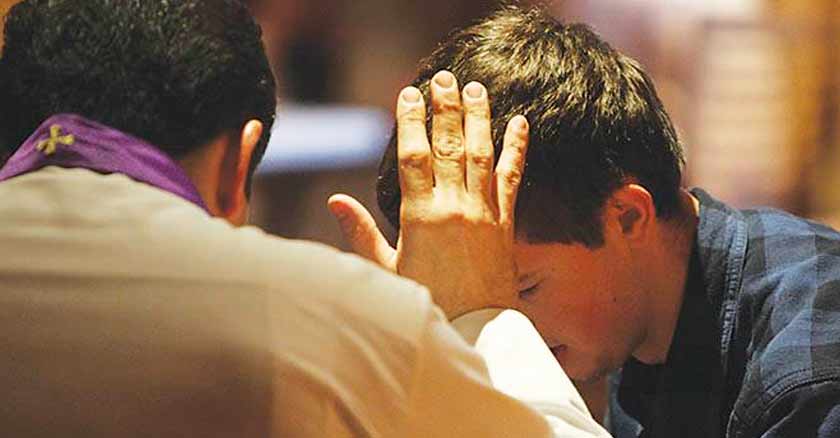
Madrid, Barcelona and the Canary Islands are preparing to welcome thousands of young people, pilgrims and curious visitors for the events linked to the Pope’s visit. Points of listening, spaces of welcome, cultural programs and information services are being announced to guide those who take part in the various activities. All of this may be reasonable and necessary at a large-scale gathering. But one absence stands out that should not go unnoticed: confession.
We do not know if there is still time to correct it, but it should be done. Because if the Church truly believes what it teaches; if it really believes in grace, in sin, in the need to be reconciled with God and in eternal salvation, then the sacrament of penance cannot occupy a secondary place in the program or become an almost invisible activity. It must be at the center.
In some editions of the World Youth Day this was perfectly understood. Many remember those images of priests hearing confessions for hours, in parks, squares or spaces set up for this purpose, while thousands of young people approached the sacrament. That had a deeply Catholic meaning. That showed a Church that believed souls matter and that understood that the greatest good it can offer a person is not a collective experience, nor an informative pamphlet, nor a generic gesture of accompaniment, but the recovery of grace.
Because the issue, at its core, is very simple. If we have faith, we believe that people need to be in a state of grace. Not only to receive Communion worthily, but also to live as Christians and to be saved. And if that is true, then it becomes inevitable to ask why so many large Catholic gatherings seem to be organized as religious events in which everything is planned except precisely that which leads most directly to conversion.
Scenarios, parallel activities, logistical points, assistance services and mass celebrations—often of questionable liturgical taste—are multiplied, while there is scarcely any visible concern to facilitate wide, clear and constant access to the sacrament of penance. And yet, few services would be more important during those days than a network of open parishes, available priests and well-marked places where anyone could go to confession.
It is not a matter of pitting one thing against another. No one disputes the need for organization, security, information or welcome. But it is fitting to remember the order of importance. The Church does not exist to produce large events or to organize massive emotional experiences. The Church exists to save souls. And a meeting with the Pope will only have true Christian meaning if it serves to bring people closer to God, to the sacraments and to conversion.
Therefore, it would be a lost opportunity if Madrid were filled with activities, programs, stages and information points while confession remained a marginal element. It would also be a worrying sign of the contemporary discomfort with everything that reminds us that sin exists, that grace exists and that eternal salvation is not a metaphor.
But perhaps there is still time to react. And here comes a concrete proposal directed to the pastors of Madrid. If, during those days, the hours for confession were extended in an extraordinary way? If certain central parishes remained open until the wee hours, or even around the clock, with priests available to administer the sacrament? If Madrid offered pilgrims not only logistical welcome, but the real possibility of being reconciled with God at any time?
That would probably be one of the most important spiritual fruits of the entire visit. Much deeper and longer-lasting than many fleeting activities. Seeing churches open, lights on, confessionals occupied and priests attending souls would be an authentically Catholic image and a response consistent with what the Church believes.
And of course, such initiatives would deserve to be promoted to the fullest. If any parish, rectory or community decides to take that step, we will be here to help communicate it, support it and give it all the possible visibility. Because few things would be more countercultural—and more necessary—today than putting confession back at the center.