


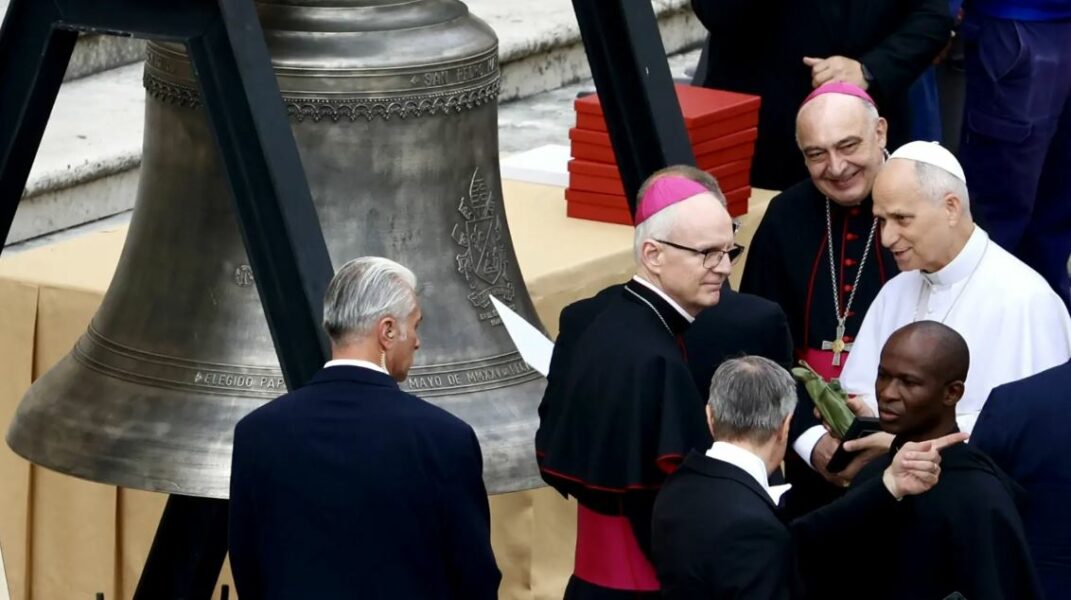
The parish of San Nicolás in Valencia has completed a singular event with the casting of a new major bell dedicated to Pope Leo XIV, blessed this Wednesday in the Vatican by the Pontiff himself.
The church, popularly known as the “Valencian Sistine Chapel”, thus recovers one of its main sonic identity markers after the removal of the former major bell, known as La Gran, which had to be taken out of use due to a structural crack that compromised its stability and altered its sound.
The new bell will now return to Valencia to be installed in the bell tower of San Nicolás, restoring to the church an essential piece of its liturgical and historical heritage.
A bell dedicated to Leo XIV
According to the Archdiocese of Valencia, the bell entered the Vatican through the Perugino Gate accompanied by a delegation led by the Archbishop of Valencia, Monsignor Enrique Benavent Vidal, and the parish priest of San Nicolás, Antonio Corbí, together with representatives of Valencian civil society.
During the blessing, it was rung with the traditional Valencian “a la española” peal, characterized by the complete rotation of the bell through a 360-degree turn. This system, deeply rooted in Valencian bell-ringing tradition, contrasts with the usual method used in Italy, where bells typically swing without completing a full turn.
The bronze incorporates the papal coat of arms of Leo XIV and the motto of his pontificate, In illo Uno Unum (“In the one Christ we are one”). In the Valencian tradition, bells usually commemorate a significant event at the time of their casting, in addition to the dedication to which they are linked.
The historic link of San Nicolás with the papacy
The dedication of the new bell to the current Pontiff is not a casual gesture. The parish of San Nicolás has maintained a singular relationship with the papacy since the 15th century.
In 1455, Alfonso de Borja, then rector of the Valencian parish, was elected Pope with the name Callixtus III. After his election, he decided to retain the title of rector of San Nicolás.
Since then, the Roman Pontiff has been symbolically established as rector of the church, while the priest in charge of the parish serves as vicerector in his name.
This historical relationship explains that the new bell incorporates a direct reference to the pontificate of Leo XIV, as a sign of continuity between the Valencian parish and the See of Peter.
The “Valencian Sistine Chapel”
The parish of San Nicolás has become one of the great referents of Spanish religious heritage after the restoration of its baroque frescoes, which is why it is popularly called the “Valencian Sistine Chapel”.
The recovery of the church was made possible thanks to the initiative of the Hortensia Herrero Foundation and the participation of the Universitat Politècnica de València in a long restoration process distinguished with recognitions such as the Hispania Nostra Award 2025.
Thanks to this intervention, more than 1,900 square meters of baroque paintings were recovered, restoring part of the church’s artistic and liturgical splendor.
Three thousand kilos of sonic heritage
The new bell has been cast in bronze using traditional artisanal techniques. It has a diameter of 1.34 meters and an approximate weight of 1,700 kilos.
The complete assembly, including the wooden yoke, fittings, and bolt, reaches 3.05 meters in height and weighs around 3,000 kilos.
The piece has been designed to restore the original sound of the bell tower and return one of the historic acoustic signals of the Valencian urban landscape.
Recovering Valencia’s Christian sonic language
Beyond its symbolic dimension, the new bell also represents the recovery of a tradition deeply linked to the Christian life of Valencia.
Manual bell ringing is recognized as Intangible Cultural Heritage and for centuries marked the religious and civil rhythm of cities and towns, announcing feasts, funerals, liturgical celebrations, and events relevant to the community.
The recovery of the major bell of San Nicolás returns to the church one of the essential elements of that sonic language that forms part of the city’s historical and spiritual identity.
An artisanal work carried out in Spain
The bell was cast in the workshop of master bell-founder Abel Portilla, in Santander.
Subsequently, the assembly of the yoke, clapper, and mechanical elements was carried out in Atzeneta d’Albaida by the company Electro-Recamp.
The transport to the Vatican and its subsequent return to Valencia has also involved a complex logistical operation to move a piece of large dimensions and notable patrimonial value.