


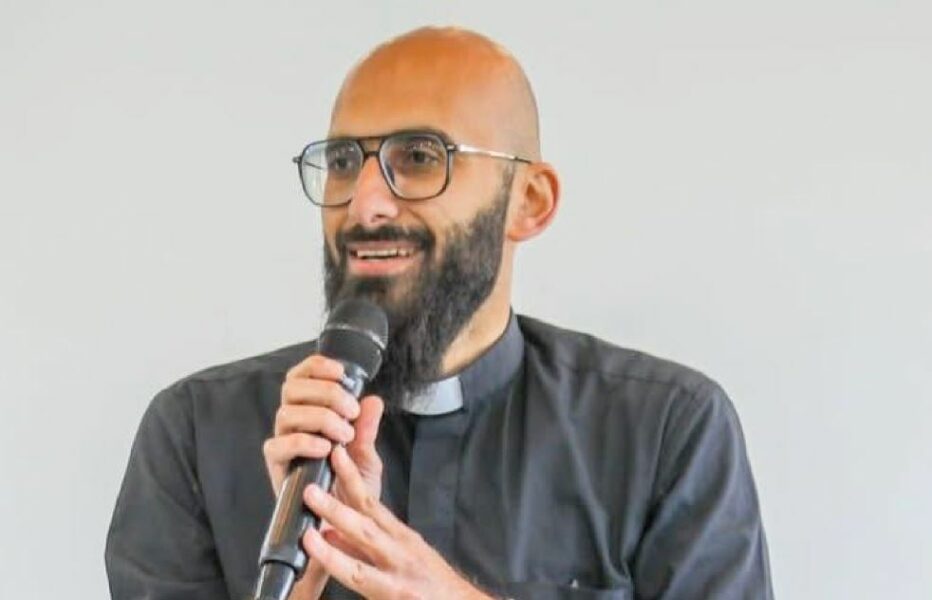
The Catholic priest Louis Salman, parish priest of Beit Sahour, a Palestinian town located next to Bethlehem, has been forced to leave the Holy Land after Israeli authorities refused to renew his residence permit.
The decision, denounced by local media and Palestinian Christian communities, has caused shock in the West Bank and once again puts the spotlight on the growing pressure faced by Arab Christians in Jerusalem and the Palestinian territories.
There was no public expulsion or formal charges. Israel simply stopped renewing the Jordanian priest’s visa, an administrative measure that, in the context of the Holy Land, effectively amounts to forcing his departure from the territory.
Louis Salman celebrated his last Mass in Beit Sahour before a packed church and amid tears. A few days later he crossed the Allenby Bridge into Jordan, the country where he was born in 1989.
A Christian community that fears disappearing
The priest’s departure has been experienced in Bethlehem, East Jerusalem and Ramallah as more than just the transfer of a parish priest.
For many Palestinian Christians, the case reflects growing pressure against the local Christian presence, especially against Arab priests and religious who are linked to defending the Palestinian population.
In recent years, attacks, insults and acts of intimidation against Christians in Jerusalem have multiplied. Spitting during processions, attacks on cemeteries, offensive graffiti on monasteries and assaults on clergy form part of a climate increasingly denounced by the local Churches.
Christian communities say that incidents once considered marginal have become more frequent and aggressive.
The Churches denounce “systematic” attacks
Although Israeli authorities usually condemn these incidents publicly, the Christian Churches consider the State’s response insufficient in the face of the growth of ultranationalist radicalism.
The patriarchs and church leaders of Jerusalem have spoken openly of “systematic attacks” against the Christian presence and denounce attempts to alter the historical balance of the Holy City.
A voice close to the Palestinian cause
Before entering the seminary, Salman studied graphic design and animation at the Princess Sumaya University for Technology in Jordan.
Over the years he became a reference for many Palestinian Christian families, especially for his closeness to young people and his public defense of the dignity of the Palestinian population.
He actively participated in the vigils and ceremonies after the death of the Palestinian-American journalist Shireen Abu Akleh, who was assassinated in 2022 during an Israeli operation in Jenin.
In addition, he publicly denounced the Gaza war and the violent actions of Israeli settlers in the West Bank.
For many local Christians, that is precisely the background to his departure: the fear that any priest or religious who publicly defends the Palestinian cause may become a target of political and administrative pressure.
The slow disappearance of the Christians of the Holy Land
The local Churches also denounce growing bureaucratic obstacles for Arab priests and religious: temporary permits, blocked renewals and increasingly strict security controls.
A silent pressure that rarely makes international headlines, but which contributes to the progressive weakening of the historical Christian presence in the Holy Land.
In Bethlehem, the number of Christians continues to decline. In Jerusalem many historical families have emigrated. And in Gaza, the war has reduced a millennial Christian community to a minimum.