


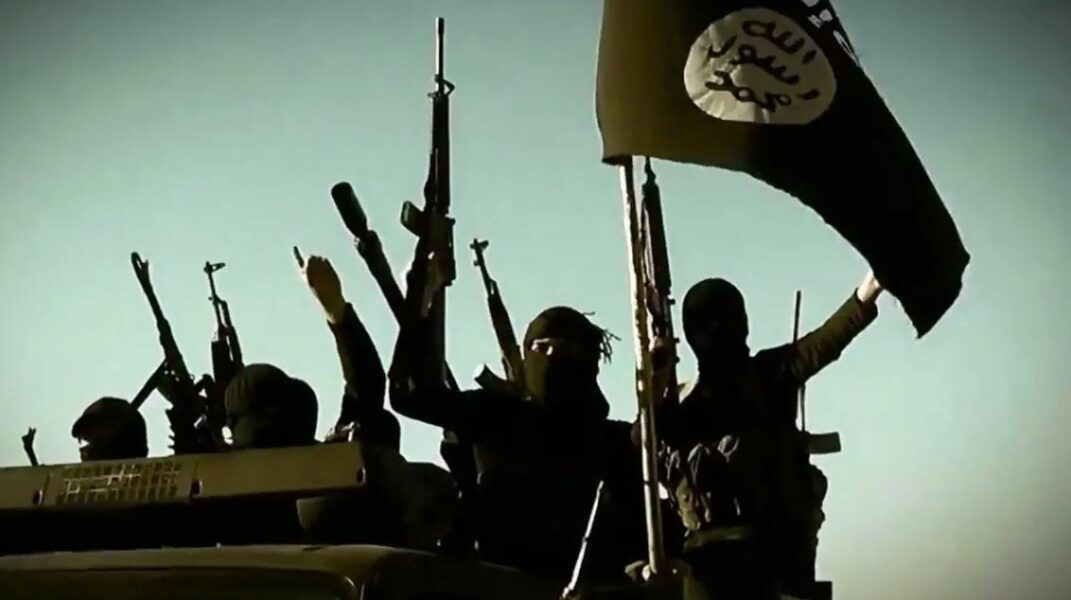
There are errors that are not simple mistakes. They are dialectical victories of the adversary. One of the most profitable of the last fifty years has been the equation between jihad and crusades: the idea that both religious traditions—the Islamic and the Christian—produce equivalent forms of sacred violence, and that, therefore, neither can cast the first stone against the other.
Cultural relativism, misunderstood Christian pacifism and the intellectual laziness of opinion journalism have turned that equation into an unwritten dogma.
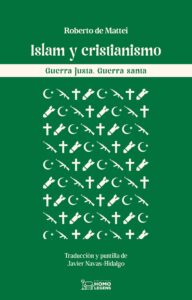
Roberto de Mattei has spent decades dismantling unwritten dogmas. The Roman historian, professor emeritus, disciple of Plinio Corrêa de Oliveira and president of the Lepanto Foundation, now publishes with Homo Legens Islam and Christianity. Just War. Holy War, a 132-page essay that does exactly what its subtitle promises: separating, with the scalpel of a theologian and historian, two concepts that have nothing to do with each other.
Two religions facing the question that modernity wants to bury
The book starts from a question that the political and media establishment prefers not to formulate: Can a war be just?
Since 9/11, public conversation has oscillated between two equally insufficient responses: unconditional pacifism—which denies legitimacy to any use of force—and visceral indignation—which dispenses with any doctrinal foundation. What is missing in that debate is precisely what De Mattei offers: the distinction.
Because Islam and Christianity do not respond equally to that question. It is not a matter of sensitivities or interpretations: it is a difference of doctrinal structure that has enormous practical consequences. The book explains them, chapter by chapter, without condescension and without trickery.
What Saint Thomas said in the thirteenth century and nobody has surpassed
The doctrinal heart of the essay is found in the first part, dedicated to the Christian tradition on the just war. De Mattei recovers the line that goes from Saint Augustine to Saint Thomas—passing through Charlemagne as a model of the Christian sovereign—and which the subsequent Scholasticism and the Church’s magisterium have confirmed without abandoning.
The contribution of Saint Thomas Aquinas in the Summa Theologica—specifically in the Secunda Secundae—is, according to De Mattei, of decisive importance «not only for its own value, but also for the influence it has had on the subsequent doctrine of the Church».
The Angelic Doctor systematizes in three conditions what makes a war just.
First: competent authority. War can only be declared by someone who has legitimate authority to do so: «it does not fall to the private person to declare war, because he can assert his right before a superior court». Private violence, terrorism, the guerilla without legitimate mandate: none of them can claim for themselves the coverage of the just war.
Second: just cause. It is not enough to want to defend oneself or to feel aggrieved. It requires that «those attacked deserve it for some cause». Saint Thomas collects the Augustinian definition: «Just wars are usually called those that avenge injuries; for example, if there has been opportunity to punish the people or the city that neglects to punish the outrage committed by their own or to restore what has been unjustly robbed».
Third: right intention. The combatant must act «with an intention directed at promoting the good or avoiding the evil». The Angelic Doctor is explicit: «the desire to harm, the cruelty of revenge, the implacable and implacable spirit, the ferocity in the fight, the passion to dominate» are vices that morally invalidate the war even wenn its external causes were legitimate.
Three conditions that limit, discipline and moralize the use of force. Three conditions that, as De Mattei demonstrates in the second part of the book, jihad does not share.
The jihad: what the «dialogue» does not want to see
The second part of the essay is dedicated to the doctrinal characteristics of the Islamic holy war. De Mattei warns from the beginning against the temptation to apply modern thought categories to Islam: «The best way to approach Islam is to respect it. And respecting it means accepting it as it is, without trying to “reinterpret” it by changing its nature».The crusades are not the Christian response to the jihad
The third part of the book addresses the relativism argument with more rhetorical ammunition than historical rigor: that the crusades are the Christian equivalent of the jihad, and that therefore the Christianity does not have moral authority to distinguish itself from Islamic violence.
The crusades were called as a defensive response to centuries of Islamic expansion that had conquered two thirds of the Christian world. They had a specific legal dimension, canonical conditions of legitimacy, and were subject—at least in theory—to the same three Thomistic conditions of the just war.
The structural difference is what matters: the crusade was a contingent response, callable and revocable, subject to papal authority and morally conditioned. The jihad is a permanent obligation inscribed in the nature of Islam itself.
They are not the same. They never have been.
A book to read before the next conversation about Islam
Islam and Christianity. Just War. Holy War is not a current book in the journalistic sense of the term. It is something more useful: a book that gives the categories to understand the current.
In a moment in which the pressure of migration, the Islamist attacks on European soil and the debates on integration again place the Islam in the center of the political and cultural conversation, De Mattei offers the only real antidote against confusion: the precise distinction.
The essay includes additionally a translator’s note, Javier Navas-Hidalgo, that updates the analysis to the context of Islamism in Western Europe in 2026. The overall result is a work that Homo Legens publishes with the same conviction with which it has published the great books of cultural diagnosis of the last years: because there are questions that cannot be left without an answer.
Islam and Christianity. Just War. Holy War, de Roberto de Mattei. Homo Legens, colección Pensamiento. 132 págs. PVP: 12,90 €. Disponible en librerías y en homolegens.com/libro/islam-y-cristianismo/