


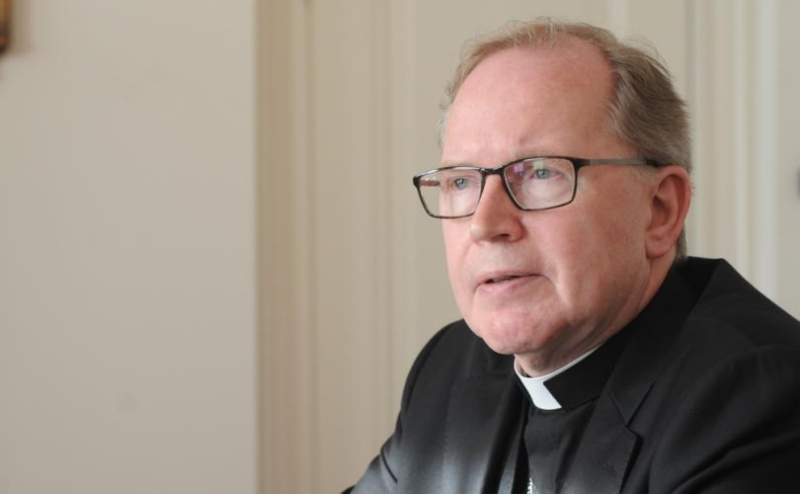
Cardinal Willem Eijk has launched a critique against the report prepared by Study Group 9 of the Synod on Synodality and accuses its authors of weakening the Church’s moral teaching, especially on issues related to homosexuality.
In an analysis published by National Catholic Herald, the Archbishop of Utrecht denounces that the document introduces “dangerous ambiguities” about Catholic doctrine and opens the door to reinterpretations incompatible with the Church’s permanent teaching on sexuality, marriage, and moral law.
Eijk’s intervention comes amid the growing controversy sparked by the report coordinated by Cardinal Carlos Castillo, Archbishop of Lima, especially due to the testimonies included in the text and the criticisms directed at the Courage apostolate.
“Homosexual acts are intrinsically evil”
The Dutch cardinal particularly criticizes the report for reproducing without correction statements according to which sin would not reside in the homosexual relationship itself, but in “the lack of faith in a God who desires our fulfillment.”
For Eijk, this statement directly contradicts Catholic doctrine.
“Homosexual acts are intrinsically evil; this is an already established Catholic doctrine,” the prelate states. Although he recognizes that every Christian needs to trust in God’s grace to avoid sin, he emphasizes that this does not eliminate the objective gravity of certain acts.
The cardinal also accuses the report’s drafters of deliberately introducing doctrinal confusion by presenting those testimonies without clarifications or references to the Catechism of the Catholic Church.
Eijk denounces the attack on Courage
Another of the points most criticized by the Archbishop of Utrecht is the treatment that the report gives to Courage International, an apostolate approved by the Church that accompanies people with same-sex attraction to help them live in accordance with Christian chastity.
The synodal document includes the testimony of a person who implicitly accuses Courage of promoting “conversion therapies,” a claim that the movement has already publicly rejected, qualifying it as “slander and defamation.”
According to Eijk, the report implicitly conveys the idea that homosexual relationships can be normalized within the life of the Church, something he considers incompatible with consistent Catholic teaching.
Criticism of the synodal process method
Beyond the specific issues on homosexuality, Eijk criticizes the general approach of the document, which he accuses of replacing moral doctrine with a model focused solely on personal experiences and listening processes.
The cardinal particularly rejects that the authors question the application of universal moral norms and present doctrine as something “rigid” or merely “abstract.”
According to the prelate, this way of framing pastoral care ends up weakening moral truth and creating the impression that the Church’s teachings can be modified according to cultural circumstances or subjective experiences.
“The truths about marriage and sexuality were established by God once and for all,” Eijk asserts.
The cardinal also recalls that St. John Paul II already condemned this type of approach in the encyclical Veritatis Splendor, where he rejected so-called “pastoral solutions” contrary to the Magisterium.
“Doctrine cannot be revised through synodal processes”
Eijk warns that the consequences of the report go far beyond the debate on homosexuality. In his view, relativizing universal moral norms ends up affecting the entire ethical teaching of the Church, including the defense of human life.
For this reason, he considers that the document must be “firmly refuted” and assures that several cardinals and bishops are already preparing objections directed to the Roman Magisterium.
“The Church’s teaching is not subject to revision through synodal processes,” the Dutch cardinal concludes. “It is the truth that sets us free.”