


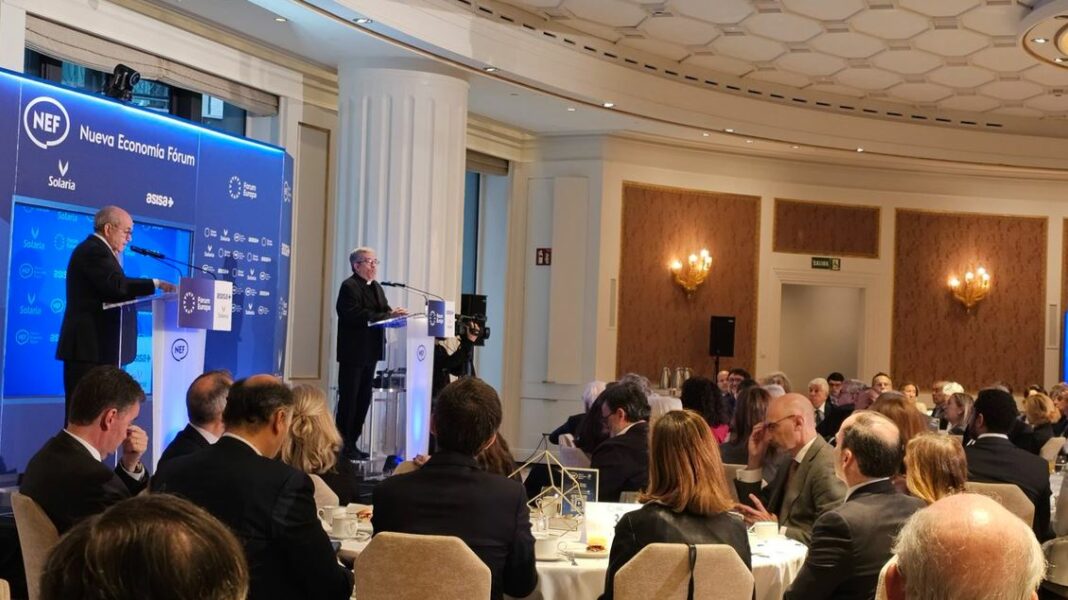
During his speech at the Breakfast Briefing of the Europe Forum organized by New Economy Forum, the president of the Spanish Episcopal Conference, Monsignor Luis Argüello, was asked about the migration issue, the Pope’s upcoming trip to the Canary Islands, and the recent tensions between the Church and Vox stemming from the debate on welcoming immigrants.
In his response, Argüello defended the need for dialogue with all political actors, reflected on the deep causes of immigration, and criticized certain political interpretations of the so-called Ordo Amoris used to justify exclusive national priorities.
Read also: Argüello’s fallacies on immigration and Ordo Amoris
Q: The Pope has wanted to place the Canary Islands and the migration issue at the center of the trip. What message is behind it? There’s also a lot of talk about peripheral neighborhoods and avoiding an overly institutional image. Was it deliberate? Does the Church want to claim a presence more attuned to social reality, as you have been saying? Laura Ramírez, from Europa Press, says “After the exchange of statements and accusations between the bishops and the president of Vox in recent weeks regarding the welcoming of migrants, have you agreed on any meeting? Is there a possibility of dialogue, or do you think they have irreconcilable positions?”
A: Irreconcilable positions, I believe there are none in principle with anyone. That doesn’t mean all ideas are equal, right? No. But always, always, it is necessary to listen to each other and dialogue. The Church, with regard to issues concerning the impoverished—and I say impoverished, not just the poor. It is a gaze, lift your gaze, surprising, because it is a gaze that makes Jesus Christ present judging history, judging history.
So, of course, our world, which on one hand is a global world, in the process of positioning itself in a multipolar global world, cannot fail to—we cannot fail to say that by the rules of the game of our world, by the situations of some countries and others, there are places in the world where people are being told “go” and there are places in the world like ours, where people are being told “come.” Because we live in a demographic winter. More people die than are born.
“Go” and “come.” What does the Church say? And I can, without further ado, review what Leo XIV said a few weeks ago, returning from Africa. The first thing we must address are the causes of why people leave, and the countries that we are on this other side of the world must think to what extent we collaborate in the causes that provoke people to leave. Money moves at the speed of light.
Goods, well, now with tariffs surely a bit more complicated, but surely, if I look at the label on this jacket, its owner may be a powerful Spanish entrepreneur, the design of it may have been done in a design studio in the United States, and the factories where it was made are in one of the countries of the global south. Many of the balls with which Madrid and Atlético, Barça or Espanyol play soccer are made in Pakistan by slave children.
So, well, we must address the causes. But the truth is that migratory flows occur. What is the next step in the reflection that the Church makes?
First, the causes. Second, the State has the right to regulate its migratory flows. Third, once people have arrived, whatever the circumstance, it also says: “let’s combat the mafias.” When they have arrived, we have a duty that springs from the very dignity that is not recognized, that is not granted, sorry, by laws, but a sacred dignity of each life is recognized, which must mobilize us. That is the issue.
So I believe this matter is a major issue that requires ethical references that we call human dignity, common good and then, when it comes to how this is regulated, it is a matter that surely the Spanish State alone cannot. It needs to do it, at least, in the European Union and, from there, it is necessary for us all to listen.
In Spain we receive very diverse people. Millions of tourists come. About that we have (…) But there is a moment when some areas of Spain say “we are saturated with tourism.” And some neighborhoods or cities that receive cruises say “well, well, first our neighborhoods, because if so many people come in, what will happen here?” That’s with tourists, but nevertheless we say “how would Spain live without what tourism contributes to the Gross Domestic Product?”.
We have just lived, we are living, the episode of the ship with the new virus, with this rat virus. And there have also been tensions there. What is appropriate? We are called by (…) to care for the sick, to welcome them, but at the same time we are also saying that we must care for the health of those who receive them. This tension is not easy.
What we say, and there perhaps some of the points of contrast with a theological and political reflection that is made from the United States and that perhaps Vox embraces may come, is a reflection on an issue that is of great interest to Leo XIV: it is the Ordo Amoris.
What is the order of love? There is a Castilian saying that says “charity well understood begins with oneself.” There is another Castilian saying that says “the bread of my children, no one touch it.”
We say that this must be overcome, that it is not true a partial reading that charity well understood begins with oneself, and that it is not legitimate to cheat for the bread of the children. But it is true that, in the theological-pastoral, political reflection that the MAGA movement in the United States makes, there is a reading of the Ordo Amoris, to be able to say America First, to be able to say national priority or Spanish priority.
What happens today? That in addition to dignity being universal, the common good is no longer only local, no. The common good has characteristics, of course, that are grounded in the local, in the national, and States have that responsibility for the common good in the nation. But it is so affected, so traversed, by multinational economy and international politics issues, that the common good must also take this dimension into account.
From there, we must make an exercise of listening, I would say Francis, to all, all, all. See the reasons of each one, make a discernment, and then, in the rules of the game of the democracy that we give ourselves, well, make a decision.
That is what I can say, regarding that, perhaps, you think that I have wanted to get out of the concrete dialogue with Vox and, more concretely, with Santiago Abascal. It goes without saying that the Church’s availability to dialogue with everyone is manifest. I would tell you about my experience over these years, in encounters, most of them informal, I have spoken with people from all parliamentary groups.