


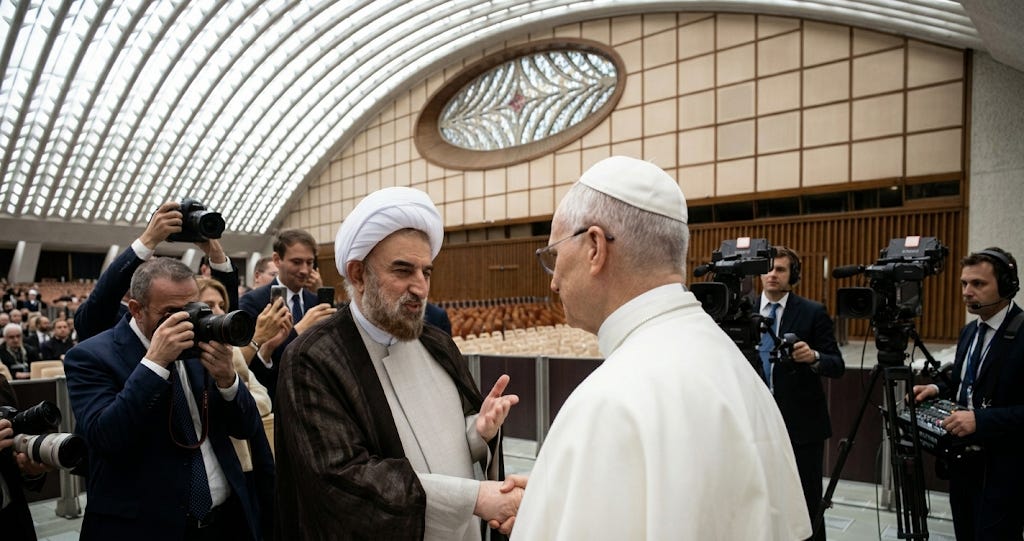
Pope Leo XIV has awarded the Grand Cross of the Pontifical Order of Pius IX, the highest active diplomatic distinction of the Vatican, to the ambassador of the Islamic Republic of Iran to the Holy See, Mohammad Hossein Mokhtari. The decision, confirmed by a diploma dated May 8 and signed by Cardinal Pietro Parolin, Secretary of State.
Although the award is usually part of the Vatican diplomatic protocol and is typically granted to ambassadors accredited to the Holy See after several years of service, the geopolitical context and the Pope’s recent statements on the conflict with Iran have turned the gesture into a subject of strong debate.
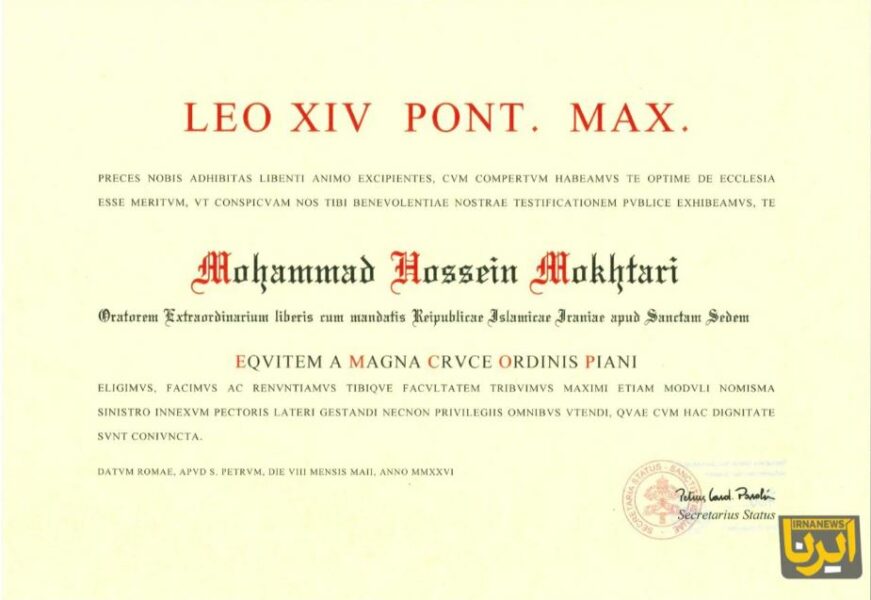
The award to the Iranian representative
The Order of Pius IX—also known as the Pian Order—was instituted by Pope Pius IX in 1847 and is considered one of the highest honorary distinctions of the Holy See. Today it is mainly awarded to heads of state and high diplomatic representatives.
According to Iranian media such as Press TV, Mehr News and the agency West Asia News, the distinction was granted to Mokhtari in recognition of his diplomatic work and his efforts to promote “peace, justice, and opposition to warmongering”.
The Iranian ambassador presented his credentials to Pope Francis in December 2023, so some observers point out that the recognition falls within the usual Vatican practice with resident ambassadors.
However, the Iranian state press has also presented the gesture as a significant political signal from Leo XIV in the face of recent tensions between the United States, Israel, and Iran.
The context: the Pope’s criticisms of the war
The act comes after Leo XIV publicly condemned the military actions of the United States and Israel against Iran and reiterated the Holy See’s traditional rejection of military escalation.
As Cardinal Parolin recently recalled, the Vatican’s position on the Iranian nuclear program has not changed and maintains the historical line of opposition to nuclear weapons defended by the Church since the 20th century.
Pope Leo XIV himself has insisted on several occasions that no conflict can be morally justified and has repeatedly called for an end to hostilities. During a papal flight last month, the Pontiff assured that the US administration “does not intimidate him”.
Read also. The Pope responds to Trump: «I am not afraid of his administration»
Nevertheless, the Pope has also openly criticized the Iranian regime’s repression against its own citizens. In statements made after an apostolic trip to Africa, he condemned the decisions of any government that “unjustly takes the lives of people”.
Critical reactions on social media
The award has generated harsh criticism among commentators and conservative figures in the United States and Europe. Some interpret the gesture as a symbolic legitimation of a regime accused of persecuting opponents, religious minorities, and converts to Christianity.
The journalist and writer Rod Dreher publicly questioned the recognition by recalling the internal repressions of the Iranian regime, while in other comments, X users denounce that Iran maintains the death penalty for Muslims converted to Christianity.
For his part, Eduard Habsburg, former ambassador of Hungary to the Holy See, tried to downplay the controversy by pointing out that the Order of Pius IX is routinely granted to numerous ambassadors accredited in the Vatican after a certain period of service.
A bad “timing” of Vatican diplomacy?
Beyond the fact that the granting of the Order of Pius IX falls within the usual diplomatic practices of the Holy See, it is difficult to ignore the context in which it has occurred. The award arrives in the midst of strong international tension and after Leo XIV’s recent statements against the military escalation in the Middle East.
The Holy See has historically defended the need to keep channels of dialogue open even with hostile governments or those distant from the Christian vision. But episodes like this leave the question open: have they chosen a bad moment to deliver this award to the Iranian representative, or has it been done taking into account the delicate international political context?
It should be added that the award was not carried out in a public ceremony nor have audiences of the ambassador Mohammad Hossein Mokhtari with Leo XIV been recorded during the month of May 2026.