


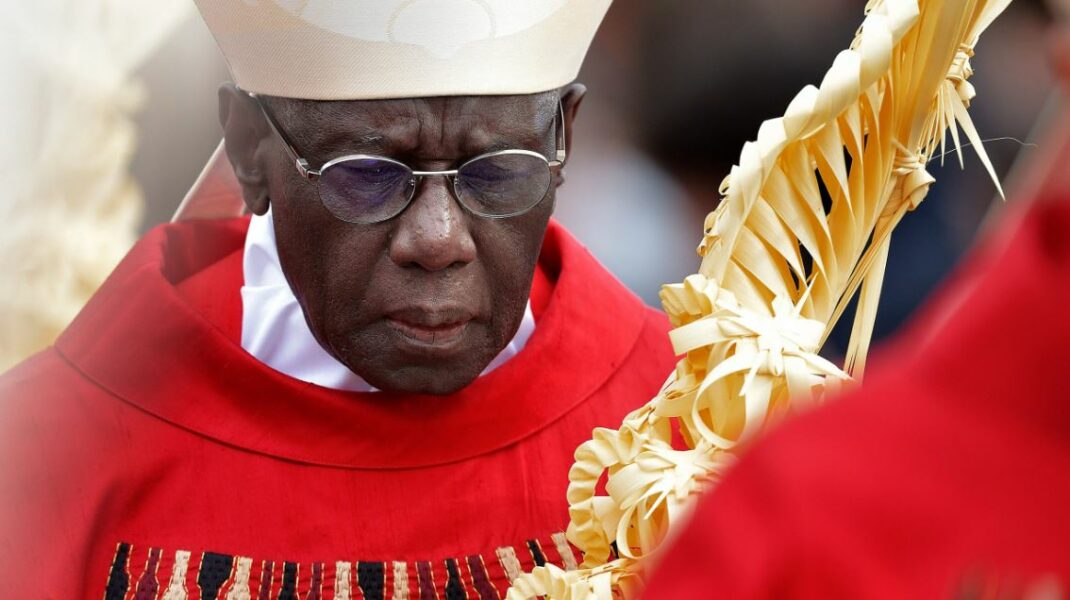
Cardinal Robert Sarah presided over the Mass of possession of the new Archbishop of Conakry—capital of Guinea—on May 9, Bishop François Sylla, leaving a homily with strong spiritual and ascetic content in which he recalled that the episcopate is not a worldly honor, but a vocation to sacrifice, suffering, and fidelity to the truth.
According to Advaticanum, the Guinean cardinal exhorted the new archbishop to ground his ministry in prayer, fasting, penance, and Eucharistic adoration, warning that without a spiritual life, a bishop cannot sustain the weight of his mission.
“He will not be able to bear this burden if he does not pray and do penance”
During the celebration in Conakry’s Sainte Marie Cathedral, Sarah evoked his own years at the helm of the archdiocese—which he governed from 1979 to 2001 before being called to Rome—and explained that he used to withdraw periodically to dedicate himself to fasting and prayer.
“He will not be able to bear this heavy burden if he does not fast, if he does not pray, if he does not make sacrifices and penance,” he affirmed, addressing Bishop Sylla directly.
The former prefect of the Congregation for Divine Worship also rejected any worldly vision of the episcopate understood as an exercise of power or personal prestige.
“Being a bishop is not about showing off or selfishly enjoying the tremendous authority of the episcopate,” affirmed the African cardinal.
“Being a bishop is accepting suffering”
In one of the most intense moments of the homily, Sarah defined the episcopal ministry as a daily participation in Christ’s cross.
“Being a bishop is dying, it is accepting suffering,” he declared.
And he added: “Being a bishop is drinking the Lord’s chalice every day, suffering and dying for others, loving and remaining united to the truth.”
The cardinal’s words have been interpreted by many as a new call to recover a supernatural and sacrificial vision of the priesthood and the episcopate in the face of the temptations of ecclesiastical careerism and the bureaucratization of pastoral life.
Priestly unity and Eucharistic adoration
Sarah also insisted on the importance of unity among priests and asked the new archbishop to remain especially close to those presbyters with whom he may experience difficulties or sufferings.
“The second duty, dear Bishop François, is to love your priests, especially those who make you suffer,” he noted.
Likewise, he called for an ecclesial life centered on prayer and continuous Eucharistic adoration: “A Church that does not pray will not survive.”
The new archbishop calls for peace and unity
For his part, Bishop François Sylla emphasized in his final intervention the role of the Church in promoting peace and social cohesion in Guinea, a country marked by political tensions and social difficulties.
The new archbishop also called for overcoming internal divisions and urged Catholics to offer coherent witness amid the identity crisis affecting contemporary society.
“We are called to work for peace, fraternity, and social cohesion,” he affirmed.
Sylla succeeds Bishop Vincent Coulibaly, whose resignation was accepted by Leo XIV on February 28 for health reasons.
A profile formed between Africa and Rome
Born in Siboty in 1972, Bishop François Sylla studied philosophy and theology in Mali before continuing his formation in Switzerland and Rome.
After his priestly ordination in 2004, he held various positions in the Archdiocese of Conakry, including chancellor, judicial vicar, and president of the metropolitan tribunal.
He was also rector of the Major Seminary of Benedict XVI in Kendoumayah before being appointed coadjutor archbishop of Conakry by Pope Francis in May 2024.