


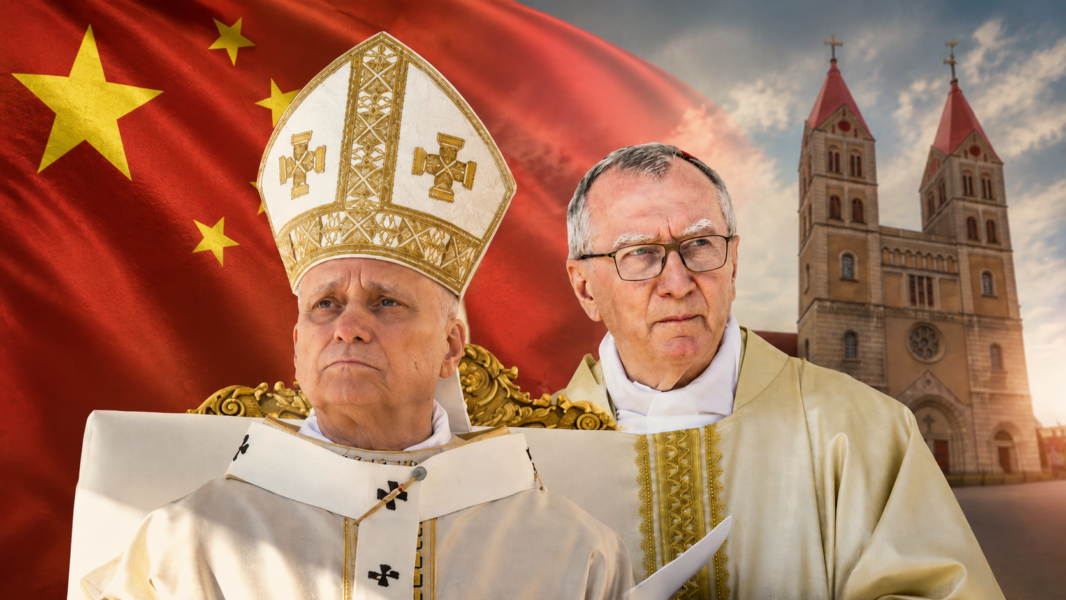
One year after the election of Leo XIV, the Vatican continues to fail to clarify what the future holds for the controversial agreement signed with China on the appointment of bishops. While Cardinal Pietro Parolin continues to control the Secretariat of State and maintain the diplomatic line inherited from Francis’s pontificate, doubts are growing within the Church about a policy toward Beijing that has not halted the persecution of Chinese Catholics.
A silence in crescendo
A recent analysis published by La Nuova Bussola Quotidiana once again focuses on one of the issues still pending for Leo XIV’s pontificate: the future of the agreement between the Vatican and Beijing signed in 2018 and subsequently renewed in 2020, 2022, and 2024.
For now, Leo XIV maintains a prudent silence on one of the most sensitive cases inherited from Francis. The pact, whose full content remains secret, establishes a system whereby the Pope appoints bishops from candidates previously approved by the Chinese Communist Party. Since its signing, the agreement has generated strong criticism within broad ecclesiastical sectors, especially among those who believe that Rome has yielded excessively to a regime that continues to tightly control religious life.
The continuity of Parolin
One of the elements that fuels the most doubts about a possible change of course is the permanence of Cardinal Pietro Parolin at the head of the Secretariat of State. Considered the main architect of the agreement with China, Parolin has defended for years a strategy of diplomatic rapprochement based on small gradual advances.
That line recalls the so-called Vatican Ostpolitik developed during the Cold War, based on dialogue with communist regimes to ensure a certain institutional survival of the Church.
However, critics argue that this strategy never really managed to halt religious persecution and recall that it was the firmness of St. John Paul II in the face of communism—and not soft diplomacy—that ultimately contributed decisively to the fall of the Soviet bloc.
John Paul II maintained a much more forceful stance toward the Chinese regime. In the year 2000, he canonized 120 martyrs killed in China despite protests from Beijing and strengthened the autonomy of the underground Church in the face of state control.
Benedict XVI and Cardinal Zen
Benedict XVI also maintained a much firmer line on the freedom of the Church in China. During his pontificate, he created Cardinal Joseph Zen, the Bishop of Hong Kong, who has since become one of the main symbols of resistance to the interference of the Communist Party.
The letter sent by Benedict XVI to Chinese Catholics in 2007 openly denounced the pressures exerted by state agencies on priests and faithful to force them to act against their Catholic conscience.
The figure of Cardinal Zen has also acquired strong symbolic value following his arrest and trial by Chinese authorities. Even today, the prelate needs government authorization to leave Hong Kong.
Persecution continues despite the agreement
Various underground bishops continue to be detained or subjected to surveillance, especially during important religious festivals. Organizations like Human Rights Watch have recently denounced an increase in religious repression under the «sinicization» process promoted by Xi Jinping.
Moreover, Beijing has continued to make unilateral episcopal appointments without papal approval, even during the recent vacancy of the Holy See following Francis’s death. For many observers, that gesture was interpreted as a demonstration of strength by the communist regime and as proof of the real limitations of the agreement.
One of the great challenges of the new pontificate
Meanwhile, voices are growing that warn of the risk that Vatican diplomacy will end up sacrificing the freedom of the Chinese underground Church in the name of a dialogue that Beijing seems to use mainly to reinforce its control over Catholicism.
Leo XIV’s silence on this issue is thus beginning to be interpreted not as temporary prudence, but as one of the most relevant—and most disturbing—signs of continuity with the China policy promoted during the years of Francis and Parolin.