


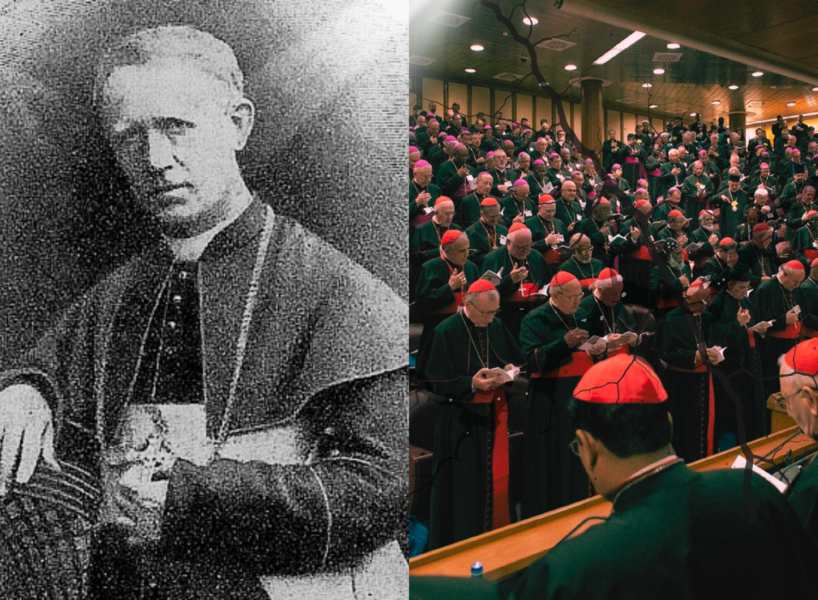
The main engineers of the disaster caused by the Second Vatican Council as a means boasted and bragged about having used the weapon of ambiguity to conquer their objectives in the conciliar texts. Father Henri de Lubac (SJ) said the following: “The title of the first part, even more in French than in Latin, has an ambiguous tone, and undoubtedly this ambiguity was necessary so that it could encompass the entire scope of the exposition.” (Cf. Athéisme et sens de I’homme – Une double requéte de ‘Gaudium et spes’ (Paris: Cerf, 1968), p. 92.). We have the dark testimony of Karl Rahner where he explains the procedure of this pernicious tactic: “Naturally, in some cases, the unity of all in freedom was sought and achieved diligently in this Council through the tactic of leaving questions unresolved or by other means that, at first glance, may seem like an unfortunate compromise. But even in these cases, true unity was achieved in a climate of authentic freedom” (Cf. Karl RAHNER, Vaticano II: Um comego de renovagéo (Sao Paulo: Herder, 1966), p. 12).
Without delving deeper into the previous, as it is an extensive topic, we can see today how this phenomenon has become daily life in every ecclesial sphere. What was manifested by these architects of the conciliar calamity is today the norm to follow, proliferated everywhere. To emphasize more emphatically, deliberate lack of clarity is the repeated conduct of high hierarchs both in the Holy See and in all dioceses of the Christian world. The modern profile of the successors of the apostles can be summarized as: lack of clarity, lack of character, sentimentalism, extremely broad generalities, concern for anything but the salvation of souls, good cheer to sympathize with secular politics in corrupt environments, and, worst of all, pursuing to the death the bimillennial tradition of the Holy Mother Church. None of this is said with pleasure or joy; quite the contrary, it is a reason to beg for mercy from heaven. May the bishops, cardinals, and the Pope himself truly be clear and consistent with the perennial Magisterium of the Mystical Body of Christ.
The way hierarchs should be is diametrically opposed to what is available in the dioceses; it is not even a tenth part of the rigor required, demonstrated by history and concrete cases in the Church, of what the faithful need to have as pastor and guide to confirm them in the faith. They are copies of copies, some with more reverent and respectful nuances, but they allow error within their jurisdiction. Let us see the recent example of the bishops of the Spanish Episcopal Conference gathered in a café when a young woman, in the image of Saint Catherine of Siena, questioned them about the Valley of the Fallen. What did they do? What was expected: victimize themselves, reframe the situation, open questions that seek to redirect the topic, and uncomfortable silences. In this, not lamentable, but disgusting, situation, it can be taken as the best panoramic view of the health of our ecclesial rulers.
Having already done an X-ray explanatory of the present, let us seek how things should be. What is that minimum? What is that profile? How should our pastors be? An endless mountain of heroes to mention! What immense glory of the Spouse of the Immaculate Lamb for all the feats of her champions! Let us take the model of a little-known bishop, but who contains in himself a double virtue: a lion’s voice for his apostolic zeal and sweet and paternal care with his beloved faithful.
Msgr. Pedro Schumacher (1839-1902) was the bishop of the diocese of Portoviejo from 1885 until his exile in Colombia—caused by the revolutionary liberals—and death in 1902. His careful and conscious manner of performing in this diocese can be evidenced through his pastoral letters and the action exercised as a result of what was stated in them. This prelate dedicated his life to writing for his faithful, preparing catechesis letters, letters to amend and warn about modern errors, exhort on spiritual life, encourage religious vocation, among other actions to fulfill his role as successor of the apostles. He invested a large part of his time in focusing on the guardianship of basic formation for the young people under his care.
Next, we are going to delight in reading some excerpts from his book titled “La sociedad civil cristiana: según la doctrina de la Iglesia Romana. Texto de enseñanza moral para la juventud”. The book explains itself by its title alone; it is an easy-to-understand treatise on how Christian society should be and what its enemies are. Let us ask ourselves quickly: when was the last time the bishop of my diocese spoke of something remotely similar? Has the bishop I so admire in my region done something similar to Msgr. Schumacher? What are the actions and plans in my diocese to undertake such a work? The illustrious bishop rings the obedient bell of doctrinal clarity of the Magisterium of the Pontiffs who gave open battle to the poisons implanted by the Revolution. See his clarity, see his precision, see his care, see his way of wielding the topics; it is simply splendid. The common denominator of the purple ones does not even reach the heels of Msgr. Schumacher. This is how a bishop should speak. With gallantry, bravery, without fears, without human respects, saying things exactly as they are, on the most dangerous topics but giving everything out of love for Christ. Let us read attentively.
***
Excerpts from the book La sociedad civil cristiana: según la doctrina de la Iglesia Romana. Texto de enseñanza moral para la juventud. By Msgr. Pedro Schumacher.
The Church – the Kingdom of God
“The object for which men, moved by nature, gather in civil society is that each one attains the means to reach the end that God has pointed out to him, and it is true temporal well-being in this life and eternal happiness in the future life…”
“The civil society organized and ordered according to divine law is the kingdom of God on earth, because such a society recognizes God as its Legislator and sovereign; it adores and serves Him. This is precisely what Liberalism calls theocracy, affecting contempt for a theory that so ennobles human society, for what can be more glorious for man than to recognize God as Lord, as it is written? ‘All the kings of the earth shall adore Him: all the peoples shall serve Him.’ (Ps. 71, 11.)”
The Kingdom of Satan – Freemasonry and Liberalism
“The most declared enemies of the kingdom of God form today a hidden or secret society that is called freemasonry, with which the sect of liberalism is intimately united, because it has the same end and the same principles.”
“The Masons keep themselves hidden and do not want to be known; the liberal sect, on the contrary, manifests itself publicly, offering peoples progress, civilization, and never-seen happiness, provided they separate from the Church of God. In the same way, Satan deceived our first parents, offering them that they would become equal to God by denying Him obedience.”
“Liberalism avails itself mainly of the following means: 1º It seeks to have peoples and their governments exclude God from the constitution and from their laws, alleging that religion has nothing to do with politics. 2º It teaches that each one can believe, speak, and write what they want, whether truth or lie, good or bad. 3º It does not consent that religion be taught to children in public schools. 4º It wants to exclude God from families, making spouses not unite with the sacrament of marriage, but live in a bad state or concubinage.”
“The so-called social pact is an absurd and fantastic thing considered in itself, and a most pernicious system in its consequences.”
On the law
“The order established by God is called natural law and what is in accordance with this order is good, what is contrary to it is bad.”
“False equality before the law consists in applying the same legal provisions to all citizens, without taking into account the diversity and inequality of their aptitudes, rights, and merits, because in this way justice is violated, which demands giving each one what is due to them.”
On governments. Christian governments and atheistic or liberal government
“Christian government is the one that takes as norm and rule of its acts the Gospel or the doctrine of Jesus Christ. Atheistic or liberal are the governments that exclude religion from public life, pretending that it has nothing to do with politics.”
“The Church teaches that revolutionaries, by attacking legitimate authority, attack God Himself, and are responsible for the deaths they cause and for all the damages of the revolution, no more and no less than homicides and thieves.”
“Governments are independent of the Church in all those provisions that do not concern religion or moral order; that is, in indifferent things; but when it comes to religion or principles of conscience, governments must listen to the Church and obey it.”
On what they call “Popular Sovereignty”
“They want to persuade us that peoples and their governments have no other superior in religious and civil matters than their own will.”
“1º Reason teaches that only God is sovereign, in the sense that everything depends on Him, and He depends on no one; the same reason makes us see that the people depend on God’s natural law, insofar as they must necessarily adjust their laws to God’s will. 2º Popular sovereignty in the sense of liberalism is opposed to Catholic teachings; let us hear Pope Leo XIII: ‘All authority comes from God as from its principal source; so attests nature. Popular sovereignty, on the contrary, which pretends to derive naturally from the multitude, without taking God into account, is supported by no plausible reason, it is good only to excite and inflame many passions’ (Enc. Immortale Dei).”
On freedom of conscience
“It is never permitted to do what conscience shows us as a bad action, because otherwise it would be permitted to have the intention or will to break God’s law. It is also a sin to fail to do what conscience represents to us as our duty, on the supposition that this conscience is true conscience, ordering with certainty and clarity, without doubt, distortion, or passion.”
“…conscience must be a certain judgment, an intimate conviction of the soul, but outside of God there is no fixed rule to judge the goodness or evil of human actions, everything remains uncertain and abandoned to each one’s whim.”
Teaching without God and atheistic schools
“Liberalism, in the war it wages against God, seeks to seize schools and educational establishments, and, consistent with its fundamental principle, excludes religion from education and from public teaching subjects. Its purpose is to snatch from God the souls of children, and to form a new generation that dispenses with God and lives without religion. Several governments in Europe and America, fully entering this practical liberalism, have arranged that no religion be taught in public schools. These are atheistic, lay, or secularized schools. And, in order to indirectly force parents to send their children to these irreligious schools, they prevent with all possible means the establishment of Christian schools.”
On freedom of the press
“By freedom of the press, liberalism understands what the so-called ‘rights of man’ express, namely: the right for each one to freely express their thoughts through the press.”
“…this would no longer be freedom, but immorality. There cannot certainly be a right to express thoughts injurious to God or contrary to truth and justice.”
“The effects of this false freedom cannot be more pernicious; here are the main ones: 1º This false freedom attacks the authority of God, and denies the truths of divine revelation. 2º It destroys all morality by its pretension to lie and slander freely. 3º It is a seedbed of revolutions against public authority, and of enmities between families and individuals.”
Note: Articles published as Tribune express the opinion of their authors and do not necessarily represent the editorial line of Infovaticana, which offers this space as a forum for reflection and dialogue.