


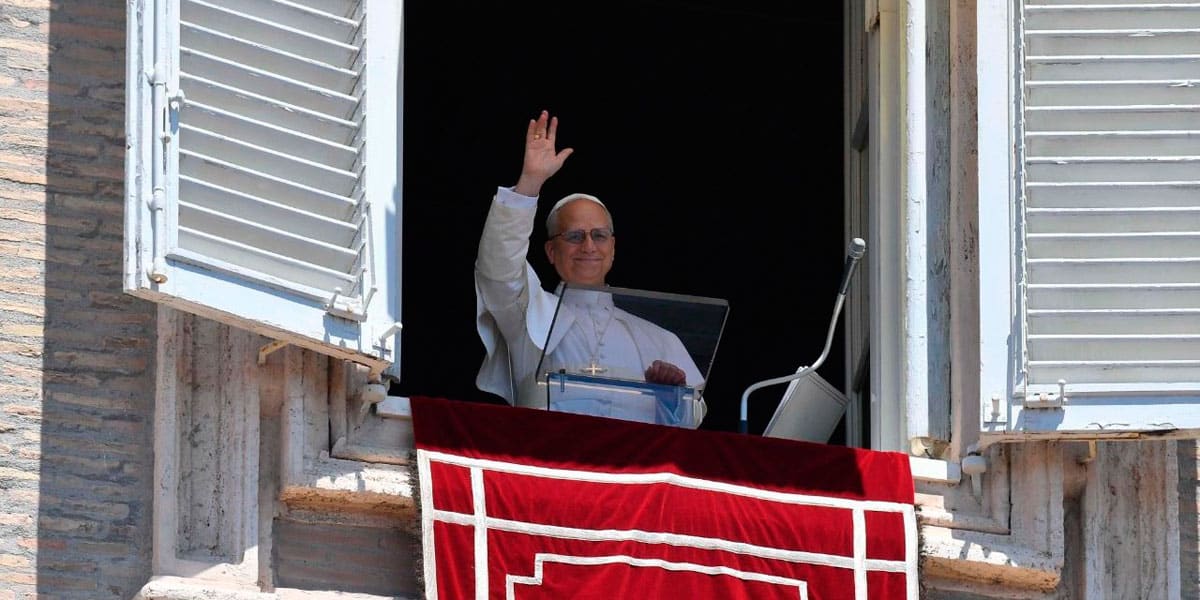
In his first Regina Caeli from the window of the Vatican Apostolic Palace, Pope Leo XIV centered this Sunday’s reflection on God’s love as the foundation of Christian life and warned against a legalistic view of faith based solely on the fulfillment of commandments. Commenting on the Gospel of the Last Supper, the Pontiff stated that Christians are not loved by God because they obey, but they can obey precisely because they have first been loved by Him.
Leo XIV also emphasized that true Christian love knows no conditions or interests and implicitly denounced the dynamics of division and lies that pit man against God and people against each other. After the Marian prayer, the Pope also expressed his concern over the increase in violence in the African Sahel region, especially in Chad and Mali, and called for an end to all forms of violence.
We leave the words of Leo XIV after the Regina Caeli prayer:
Dear brothers and sisters, happy Sunday!
In today’s Gospel, we have heard some words that Jesus addresses to his disciples during the Last Supper. While transforming the bread and wine into the living sign of his love, Christ says: «if you love me, you will keep my commandments» (Jn 14,15). This statement frees us from a misunderstanding, that is, from the idea that we are loved if we keep the commandments: our justice would then be a condition for God’s love. On the contrary, God’s love is the condition for our justice. We truly keep the commandments, according to God’s will, if we recognize his love for us, just as Christ reveals it to the world. Jesus’ words are therefore an invitation to relationship, not blackmail or a putting into doubt.
That is why the Lord commands us to love one another as he has loved us (cf. Jn 13,34): it is Jesus’ love that gives birth to love in us. Christ himself is the criterion, the rule of true love; the one who is faithful forever, pure and unconditional. The one who knows neither «but» nor «perhaps,» the one who gives himself without wanting to possess, the one who gives life without asking for anything in return. Since God loves us first, we too can love; and when we truly love God, we truly love one another. It happens like with life: only those who have received it can live, and thus, only those who have been loved can love. The Lord’s commandments are therefore a form of life that heals us from false loves; they are a spiritual style that is a path to salvation.
Precisely because he loves us, the Lord does not leave us alone in the trials of life: he promises us the Paraclete, that is, the Advocate defender, the «Spirit of Truth» (Jn 14,17). It is a gift that «the world cannot receive» (ibíd.), while it persists in the evil that oppresses the poor, excludes the weak, and kills the innocent. Whereas those who respond to the love that Jesus has for all find in the Holy Spirit an ally who never fails: «But you know him, —Jesus says—, because he remains with you and will be in you» (ibíd.). Always and everywhere we can then bear witness to God, who is love: this word does not mean an idea of the human mind, but the reality of divine life, by which all things have been created from nothing and redeemed from death.
By offering us true and eternal love, Jesus shares with us his identity as the beloved Son: «I am in my Father, and […] you are in me and I in you» (v. 20). This all-encompassing communion of life refutes the accuser, that is, the adversary of the Paraclete, the spirit opposed to our defender. In fact, while the Holy Spirit is the force of truth, this accuser is the «father of lies» (Jn 8,44), who wants to pit man against God and men against each other: just the opposite of what Jesus does, saving us from evil and uniting us as a people of brothers and sisters in the Church.
Dear friends, full of gratitude for this gift, let us entrust ourselves to the intercession of the Virgin Mary, Mother of Divine Love.