


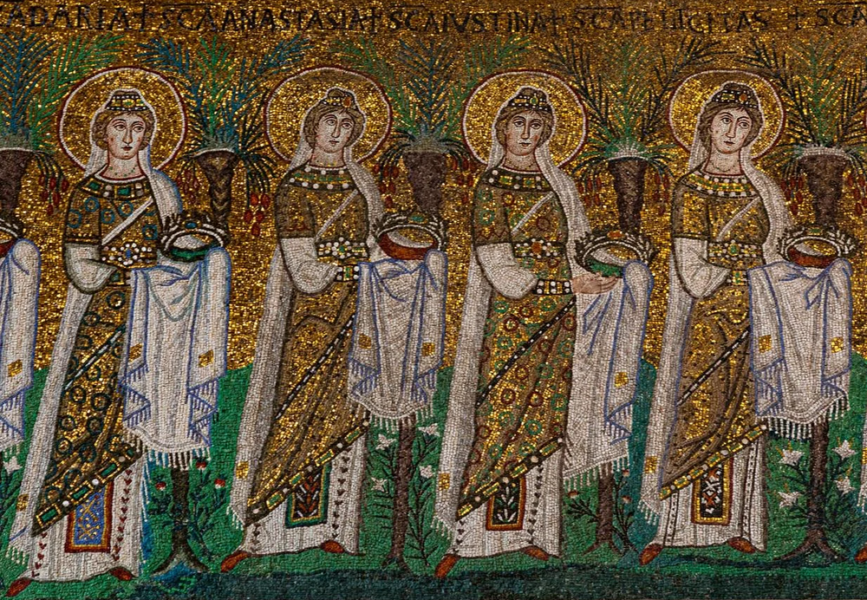
An ancient word for a modern issue
Every so often, a question reappears in the Church that, although presented as a novelty, actually belongs to Christian antiquity: that of the so-called “deaconesses.” The term immediately seems to evoke a female ministry parallel to the sacramental diaconate of men, as if in the early centuries there had existed a kind of female clergy that later disappeared. However, when one descends from debate to documents, and from modern simplifications to the truth of history, the picture turns out to be much more nuanced, richer, and also much more interesting.
Because the ancient Church certainly knew women called deaconesses. But it is quite another matter to affirm that those women received the sacrament of Orders in the proper sense or performed functions equivalent to those of the deacon as the Church understands it today. And that is where history, read serenely and without ideological presuppositions, forces us to introduce many questions.
Presenting it in feminist terms—not diminishing women or relegating them to a second plane—is simply absurd. It is enough to survey twenty centuries of Christianity to realize that few institutions have dignified women as much as the Church. The Church elevated women when the pagan world barely considered them legally; it surrounded them with veneration in the incomparable figure of the Most Holy Virgin; it filled history with martyrs, virgins, doctors, founders, mystics, and saints whose spiritual influence surpasses that of many men vested with authority. The problem, then, is not dignity, but the nature of certain ecclesial functions. And history tells us that the ancient deaconesses were never “women deacons.”
The clumsiness of our clumsy time lies in projecting modern categories, ideological readings, or contemporary claims onto the primitive Church, which end up forcing ancient texts to say what they never intended to affirm and leading to an archaeology devoid of theology, which, according to Pius XII, is one of the causes of the ruin of the liturgy and, therefore, of the faith. Because history can be a teacher of truth, but also an instrument of confusion when it is torn from its context and turned into an apologetic argument to justify previously decided options.
Phoebe, the widows, and the silent female service
From the beginnings of Christianity, the active and generous presence of women in the life of the Church appears clearly. The Gospels recall with emotion those women who followed Christ from Galilee and “served him with their goods” (Lk 8:3). Saint Paul, for his part, continually mentions female names linked to the nascent apostolate: Prisca, Mary, Tryphena, Tryphosa, the mother of Rufus… discreet but decisive figures who materially sustain the communities, host missionaries, care for the poor, and intensely participate in Christian life. Among those names stands out that of Phoebe, whom the Apostle presents as “our sister, who is at the service of the church in Cenchreae” (Rom 16:1). She must have been a well-off woman, for Paul himself adds that “she has helped many and also me” (Rom 16:2). For centuries, that expression was interpreted as a reference to a deaconess. But the Greek term diákonos then had a much broader semantic range than later: it simply meant servant, collaborator, helper. Paul himself applies it to Christ, to himself, to preachers of the Gospel, and even to civil authorities. Nothing obliges us, therefore, to conclude that Phoebe received a sacramental degree.
Moreover, Paul’s own letters show a clear concern to avoid certain women assuming doctrinal or liturgical functions proper to ordained ministers: Paul insists that it is not their place to teach authoritatively in the assembly or to exercise presiding functions, and he also warns against the danger of gossip, spiritual idleness, and being seduced by erroneous doctrines (cf. 1 Tim 2:12; 5:13-15). The nascent Church already distinguished clearly between ecclesial service—very broad and precious—and the apostolic ministry proper.
At the same time, groups of widows and consecrated virgins begin to appear. They constitute a kind of intermediate ecclesial state: women dedicated to prayer, fasting, charitable assistance, and certain community tasks. Saint Ignatius of Antioch mentions them with veneration under the common name of widows; Saint Polycarp beautifully calls them “altar of God”, because they live from the community’s offerings and consume their existence in intercession. It is in this context that the figure of deaconesses will slowly begin to take shape.
The “ministers” of Bithynia and the birth of an auxiliary institution
One of the oldest testimonies appears in the famous letter of Pliny the Younger to Emperor Trajan, around the year 112. The governor of Bithynia, trying to understand the nature of Christianity, writes that he judged it necessary to interrogate under torture two female slaves “who were called ministers” (quae ministrae dicebantur). They were probably two Christian “deaconesses.” However, this fact is very revealing precisely for what it does not say. They do not appear as priestesses, nor as liturgical leaders, nor as holders of doctrinal authority, but as auxiliaries of the community.
In fact, the ancient ecclesiastical norms normally required that “deaconesses” be mature women, widows or virgins, already free from important family obligations. According to the Didascalia Apostolorum of the third century, widows and “deaconesses” form distinct groups: the former are especially dedicated to prayer and fasting; the latter collaborate in certain practical services dependent on the bishop. But the same text expressly prohibits them from preaching or baptizing, in which something fundamental is noted: the ancient Church wanted to make wide use of feminine genius, but at the same time drawing very precise limits regarding the liturgical and doctrinal functions reserved for the ordained ministry.
Baptismal modesty and the true origin of “deaconesses”
The historical explanation of the institution is, in the end, quite simple. In the early centuries, adult baptism was normally performed by immersion and involved a series of bodily anointings. The sense of modesty made it inconvenient for such rites to be performed directly by male clerics when it came to women. Thus arose the practical need for female collaborators who would help in the preparation of catechumens and assist materially during baptism. There appears— and let us not stop using the quotes! —the “deaconess.” That is, the “female helper.” Her mission was auxiliary and was linked almost exclusively to women: elementary catechetical preparation, assistance—only assistance—in female baptism, visits to the sick, custody of spaces reserved for women in churches, and certain charitable or disciplinary tasks that would have been improper for a man, who was truly a deacon.
The sources are clear: the Apostolic Constitutions, for example, state that “deaconesses” help the presbyters “when women are baptized, for the sake of decorum and modesty” (propter decorum et honestatem). It was their role to perform the preliminary anointing of catechumens and assistance during the baptismal ablution. In the Gauls, some texts also attribute to them the elementary instruction of rude or ignorant women on how to respond in baptism and how to live Christianly afterward. Nothing is said about liturgical presidency, official preaching, or sacramental power. In fact, the same sources insist precisely on the opposite.
A blessing is not a sacramental ordination
Modern confusion often arises from the liturgical language used in the East. In certain ancient texts, deaconesses receive the laying on of hands and are incorporated through very solemn ceremonies. The Apostolic Constitutions even describe a prayer of the bishop asking God to pour out his Spirit on the chosen one to make her worthy of his service. Some post-seventh-century Byzantine rites went so far as to use external elements similar to those of the male diaconate, such as the imposition of a stole or the symbolic delivery of an empty chalice, which the deaconess then placed on the altar. If it might seem that these were true sacramental ordinations, the ancient tradition itself expressly denies that interpretation.
Saint Epiphanius, one of the great Eastern Fathers of the fourth century, states with absolute clarity that such service “was not instituted for priestly functions or for a similar ministry” (Panarion, III, 2). The Roman Traditio Apostolica likewise distinguishes between widows and the ordained clergy, explaining that ordination is reserved for those who exercise a properly priestly liturgical service: “The widow does not receive the laying on of hands, because she does not offer the oblation nor perform a liturgical function”. The difference is capital.
In antiquity, there were many constitutive blessings: for virgins, abbesses, kings, emperors, lectors, monks… Some included the laying on of hands without thereby being sacraments of Orders. The Church never automatically interpreted every ancient cheirotonía as a sacramental ordination in the strict sense.
“Deaconesses” were blessed and instituted for a specific service; they were not incorporated into the sacrament of Holy Orders. And precisely for that reason, they never performed essential functions of the diaconate: official proclamation of the Gospel in the liturgy, authorized homiletic preaching, sacramental presidency, or properly clerical liturgical ministry. The contemporary temptation consists in confusing ritual similarity with sacramental identity. Perhaps it is an excess of fiducia…
Between Eastern expansion and Western sobriety
Over time, some Syriac churches—especially Nestorian and Jacobite—allowed abuses or improper extensions of these functions. In certain places, deaconesses came to read sacred texts in the assembly or exceptionally distribute communion in female monasteries. But precisely those examples show that these were local, supplementary, and debated practices, not a universal consciousness of female sacramental ministry.
While some Eastern regions tended toward a certain ceremonial exuberance, the West remained much more sober and prudent.
The reason was very simple: with the disappearance of mass adult baptism, the practical function of “deaconesses” was practically emptied. Many ended up linking themselves to religious life. The name sometimes survived as an honorary title for certain abbesses or nuns in charge of reading during the divine office, but the unofficial “institution” gradually disappeared. And this historical fact has enormous importance, because if “deaconesses” had truly belonged to the sacrament of Orders, the Church could never have simply allowed that supposed sacramental degree to become extinct. Just as the minor orders and the subdiaconate have not disappeared, alive in the Pontificale Romanum, despite the dispositions—so difficult to understand—of Paul VI. A disciplinary function can disappear; not a constitutive sacramental structure of the Church.
That is why the Western conciliar decisions are particularly eloquent. The Council of Orange, in the fifth century, stated bluntly: “Deaconesses must not be ordained” (Diaconissae omnino non ordinandae). And the Council of Orléans soon after prohibited maintaining the institution: another historical proof that the Church never considered those functions as part of the sacrament of Orders.
Does the woman really influence more by clericalizing herself?
It was significant the moral level that the Church demanded of “deaconesses.” The Apostolic Constitutions prescribed: “Let a pure virgin be chosen; and if not a virgin, at least a widow of one husband”. The Council of Chalcedon went so far as to excommunicate those who violated chastity, and Justinian’s legislation even contemplated very severe civil penalties against those who discredited that state. All this demonstrates the great respect the Church felt toward these women. But precisely because it venerated them, it also took care to define their limits and nature carefully: they were not “female clerics,” but women consecrated to certain ecclesial services.
Moreover, there is a deeply revealing paradox: while deaconesses were disappearing, female influence in the Church was increasing extraordinarily. The great medieval abbesses, founders, spiritual teachers, saintly reformers, mystics, and doctors of the Church emerge: women who exercised immense moral, spiritual, and cultural authority. Saint Scholastica, Saint Clare of Assisi, Saint Hildegard, Saint Catherine of Siena, Saint Teresa of Ávila, or Saint Thérèse of Lisieux have shaped Christian spirituality much more profoundly than a multitude of clerics.
Perhaps the contemporary problem lies in having reduced the concept of ecclesial importance to that of clerical power. The Church has never taught that holiness depends on access to hierarchical functions: the female history of Christianity constitutes the most dazzling proof of this. But there is the risk that certain current synodal approaches transmit the idea that women need to clericalize themselves to be fully recognized in the Church. And that, far from ennobling their mission, would impoverish precisely what constitutes their most fruitful spiritual originality.
Today the ancient deaconesses have not disappeared: they have changed faces. Every woman, consecrated or lay, who cares for the sick and elderly, teaches children, evangelizes mission lands, accompanies the dying, or silently sustains the life of a parish, prolongs, in some way, that spirit of female service from the early centuries.
From hospital and teaching religious to contemplatives who sustain the world with prayer; from the unknown catechist in an African village to the Christian caregiver who watches at night by a terminally ill patient and the self-sacrificing mother who educates her children in the Catholic faith, the Church continues to contemplate the same miracle of hidden love. They do not wear a diaconal stole, but they carry on their shoulders something heavier and more beautiful: everyday charity. There lies the true historical continuity of the ancient “deaconesses”: not in a liturgical or clerical claim, but in that silent spiritual motherhood that has sustained the Church from apostolic times until today. That is why the question of “deaconesses” is poorly posed: because not every ecclesial service needs to be translated into a clerical category, nor does every dignity require functional homologation, nor is the feminine richness of the Church measured by its external proximity to the altar.
In an era obsessed with power and visible recognitions, it would be good to remember that Christianity began precisely when a Woman of Nazareth changed universal history without preaching, holding offices, or vesting herself in liturgical dignities. Her fiat as Co-Redemptrix was enough (Lk 1:38).
P.S.: A friend, father of a family, writes me this, which I incorporate:
“Very good. It lacked an exegetical example that is visual: if the servants (δῐᾱ́κονοι) of the wedding at Cana are not considered deacons, there is no basis for the mere name διάκονον of Phoebe to mean it”.