


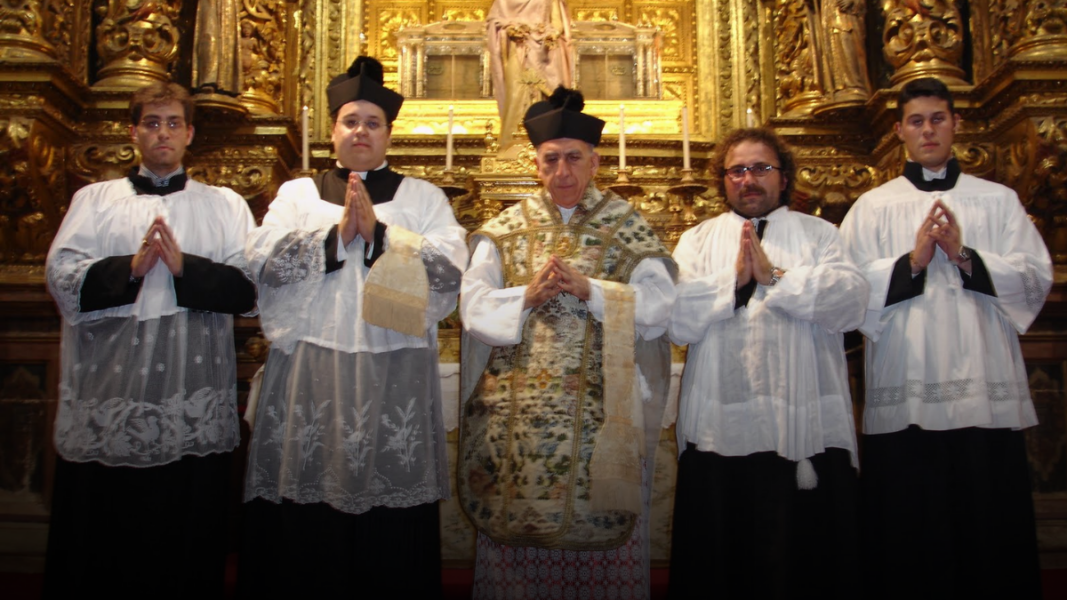
The Italian theologian and liturgist Monsignor Nicola Bux, former collaborator of Joseph Ratzinger and consultant to various Vatican dicasteries, has defended the need to recover the so-called “reform of the reform” promoted by Benedict XVI and has warned of the deep liturgical and doctrinal crisis that, in his opinion, the Church has been going through since the post-conciliar period.
In an interview granted to AdVaticanum, Bux argues that the current problems of the Church are not limited to a discussion between the traditional Mass and the rite reformed after the Second Vatican Council, but affect the very understanding of the liturgy and the sacred.
“The crisis of the liturgy and, therefore, of the Church, continues,” he states.
The Italian priest considers that after the post-Conciliar liturgical reform, a “pathological search for novelty” developed that ended up weakening the sense of mystery within ecclesial life. For this reason, he defends recovering traditional elements such as liturgical silence, Eucharistic adoration, kneeling communion, and celebration oriented toward the altar or the cross.
Hope in the face of Leo XIV’s gestures toward the traditional Mass
Bux also interprets as a positive sign the recent words and gestures of Leo XIV regarding the traditional liturgy, especially the letter sent to the French bishops requesting “generous” pastoral solutions for communities linked to the Mass in the ancient rite.
In the theologian’s opinion, the Pope seems to want to recover the approach promoted by Benedict XVI in Summorum Pontificum.
“What previous generations considered sacred remains sacred and great for us as well,” he recalls, quoting Benedict XVI.
The former Vatican consultant also rejects the idea that accepting the Second Vatican Council implies assuming without nuances the entire subsequent liturgical reform. As he explains, even Ratzinger acknowledged that certain concrete applications developed after the Council could be corrected or revised.
Criticism of the Priestly Fraternity of St. Pius X and current ecumenism
Asked about the Priestly Fraternity of St. Pius X, Bux acknowledges that many of the fears that arose after the post-conciliar crisis were understandable, although he considers that the group ended up developing a “museum-like” vision of Tradition by distancing itself from Rome.
“Where Peter is, there is the Church,” he maintains.
The Italian liturgist also criticizes some aspects of contemporary ecumenism, especially the message sent by the Pope to Sarah Mullally after her installation as Anglican Primate of Canterbury.
According to him, the ordination of women is incompatible with Catholic doctrine, and this type of gesture generates confusion among many faithful.
Read also: Mons. Bux asks the Vatican for clarification on the gestures toward Mullally
Crisis of vocations and loss of the sacred
Finally, Bux attributes the crisis of priestly vocations in the West to weakness in the transmission of the faith and the growing secularization of society.
He also questions the so-called “pastoral units,” promoted to reorganize parishes in the face of the shortage of priests, and laments the progressive loss of traditional references within liturgical and pastoral life.
For the Italian priest, the true renewal of the Church can only come through a deep recovery of the sense of the sacred.
“The rebirth of the sacred is the condition for the renewal of the Church,” he concludes.