


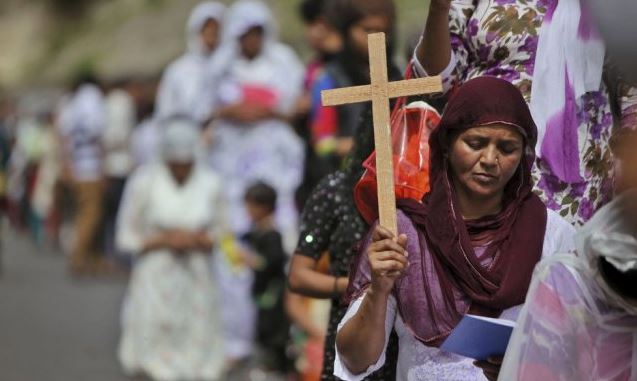
The pressure against Christians in India continues to increase. Four Catholics were arrested in the locality of Kalinjara, in the Banswara district, belonging to the diocese of Udaipur, in the state of Rajasthan, under accusations of “forced conversions”, according to local ecclesiastical authorities.
The incident occurred during a Catholic meeting attended by around 70 faithful. A group of activists linked to the Hindutva movement burst into the gathering accusing those present of conversion activities and illegal cow slaughter, triggering disturbances that ended with police intervention and the arrest of four Catholics.
“Being a Christian today poses great challenges”
In an interview granted to Crux, the bishop of Udaipur, Monsignor Devprasad Ganawa, strongly condemned what happened and denounced the climate of constant surveillance that Christians in the country suffer.
“A religious act was being peacefully celebrated, attended only by Catholic faithful. Today, being a Christian presents great challenges and many times we feel that we are under constant surveillance,” the prelate stated.
Ganawa also recalled that the Church continues to develop its educational, healthcare, and welfare work “without discrimination of castes or creeds”, insisting that Catholics remain committed to serving the entire Indian nation.
Reports of persecution against Christians are increasing
The arrests occur in a context marked by the tightening of anti-conversion laws in various states of India and by the increase in pressure from Hindu nationalist groups against Christian communities.
India has been governed since 2014 by the Bharatiya Janata Party (BJP), a formation closely linked to the Hindu nationalist movement Rashtriya Swayamsevak Sangh (RSS). Various affiliated organizations have promoted campaigns against alleged illegal conversions, routinely accusing Christians of using coercive or deceptive methods to evangelize, accusations that the Church systematically rejects.
The emeritus archbishop of Guwahati, Thomas Menamparampil, denounced that violence against Christians is becoming normalized with the connivance of the authorities.
“Our national leaders condone these episodes of violence,” he assured.
According to data from the Evangelical Fellowship of India (EFI), 747 verified incidents of hostility against Christians were recorded in 2025, compared to the 640 cases documented in 2024, reflecting a sustained increase in persecution.
Accusations against Hindu nationalism
Menamparampil was particularly critical of the role of the RSS and the Hindutva movement in the growing religious polarization of the country.
Although he acknowledged that the RSS does not directly practice violence in the style of the American Ku Klux Klan, he maintained that it does foster a climate of communal division that ends up leading to attacks against religious minorities.
“The RSS plants divisions between communities that lead to confrontations and victimization of minorities,” he stated.
The archbishop also denounced that nationalist youth groups are encouraged and prepared to act against Christians and Muslims, while those who participate in violent episodes are subsequently presented as “heroes”.
Concern after the BJP’s electoral victories
The Church’s concern has also increased following the BJP’s recent electoral victories in the states of West Bengal and Assam. Menamparampil fears that these results will further strengthen the restrictive policies promoted by Hindu nationalism.
The prelate warned that campaigns for “cow protection”, restrictions on meat consumption near Hindu temples, as well as new accusations of forced conversions could multiply.
In Assam, he recalled, certain Christian healing services are already prohibited by law. “We are waiting to see what the first decision of the new government will be,” he noted.
Despite everything, the archbishop called for avoiding direct confrontation and bet on social collaboration and joint work between religious communities.
“What we propose is not collision, but collaboration; not permanent struggle, but working together in shared social service,” he concluded.