


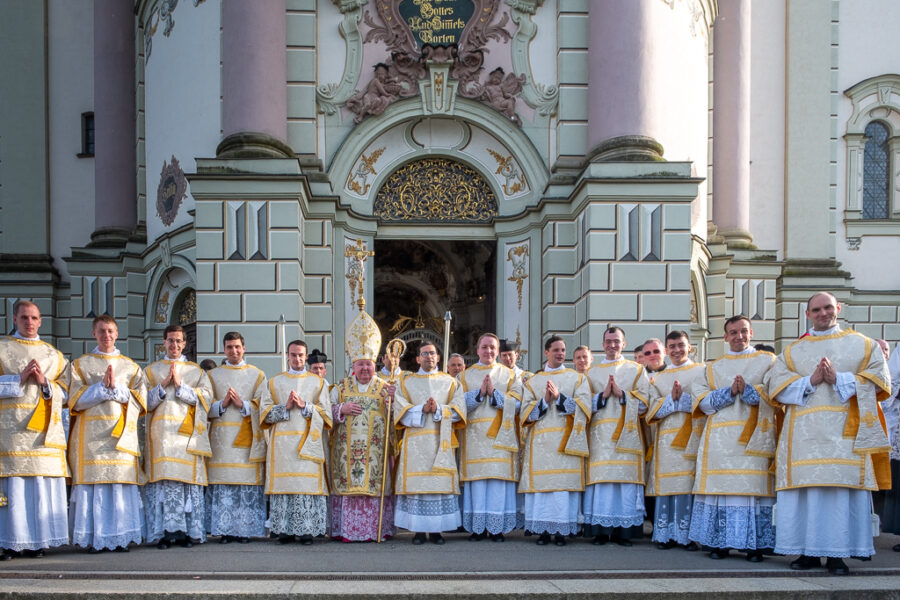
The Church is not primarily an institution that organizes itself, but a mystery that is transmitted; not a machine that functions, but a life that is given. Ecclesia de Eucharistia vivit: from what it receives and transmits.
On May 2nd, feast of Our Lady, Patroness of Bavaria – Maria duce! – in the majestic Benedictine Abbey of Ottobeuren, in Bavaria, at the Hour of Mercy the time seemed to expand and the sky allowed to see, through a window of eternity, the spousal caress of Jesus Christ to his Church.
Twelve young men from the Priestly Fraternity of Saint Peter —three Spaniards, one Mexican, one Portuguese, four Frenchmen, one Austrian, one German, one Englishman— received the sacred order of the diaconate.
Everything was fullness: the clear light of Bavaria, the green fields that surround the abbey like a humble and fertile mantle, the silence full of history of those walls, the arrival of families come from afar —fathers with contained tears, mothers with their mixture of proud joy and sacrificed offering, brothers who, perhaps distant from God, look on with astonishment and admiration—, the presence of more than a hundred seminarians, aligned like a living promise of continuity, and the gathered multitude of the faithful arrived from a thousand places, united by a same faith that needs no translation because it communes them in the incorruptible elegance of Latin, the virile and immortal sobriety of Gregorian chant, the stature of polyphony, the robust embrace of the organ notes rebounding in the vaults.
In the Pontifical Mass ad thronum —the most solemn possible—, with his cothurns, his maniple, his triple ornament signifying the fullness of the priesthood, the endearing and joyful figure of the emeritus Archbishop of Vaduz, Monsignor Wolfgang Haas, exuded a serene, almost transparent sacrality, as if in that man – may he live at least one more century! – the passage of years did not weigh, but, despite the corporeal, elevated. His way of celebrating, without haste, without emphasis, without protagonism, revealed something that is so missed today: the awareness of touching the holy. He did not invade or dominate the rite; he let himself be carried by it: Sacerdos magnus, qui in diebus suis placuit Deo (cf. Sir 44,16).
I had the impression—not aesthetic, but theological—that the very stone was in act of confession. Because in Ottobeuren everything ascends, everything sings, everything proclaims that God is worthy of being loved with the fullness of form: Domine, dilexi decorem domus tuæ! (Ps 25, 8). In the temple, majestic, with a beauty that was not ornament but epiphany, the Church, mother and teacher, returned to doing what she has done since the Apostles: beget ministers for the mystery.
In Ottobeuren, beauty was the language of a visible theology. Because the baroque, and the Bavarian is so much so!, does not distract from the mystery: it makes it patent, elevating without violence. Ad te levavi oculos meos (Ps 122,1). And in that context, the diaconate appeared in all its truth: service as elevation, humility as a form of glory, obedience as the path of that freedom with which those twelve young men pronounced their yes: Ecce venio ut faciam voluntatem tuam (Heb 10,9).
The Sacred Threshold of the Word
The traditional liturgy, which never speaks in vain, places the ordination of the deacon at a moment of silent eloquence: after the Epistle and before the Gospel. It is not a rubric; it is a theology: the deacon is born on the threshold of the Word.
When the bishop, seated, calls the candidates —Accedant qui ordinandi sunt ad Diaconatum—, he is opening a transmission. The Church receives them, examines them, presents them: Postulat Sancta Mater Ecclesia ut hos praesentes ad onus Diaconatus ordinetis. Then, men among men, those twelve young men, interweaving emotion and recollection in their eyes, took a step forward – adsum! – to be introduced into a region where life will no longer belong to them entirely, where existence is gently expropriated by a higher design.
And scarcely ordained, they received the gift: Accipe potestatem legendi Evangelium in Ecclesia Dei, tam pro vivis quam pro defunctis. A book was not given to them, but a Voice: the tremendous responsibility of being, not owners of the Word, but servants of it, not domesticating it: letting themselves be pierced by its edge. Non enim nosmetipsos praedicamus, sed Iesum Christum Dominum (2 Cor 4,5). They were, from that instant, men whose throat no longer belonged to them entirely: they had just given it to the Word.
That is why, scarcely ordained, one of the new deacons sang the Gospel. When his voice rose—young, firm and at the same time slightly trembling—the whole Church that returned to cry out like Paul with ancient freshness, the same eternal Word: Vae mihi si non evangelizavero! (1 Cor 9,16). When the young Portuguese, already vested as a deacon, intoned the Gospel, I had the impression that the entire ceremony found its meaning in that instant. For that they were ordained: so that Christ may continue speaking and His Word may continue burning. So that the Church may continue being what it is: a Voice that is not its own. Because, Verbum Dei non est alligatum (2 Tim 2,9).
Configured with Christ the Servant
Here is the mystery of a silent identity: the diaconate is not a psychological antechamber to the priesthood. It is a sacrament. Also a character, though it is pilgrimingly called «inchoative.» It is real configuration with Christ in his redemptive dimension as Servant. Filius hominis non venit ministrari, sed ministrare (Mt 20,28).
There is in this identity a hidden nobility, almost secret, but of immense force. The deacon does not consecrate, but stands by the Sacrifice; he does not absolve, but prepares the path of grace, like the rugged paths, festooned with wild and dancing crops, that do not preside in fullness, like a humble and necessary presence, lead to the bold baroque explosion of Ottobeuren.
It is the Levitical order. Ad ministerium altaris assumuntur. Like the tribe chosen to guard the sanctuary, the deacon is placed before the mystery with an attitude of sacral vigilance. Qui bene ministraverint, gradum sibi bonum acquirunt (1 Tim 3,13). Sed mundi estote qui fertis vasa Domini (Is 52,11). Is it moral exhortation or consequence of an ontological change? He who has been touched by the bishop’s hand, he who has received the Spirit in the consecratory prayer, can no longer live as if he did not carry something of the altar within him. Habemus thesaurum istum in vasis fictilibus (2 Cor 4,7). And that treasure, paradoxically, shines more the more it hides in the humility of service.
Laying on of Hands: God Takes Possession
There is a moment in the ordination when everything concentrates, gathers, and densifies: the laying on of the bishop’s hand super caput uniuscuiusque ordinandi… In that silence that does not break the contained breathing of the assembly, because it densifies it with the interior prayer of so many souls, God takes quiet and peaceful possession, loving and serene, transformative. Without spectacularity, without outward evidence, but with absolute efficacy. The Church has always known that something happens there that man cannot produce: the communication of the Spirit, the sacramental configuration, the seal. And the prayer that accompanies that gesture asks for it with words that pierce the centuries: Emitte in eos, quaesumus, Domine, Spiritum Sanctum, quo in opus ministerii fideliter exsequendum, septiformis gratiae tuae munere roborentur.
Afterward, the stole crossed over the chest, the dalmatic, protecting and solemnizing. The Church, wise, first imprints, then shows and vests. Induat te Dominus vestimento salutis (cf. Is 61,10).
Vocation and Mission: Well Done, Haas!
In his homily, brief, Mons. Wolfgang Haas told the new deacons that they were oriented toward an ecclesial vocation and an ecclesiastical mission. Two words, antidotes to dangerous and reductive institutionalisms. Being a family respected and loved by all those present, the ordaining prelate did not speak of the Fraternity of Saint Peter, but of a reality much broader, older and younger, which is the Church, in its two levels: mystery – ecclesial vocation – and institution – ecclesiastical mission -. Vocation: what is received; mission: what is given. Because the ecclesial vocation that transforms precedes the ecclesiastical mission that sends.
The deacon does not belong to himself; he has been called: Non vos me elegistis, sed ego elegi vos (Jn 15,16). Precisely for that reason he is sent: Sicut misit me Pater, et ego mitto vos (Jn 20,21). The Church does not grant him a space; it entrusts him with a service. It does not bestow a rank; it delivers a task.
In those twelve young men—looked upon with discreet pride by their families, sustained by the prayer of so many, accompanied by another hundred seminarians, intrepid promise of the Church—that mission acquires a particular tone: to guard the sacred fire of the liturgy, not as one who preserves a relic, but as one who keeps the hearth of light alive.
Guardians of the Sacred Fire
The liturgy is a living inheritance, a crackling bonfire of which the deacon is guardian. Ignem veni mittere in terram (Lc 12,49). He does not invent the fire; he does not possess it nor transform it at his whim: he receives it, guards it, and transmits it: O Timothee, depositum custodi (1 Tim 6,20).
In a dispersed era, where everything seems negotiable and revisable, the figure of the deacon is a call to concrete, humble, persevering fidelity; the one that makes no noise, but sustains the building, like the silent columns of Ottobeuren. Esto fidelis usque ad mortem (Ap 2,10). And that fidelity does not harden or cool: it warms the solar house, like the fire of the hearth.
The Sweetness of the Chalice: Honey for the Cross
There is, within the rite, a small, almost secret gesture, that goes unnoticed by those who do not know how to look, but that contains one of the most delicate metaphors of the entire ordination. After having communed the Body of Christ, on their knees and in the mouth, the new deacons drink from a chalice in which wine has been mixed with a few drops of honey. Seeing them—from my privileged place—perform such a tender ablution at the credence, one after another, I thought that the Church, so motherly, was giving them to taste in advance the entire mystery of their life.
The wine: the blood, the sacrifice, the giving, the harshness of the cross, the reality of an existence that will no longer be comfortable or self-referential, but poured out. Calicem salutaris accipiam (Ps 115, 13). The Lord’s chalice: glory and passion, that intoxicates and wounds, elevates and purifies. The honey: secret sweetness of Christ, softness of his Heart, hidden consolation that only He knows how to give to those who belong to Him. Quam dulcia faucibus meis eloquia tua! (Ps 118,103). It is the tenderness of God that does not suppress the cross, but inhabits it; and, without banishing the bitterness, transfigures it from within.
In that mixture of wine and honey I wanted to see enclosed the entire program of a diaconal life: bitterness and sweetness, Calvary and Tabor, solitude and consolation, stripping and joy. The Eucharistic Heart of Jesus told them, in the silence of the rite: “You will drink my chalice—potestis bibere calicem quem ego bibiturus sum? (Mt 20,22)—, but you will not drink it alone. I myself will sweeten it from within with my presence”.
It was a scene of immense theological tenderness: the deacon, who will live harshnesses and interior struggles, received a divine promise: the cross will not be bitter: it will be permeated by the sweetness of Christ; service will not be arid if it is soaked in charity; giving will not be sterile, grace will make it fruitful.
And so, while purifying the chalice, each deacon seemed to purify his own future life as well, already learning that everything in him must pass through that mystery: letting himself be emptied, filled, and transformed; being vessel, fire, offering.
I, in Ottobeuren, asked the Patrona Bavariæ, dulcis Virgo Maria, that She always sweeten all the bitterness that may appear in the lives of those twelve brave ones.