


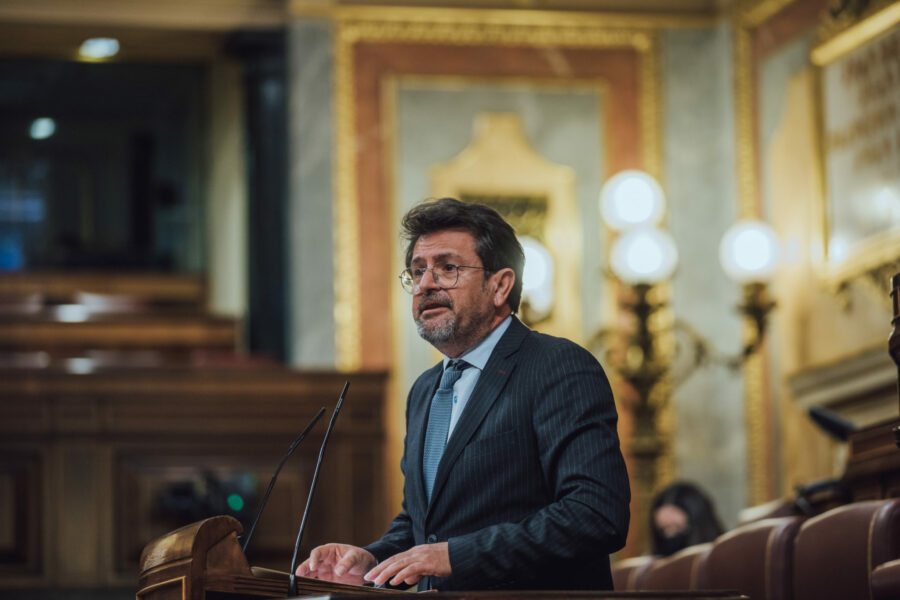
The VOX deputy for Murcia and national spokesperson for Education of the party, Joaquín Robles, starred in one of the most commented parliamentary episodes of the day this Thursday by stating from the Congress rostrum that his group would be “in agreement with a law of assumptions”. The phrase, pronounced during the debate on the motions of total amendment presented by PP and VOX against the reform of article 43 of the Constitution promoted by the Government to safeguard abortion, has been immediately picked up by much of the mainstream press as an “historic shift” of Santiago Abascal’s party.
El Español headlined a few hours later: “VOX supports for the first time an abortion law that includes assumptions”. The reading that has spread on social networks and talk shows is, essentially, that the party would have shifted toward a pragmatic position equivalent to the 1985 law, which decriminalized abortion in cases of rape, serious risk to the mother, or fetal malformation.
What Robles said, in its context
Robles’ intervention took place in a debate whose object was not a hypothetical future VOX abortion law, but rather the rejection of the constitutional reform of Pedro Sánchez’s Government, which seeks to elevate abortion to the category of fundamental right by embedding it in Title I of the Magna Carta. In that context, the deputy stated that “abortion practices are older than the black thread” and that “what cannot be is that abortion is considered a contraceptive method”, before adding the phrase that has generated the uproar.
VOX’s motion of total amendment, for its part, maintains a frontally pro-life language: it denounces that the reform “contravenes article 15 of the Constitution”, which “recognizes everyone’s right to life”, and that the Executive’s project “conceals, under the guise of rights to sexual and reproductive health, an attack on the dignity of the person”. Nothing in the text registered by the group points to a transaction with the current deadlines model or to a new internal doctrine.
The “Polish strategy”
Voices close to the party, as well as pro-life sectors that closely follow anti-abortion policy in Europe, have been explaining for years what the real strategy defended by VOX on this matter is, and it has little to do with supposed enthusiasm for the 1985 law. The approach follows the pattern of the so-called Polish strategy: in a country that for four decades has been acculturated by ideological propaganda favorable to free abortion, the first realistic step is not immediate criminalization —politically unfeasible and socially counterproductive—, but the repeal of the deadlines law and the transition to a law of assumptions strictly fulfilled, also eliminating the most questionable assumptions such as psychological risk or malformation, which in practice functions as a eugenic elimination route for children with Down syndrome and other conditions.
From that starting point, the battle is cultural before legal: progressively creating in Spanish society a culture in favor of life that allows, in successive legislative steps, to restrict the practice of abortion more and more as the propaganda of the last decades is countered. It is the logic of pro-life gradualism that countries like Poland or, on another scale, Hungary have followed —with notable results—.
Saying that VOX is “in favor” of an assumptions law in the sense in which some media title it is, therefore, a biased reading. As deputy Robles himself explained upon leaving the hemicycle, the party is “in agreement” with an assumptions law insofar as it is a means to reduce the number of abortions and facilitate a progression toward a society in which abortion is unnecessary and absent. That is a substantially different position —and much more coherent with the pro-life tradition— than the one suggested by the headlines.
The problem, then, is one of communication
Which does not exempt the deputy from criticism. Robles, without being spokesperson on Life or Family matters, addressed from the rostrum an issue of extraordinary doctrinal and strategic sensitivity, and did so with a formulation that has allowed headlining against the party. Defending an assumptions law against free abortion as if it were a good in itself —and not as a step in a broader pro-life strategy— is a communication error that the party’s political and media adversaries exploit effectively.
The legitimate criticism of VOX on life protection matters —and it exists— goes another way. During the 2023-2024 period, wherever it had executive capacity in regional governments, the party went so far as to promote concrete life protection measures —such as the well-known case of the pro-life booklet in Castilla y León—, but encountered an overwhelming media front, in which even formally allied media like COPE joined the lynching, leaving those attempts politically deactivated. There is, however, a second opportunity underway. In Aragón, the recent agreement with Jorge Azcón’s PP has placed the Department of Social Welfare and Family in VOX’s hands, with the rank of first vice presidency; and in Extremadura, the pact with María Guardiola has given it competencies in related areas. It remains to be seen what VOX achieves from those portfolios in the remainder of the legislature: there, and not in an unfortunate phrase from the Congress rostrum, its pro-life commitment will truly be measured.
What is really at stake
While the press entertains itself with VOX’s supposed change of position, the relevant political fact of the day is another: Congress has rejected the motions of total amendment from PP and VOX (171 votes in favor, 177 against), but the Government’s constitutional reform does not have the necessary three-fifths to prosper. PNV, Junts, and Podemos have joined the criticisms, and the project is, in the words of several analysts, doomed to failure after the Andalusian elections. Sánchez has opened a constitutional debate that he cannot win, amid a judicial offensive on the Ábalos case, and with abortion turned —once again— into a smokescreen.