


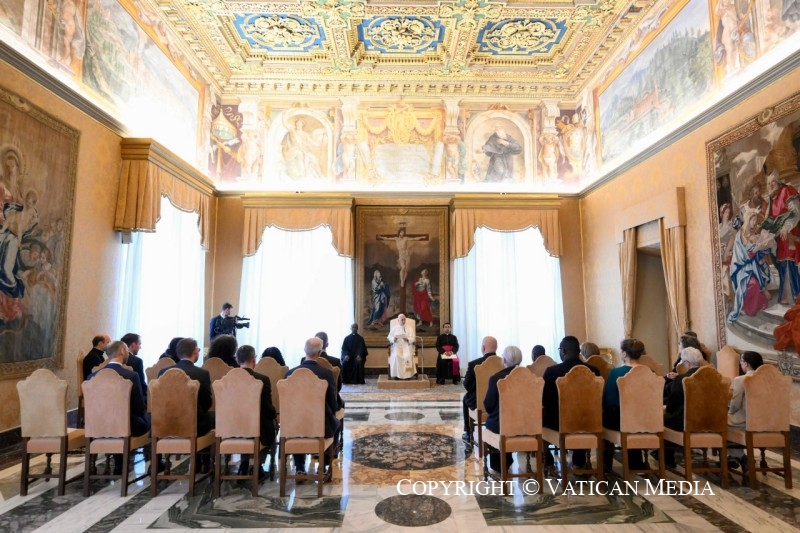
Pope Leo XIV received this Wednesday in audience at the Apostolic Palace a delegation from “Weltkirche & Dialog”, an organization of the Archdiocese of Cologne for the universal Church and dialogue, on the occasion of the 50th anniversary of its foundation. The meeting, held during the Easter season, was marked by a double axis: the promotion of dialogue in the Church and thanks for the contribution of the German Church in sustaining the Catholic mission worldwide.
“This is an opportune occasion to reflect on the universality of the Church and on the importance of dialogue,” affirmed the Pontiff, emphasizing that the Church is called to proclaim the Gospel “not by imposing itself, but by bearing witness to the truth in charity”.
Cologne, economic powerhouse of the universal Church
The delegation came from the Archdiocese of Cologne, governed by Cardinal Rainer Maria Woelki, considered one of the most critical voices within the German episcopate regarding the controversial “Synodal Way”.
Read also: Woelki: «For me, the Synodal Way is closed»
Cologne not only stands out for its ecclesiastical weight, but also for its economic capacity. It is considered the richest diocese in Germany and one of the richest in the world, with a financial structure that allows it to sustain a significant part of the Church’s missionary action.
Through “Weltkirche & Dialog”, the archdiocese channels aid on a global scale. According to its 2024 report, it managed 2,747 requests from 104 countries and approved 608 projects for a total value of 66 million euros. Of these, 21.3 million were contributed directly by the diocese to support 379 ecclesiastical circumscriptions.
The destination of these funds reflects a clear missionary projection: 42% went to Asia, 33% to Africa, and 16% to Latin America, with special attention to the construction of churches, seminaries, and pastoral centers, as well as social and health projects.
The Pope’s thanks: a Church that supports other Churches
Leo XIV highlighted that, through this type of initiative, “the universal dimension of the Church is made visible and concrete,” fostering solidarity among communities and strengthening bonds of unity.
The Pontiff explicitly thanked the impact of these aids, even recalling his own experience in Peru: “When I was bishop in Chiclayo, the Archdiocese of Cologne gave strong support to many initiatives, even helping to acquire machines that generated oxygen and saved the lives of many people. And people are still grateful for that support today”.
Dialogue, unity, and mission
In his speech, Leo XIV insisted on the value of dialogue as an instrument in the service of unity: “Dialogue strengthens communion, opens paths of understanding, and serves the cause of peace”.
At the same time, he emphasized that this openness cannot be detached from the Church’s identity: “In the light of Christ’s Resurrection, the Church recognizes itself as sent to all peoples,” in a mission centered on the proclamation of the Gospel.
“The Risen Christ draws all to himself and makes the Church a sign of unity and hope for the world,” he added.
Support for persecuted Christians
The Pope also focused on the situation of Christians in contexts of persecution or war, recalling that “many of our Christian brothers and sisters have been forced to leave their countries because of violence, poverty, and conflicts”.
In this regard, he asked to continue supporting these communities, with special mention of the Middle East: “I ask you in particular to continue sustaining the presence of Christians in the Middle East, so that those venerable traditions can be preserved and known”.