


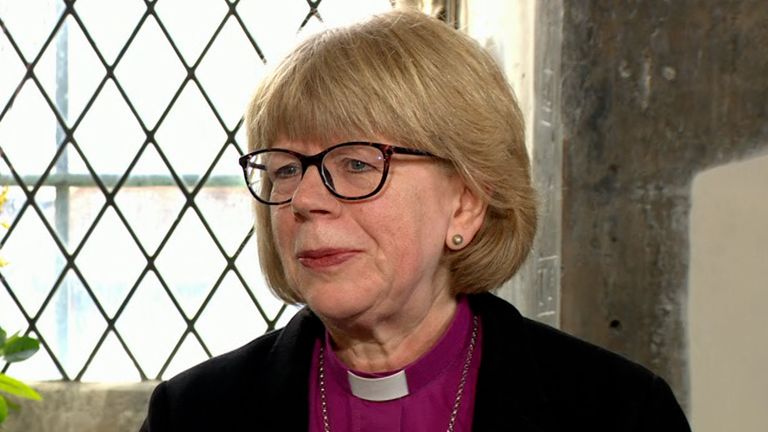
The Primate of the Anglican Communion, Sarah Mullally, avoided clarifying whether female priesthood was addressed in her recent meeting with Pope Leo XIV, one of the most evident doctrinal differences between the Catholic Church and the Anglican Church.
Asked directly in a subsequent interview covered by APT, Mullally responded in general terms, without confirming whether the topic was addressed. “Above all, I am a spiritual leader,” she stated, emphasizing that her mission is to offer hope and, on occasions, to speak out against situations she considers unjust, although she insisted that she does not act as a political figure. “What I hope is to offer hope to those in difficulty and, on occasions, to speak when there is injustice, but to do so in a clearly pastoral and spiritually grounded manner,” she added.
A language of unity without content
Mullally insisted on presenting the meeting as a “significant” moment within the path of dialogue between both Churches, focused on prayer and the search for unity. However, she offered no details on specific doctrinal issues or on the points of divergence that continue to separate both confessions.
This absence is not minor. The issue of the priesthood—and in particular the ordination of women—is not a secondary aspect of the dialogue, but one of its doctrinal cores.
Gestures that generate the opposite impression
Despite this, Mullally’s visit to the Vatican was marked by gestures of closeness: she was received with honors, participated in a moment of prayer with the Pope, and had a meeting described as “very warm”.
However, in the face of specific questions, her responses remained in the same evasive register. She avoided pronouncing on female priesthood, eluded positioning herself on political issues, and limited herself to highlighting secondary aspects of the meeting, such as the gifts delivered—a book by Newman, a Peruvian icon, and a jar of honey—or the invitation to the Pope to visit the United Kingdom.
The risk of a unity without clarity
Pope Leo XIV himself warned that it would be “a scandal” to stop working for unity among Christians, recalling the path traveled in ecumenical dialogue since the 20th century. The Pontiff pointed out that, along with the advances achieved, “new problems” have appeared that complicate the path toward full communion between both confessions. However, he also gave no further details on the matter.
The tradition of the Church adds an inseparable requirement: unity can only be sustained on truth.
When responses like public interventions avoid specifying the content of the dialogue, the result is an imprecise message. Unity is presented as a goal, but without clarity on the points that make it possible or impossible.
In that context, the combination of visible gestures, absence of doctrinal detail, and responses that are not very concrete and evasive from both sides not only does not dispel the differences, but accentuates the confusion. And that confusion—by diluting issues defined by the Church—ends up generating a more problematic effect than the very divisions it seeks to overcome.