


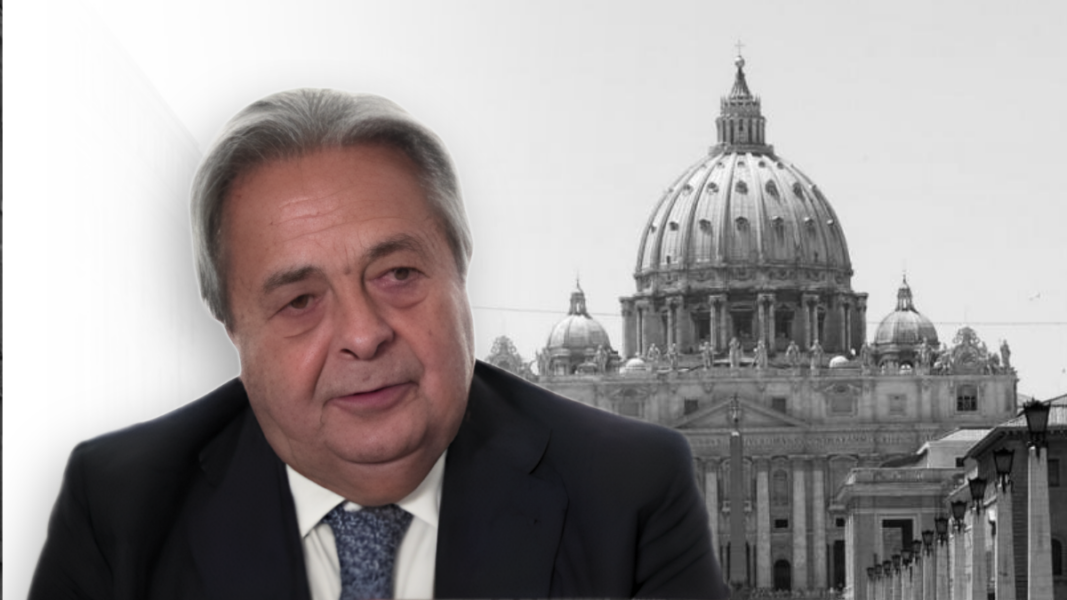
The so-called “trial of the century” in the Vatican adds a new international setback. The Swiss federal prosecutor’s office has archived the criminal proceedings against financier Enrico Crasso, former advisor to the Secretariat of State, due to a lack of evidence of wrongdoing in the management of the Centurion fund. The decision, known on April 28, not only closes the Swiss front but also questions at its root the narrative sustained by the Vatican for years.
According to Il Giornale, prosecutor Annina Scherrer found no evidence of fraud or corruption, thus dismantling the accusations presented in 2020 by the Secretariat of State itself.
From key advisor to accused in the “trial of the century”
Crasso is not a minor figure. For over a decade, he was one of the main financial managers of the Vatican, operating through his company Sogenel Capital Investment and managing large-volume investments.
His name became linked to the scandal of the Sloane Avenue building in London, an operation that involved around 350 million euros from the Holy See and led to estimated losses of at least 139 million. For his role in that operation, he was sentenced in December 2023 to seven years in prison for embezzlement and self-laundering in the Vatican court.
However, even in that sentence, he was acquitted of all charges related to the Centurion fund, the same one now analyzed by Swiss justice and which has been completely archived.
Switzerland disavows the Vatican’s thesis
In her decree, prosecutor Scherrer states that the Vatican body must be considered an “expert investor,” with sufficient resources, advice, and decision-making capacity to understand the financial operations in which it participated. This conclusion dismantles the idea that Crasso had deceived the Vatican.
Additionally, the Prosecutor’s Office found no indications that the financier acted against the interests of the Holy See in the management of the fund, further weakening the original accusation.
A whistleblower who obstructs the investigation
The archiving of the case not only responds to the lack of evidence but also to the contradictory behavior of the Vatican itself.
Despite being the complaining party, the Secretariat of State refused to fully collaborate with Swiss justice. In particular, it blocked the possibility of questioning key witnesses through letters rogatory, including Monsignor Alberto Perlasca, a central figure in the Vatican process.
This behavior was expressly pointed out by the Swiss prosecutor, who highlighted the inconsistency of denouncing and, at the same time, impeding the development of the investigation.
A Vatican process in crisis
The Swiss decision arrives at a moment of tension for the Becciu case. In March 2026, the Vatican Court of Appeal declared the relative nullity of the first-instance trial, in an unprecedented resolution that questions the validity of the procedure.
Read also: The Becciu case collapses: the Vatican annuls the trial and forces to start from scratch
The court detected serious irregularities, such as the partial concealment of evidence from the defense and the existence of secret papal decrees that expanded the prosecutor’s powers without sufficient legal backing.
To this are added doubts about the impartiality of the prosecution, after thousands of messages were revealed pointing to possible manipulation of the main witness’s testimony in the case.
Crasso, in the most favorable position from the start
With the archiving in Switzerland and the partial nullity of the trial in the Vatican, Crasso’s procedural situation has changed significantly.
His conviction remains formally in force, but it is not executive and will have to be reviewed in a new trial that will begin on June 22, 2026. In that process, the defense will be able to use documentation that was previously inaccessible.
Additionally, the most serious charges have already been dismissed in the international sphere, while the key testimony of the prosecution is under suspicion.