


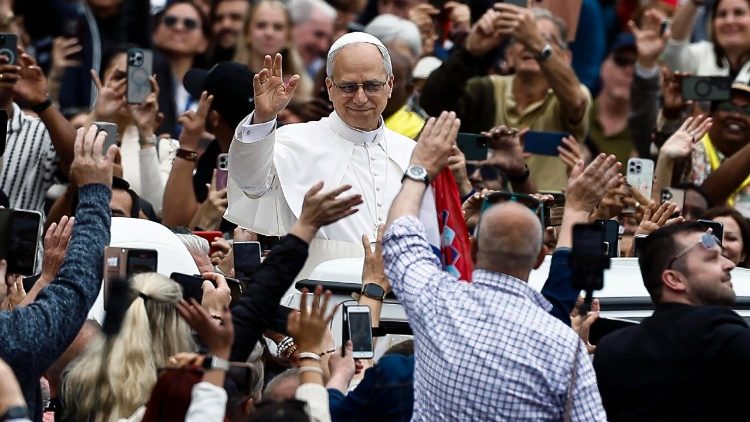
After his apostolic journey through Africa, Pope Leo XIV resumed the general audiences in St. Peter’s Square this Wednesday, centering his intervention on the pastoral and political significance of his visit to Algeria, Cameroon, Angola, and Equatorial Guinea. The Pontiff presented the trip as a “message of peace” in an international context marked by wars and violations of international law, highlighting the witness of African communities as a sign of hope in the face of the failed promises of the powerful and ideologies that do not respond to the real needs of peoples.
Here below are the words of Leo XIV:
Dear brothers and sisters, good morning and welcome!
Today I wish to speak about the apostolic journey I made from April 13 to 23, visiting four African countries: Algeria, Cameroon, Angola, and Equatorial Guinea.
From the beginning of my pontificate, I had thought about a trip to Africa. I give thanks to the Lord, who has allowed me to carry it out as a Pastor to visit and encourage the people of God, and to live it as a message of peace in a historical moment marked by wars and grave and frequent violations of international law. I express my most sincere gratitude to the bishops and civil authorities who welcomed me, as well as to all those who collaborated in the organization.
Providence willed that the first stop be precisely the country where the places of St. Augustine are found, that is, Algeria. Thus, on the one hand, I was able to begin from the roots of my spiritual identity; and, on the other hand, it was possible for me to cross and consolidate very important bridges for the world and the Church of today: the bridge with the extraordinarily fruitful era of the Church Fathers; the bridge with the Islamic world; the bridge with the African continent.
In Algeria, I received a welcome not only respectful but also cordial, and we were able to witness firsthand and show the world that it is possible to live together as brothers and sisters, even of different religions, when we recognize ourselves as children of the same merciful Father. Likewise, it was a propitious occasion to enter the school of St. Augustine: with his life experience, his writings, and his spirituality, he is a master in the search for God and for truth. His witness is of great importance today for Christians and for any person.
In the following three countries I visited, the population is, on the other hand, predominantly Christian, and therefore I immersed myself in an atmosphere of festivity of the faith, of warm welcome, favored also by the typical character of African people. Like my predecessors, I too experienced a little of what happened to Jesus with the crowds of Galilee: He saw them thirsty and hungry for justice, and He proclaimed to them: “Blessed are the poor in spirit, blessed are the meek, blessed are those who work for peace…” And recognizing their faith, He said: “You are the salt of the earth and the light of the world” (cf. Mt 5,1-16).
The visit to Cameroon allowed me to reinforce the call to commit ourselves together to reconciliation and peace, because this country too, unfortunately, is marked by tensions and violence. I am glad to have gone to Bamenda, in the Anglophone region, where I encouraged working together for peace. Cameroon is called “Africa in miniature,” in reference to the variety and richness of its nature and resources; but we can also understand this expression in the sense that in Cameroon we find the great needs of the entire African continent: the need for an equitable distribution of wealth; to give space to young people, overcoming endemic corruption; to promote integral and sustainable development, opposing the various forms of neocolonialism with international cooperation that has a vision for the future. I thank the Church in Cameroon and the entire Cameroonian people, who welcomed me with so much love; and I pray that the spirit of unity that was manifested during my visit may remain alive and guide future decisions and actions.
The third stop of the journey was Angola, a large country south of the equator, with a multi-secular Christian tradition linked to Portuguese colonization. Like many African countries, after achieving independence, Angola went through a difficult period, which in its case was bloodied by a long internal war. In the crucible of this history, God has guided and purified the Church, making it ever more oriented toward the service of the Gospel, human promotion, reconciliation, and peace. A free Church for a free people! In the Marian shrine of Mamã Muxima – which means “Mother of the heart” – I felt the heartbeat of the Angolan people. And in the various events, I saw with joy many religious sisters and brothers of all ages, a prophecy of the Kingdom of Heaven in the midst of their people; I saw catechists who dedicate themselves entirely to the good of the community; I saw faces of elders sculpted by hardships and sufferings, and who reflect the joy of the Gospel; I saw women and men dancing to the rhythm of songs of praise to the Risen Lord, the foundation of a hope that withstands the disappointments caused by ideologies and the vain promises of the powerful.
This hope demands concrete commitment, and the Church has the responsibility, with witness and the courageous proclamation of the Word of God, to recognize the rights of all and to promote their effective respect. I was able to assure the Angolan civil authorities, and also those of the other countries, of the Catholic Church’s willingness to continue offering this contribution, especially in the health and educational fields.
The last country I visited is Equatorial Guinea, on the 170th anniversary of the first evangelization. With the wisdom of tradition and in the light of Christ, the Guinean people has gone through the events of its history, and, in recent days, in the presence of the Pope, has renewed with great enthusiasm its will to walk united toward a future of hope.
I cannot forget what happened in Bata prison, in Equatorial Guinea: the inmates sang at the top of their lungs a song of thanksgiving to God and to the Pope, asking him to pray “for their sins and their freedom.” I had never seen anything like it. And then they prayed the Our Father with me, under a torrential rain. A true sign of the Kingdom of God! And, still under the rain, the great meeting with youth began at the Bata stadium. A festival of Christian joy, with moving testimonies from young people who have found in the Gospel the path to free and responsible growth. This festival culminated in the Eucharistic celebration of the following day, which worthily crowned the visit to Equatorial Guinea and the entire apostolic journey.
Dear brothers and sisters, the Pope’s visit is, for the African populations, an opportunity to make their voices heard, to express the joy of being the people of God and the hope in a better future, of dignity for each one and for all. I am glad to have given them this opportunity, and, at the same time, I thank the Lord for what they have given me: an inestimable wealth for my heart and my ministry.