


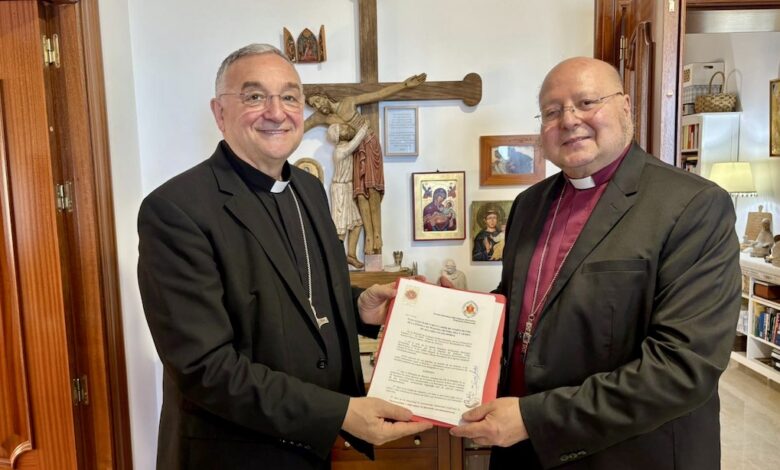
The Diocese of Almería has signed an agreement that will allow the Spanish Reformed Episcopal Church (Anglican Communion) to use the hermitage of Our Lady of Carmen, located in Aguadulce, as a stable place of worship. The agreement has been signed by the Bishop of Almería, Antonio Gómez Cantero, along with the president bishop of this community, Carlos López Lozano.
According to the same diocese, at the signing ceremony, held in a context of institutional collaboration, the deacon Carlos Romero, responsible for the Anglican community in the province, and the director of the Episcopal Delegation for Ecumenism, José Antonio Díaz Alonso, were also present.
A historical space with its own identity
The hermitage of Our Lady of Carmen is not a recent or secondary building. It is one of the oldest temples in Aguadulce, linked to the development of the urban center since the late 19th century and for decades the main center of religious life in the area, before the creation of the current parish. Its history is closely tied to the devotion to the Virgin of Carmen, patron saint of the locality.
The agreement in an ecumenical key
From the diocese, this step is framed within the promotion of ecumenical dialogue and the willingness to collaborate between Christian confessions. In this sense, the agreement seeks to facilitate coexistence and offer a stable space to a community present in the territory.
The statement recounts that until now, the Anglican community had been meeting provisionally in the parish of San Luis Gonzaga, so thanks to this agreement, it now has a stable space for the celebration of its religious services in Aguadulce, which represents a significant change in its local presence.
A decision with canonical implications
In this context, the initiative of the Diocese of Almería is situated within the framework of ecumenical dialogue, but it must also be interpreted in light of the Church’s own regulations on sacred places. The Code of Canon Law states that:
«In a sacred place, only those things that favor the exercise and promotion of worship, piety, and religion may be admitted, and anything that is not in keeping with the holiness of the place is prohibited. However, the Ordinary may permit other uses in specific cases, provided they are not contrary to the holiness of the place.» (c. 1210).
For its part, the Directory for the Application of Principles and Norms on Ecumenism (1993) provides for the possibility that other Christian communities use Catholic temples, but it does so in specific terms and under certain conditions, such as the bishop’s authorization and the existence of a justified cause.
In this sense, the stable use of a consecrated space for non-Catholic celebrations introduces an element that, beyond the agreement reached, places this type of initiative in a realm that requires careful evaluation within ecclesial practice.