


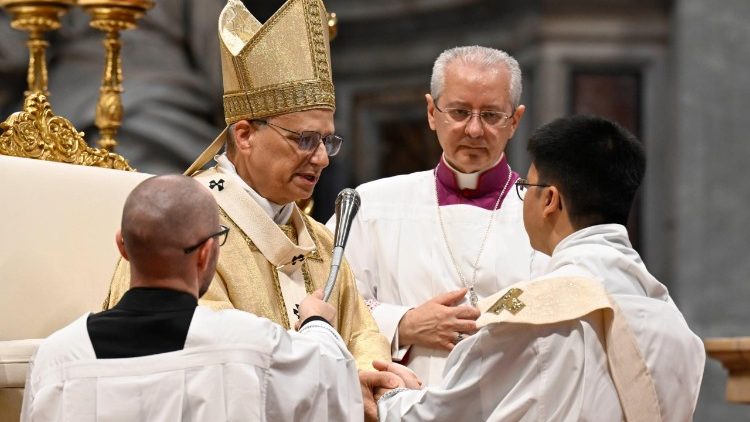
Pope Leo XIV presided this Sunday in St. Peter’s Basilica over the Mass with presbyteral ordinations, in which several deacons received the sacrament of Holy Orders, at a particularly significant moment for the Church marked by the shortage of vocations in Europe. In his homily, the Pontiff outlined a clear profile of the priest: a man of communion, unafraid of reality, called to keep the Church’s “door open” and to be—in his own words—“a channel and not a filter” in the transmission of the faith.
We now leave below the complete homily of Leo XIV:
Dear brothers and sisters:
With this greeting, I address in particular those who have just been presented and who will receive presbyteral ordination; also their families, the priests of Rome—many of whom remember their ordination on this fourth Sunday of Easter—and all those present here.
This is a Sunday full of life! Although death surrounds us, Jesus’ promise is already being fulfilled: “I have come that the sheep may have life, and have it abundantly” (Jn 10,10). In the availability of the young people whom the Church today asks to be ordained presbyters, we see much generosity and enthusiasm. As we gather, so numerous and diverse, around the one Master, we perceive a force that renews us. It is the Holy Spirit, who unites persons and vocations in freedom, so that no one lives any longer for himself. Sunday—every Sunday—calls us to leave the “tomb” of isolation and closure to meet in the garden of communion, of which the Risen One is the guardian.
The service of the priest, to which the call of these brothers invites us to reflect, is a ministry of communion. In fact, “life in abundance” comes to us in the most personal encounter with the person of the Son, but immediately opens our eyes to a people of brothers and sisters who already experience, or are still seeking, the “power to become children of God” (Jn 1,12). This is the first secret in the life of the priest. Dear ordinands, the deeper your union with Christ, the more radical your belonging to the common humanity. There is no opposition, nor competition between heaven and earth; in Jesus they are united forever. This living and dynamic mystery commits the heart to an indissoluble love; it commits it and fills it. Certainly, like the love of spouses, the love that inspires celibacy for the Kingdom of God must also be cared for and renewed always, because every true affection matures and becomes fruitful over time. You are called to a specific, delicate, and difficult way of loving, and even more, to a way of allowing yourselves to be loved in freedom. A way that will make you not only good priests, but also honest citizens, available, builders of peace and social friendship.
In this regard, in the Gospel we have just proclaimed (Jn 10,1-10), Jesus’ reference to figures and gestures of aggression surprises: between him and those he loves, strangers, thieves, and bandits burst in who exceed the limits; they do not come, says Jesus, “except to steal, kill, and destroy” (v. 10) and, above all, they have a voice different from his, unrecognizable (cf. v. 5). There is great realism in the Lord’s words: he knows the cruelty of the world in which he walks with us. With his words, he evokes forms of physical aggression, but above all spiritual. However, this does not dissuade him from giving his life. The denunciation does not become renunciation, the danger does not lead to flight. This is a second secret of the priest: reality must not frighten us. The one who calls us is the Lord of life. May the ministry entrusted to you, dear brothers, communicate the peace of the one who, even in the midst of dangers, knows why he feels secure.
Today the need for security makes spirits aggressive, encloses communities in themselves, incites the search for enemies and scapegoats. There is often fear around us and perhaps also within us. May your security not reside in the role you perform, but in the life, death, and resurrection of Jesus, in the history of salvation in which you participate with your people. It is a salvation that already acts in so much good that is done silently, among people of good will, in parishes and in the environments to which you will draw near, as fellow travelers. What you announce and celebrate will also protect you in difficult situations and times.
The communities to which you will be sent are places where the Risen One is already present, where many have already followed him in an exemplary way. You will recognize his wounds, distinguish his voice, find those who will point him out to you. They are communities that will also help you to be saints. And you help them to walk united in following Jesus, the Good Shepherd, so that they may be places—gardens—of life that is reborn and communicated. Often, what people lack is a place to experience that together is better, that together is beautiful, that it is possible to live together. Facilitating encounter, helping to gather with those who would otherwise never meet, and bringing opposites closer is intimately united to the celebration of the Eucharist and Reconciliation. Gathering is, always and anew, establishing the Church.
A significant image in the Gospel with which Jesus, at a certain point, begins to speak of himself is noteworthy. He was describing himself as the “shepherd,” but it seems that those listening to him do not understand; then, he changes the metaphor: “Truly, I say to you, I am the door of the sheep” (Jn 10,7). In Jerusalem there was a door called precisely that, “the door of the sheep,” near the pool of Bethesda. Through it the sheep and lambs entered the temple, before being immersed in the water and then destined for sacrifices. It is spontaneous to think of Baptism.
“I am the door,” says Jesus. The Jubilee has shown us how this image still speaks to the hearts of millions of people. For centuries the door—often a true portal—has invited crossing the threshold of the Church. In some cases, the baptismal font was built outside, like the ancient pool of Bethesda, under whose porticos “lay a multitude of invalids, blind, lame, and paralyzed” (Jn 5,3). Dear ordinands, feel part of this suffering humanity that awaits life in abundance. By initiating others into the faith, you will rekindle your own faith. Together with the other baptized, you will cross every day the threshold of the Mystery, that threshold which has the face and name of Jesus. Never hide this holy door, do not close it, do not be an obstacle to the one who wants to enter. “You yourselves did not enter, and you prevented those who wanted to enter” (Lc 11,52): it is Jesus’ bitter reproach to those who hid the key to a passage that should be accessible to all.
Today more than ever, especially when numbers seem to mark a distance between people and the Church, keep the door open! Let them enter and be ready to go out. This is another secret for your lives: you are a channel, not a filter. Many believe they already know what is behind that threshold. They carry memories with them, perhaps from a distant past; often there is something alive that has not gone out and that attracts them; but other times there is something more, that still bleeds and provokes rejection. The Lord knows it and waits. Be a reflection of his patience and tenderness. You are for all and of all! May this be the fundamental profile of your mission: to keep the threshold free and point it out, without need for many words.
On the other hand, Jesus insists and specifies: “I am the door. Whoever enters through me will be saved; he will go in and out and find pasture” (Jn 10,9). He does not stifle our freedom. There are affiliations that suffocate, companies where it is easy to enter and almost impossible to leave. The Church of the Lord is not like that, nor is the company of his disciples. Whoever is saved, says Jesus, “goes in and out and finds pasture.” We all seek protection, rest, and care: the door of the Church is open. Not to detach ourselves from life; life is not exhausted in the parish, in the association, in the movement, or in the group. Whoever is saved “goes out and finds pasture.”
Dear brothers, go out and meet culture, people, life. Admire what God makes grow without our having sown it. Those for whom you will be priests—lay faithful and families, young and elderly, children and the sick—inhabit meadows that you must know. Sometimes it may seem to you that you do not have the maps; but the Good Shepherd has them, whose voice you must listen to, so familiar. How many people today feel lost! To many it seems they can no longer find their way. There is then no more beautiful witness than that of the one who trusts: “He makes me lie down in green pastures, he leads me beside still waters, he restores my soul; he leads me in paths of righteousness for his name’s sake” (Sal 23,2-3). His name is Jesus, “God saves.” You are witnesses to this. “Surely goodness and mercy shall follow me all the days of my life” (v. 6). Brothers, sisters, dear young people: may it be so!