


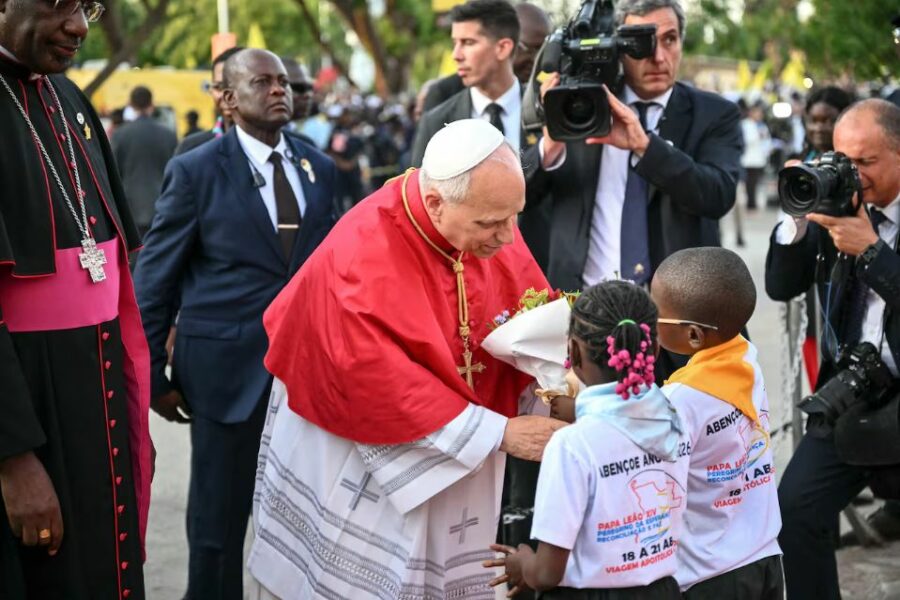
Pope Leo XIV landed this April 21 in Malabo, the capital of Equatorial Guinea, after departing from Luanda, in Angola, which constitutes the final stage of his first apostolic journey to Africa as pontiff.
Arrival in Malabo after departure from Angola
The Pontiff took off at 9:19 from Luanda International Airport, after the official farewell ceremony with the Angolan president, João Manuel Gonçalves Lourenço. The flight concluded at 11:31 local time, with his arrival in Malabo.
After leaving Angola, Leo XIV sent a telegram of thanks to the country’s president, highlighting the welcome received and assuring his prayers for the nation. During the journey, he also sent messages to the heads of state of the Republic of the Congo, Gabon, and Cameroon.
A deeply Catholic country with Hispanic heritage
Equatorial Guinea is the only African country with Spanish as the official language, a result of its colonial past, and it has a strong Catholic identity. Around 75% of the population is baptized, and the Church plays a central role in education, healthcare, and social life.
The ecclesial structure, headed by the Archdiocese of Malabo and several suffragan dioceses, has evolved in recent decades toward local leadership, after a long period marked by missionary presence.
This is only the second visit by a Pope to the country, after the one made by Saint John Paul II in 1982.
A political and social context that marks the visit
The Pope’s arrival takes place in a country governed since 1979 by Teodoro Obiang Nguema Mbasogo, one of the world’s longest-serving heads of state.
The discovery of oil in the 1990s transformed the economy, which today depends heavily on this resource, responsible for a large part of the country’s exports. However, this wealth has not translated into a generalized improvement in living conditions: more than half of the population lives in poverty.
Various international organizations and human rights groups have denounced for years problems of corruption, inequality, and limitations in the political and social spheres.
The Church in a complex environment
In this context, the Catholic Church maintains a significant presence, both in religious life and in the social sphere. Its work in education, healthcare, and assistance makes it one of the most visible institutions in the country.
Relations between the Holy See and the State have been stable, although pastoral action develops in an environment marked by structural tensions.
From the Vatican, it is emphasized that the Church’s mission in these contexts involves proclaiming the Gospel and defending human dignity, social justice, and the common good.
During this trip, Leo XIV has already addressed these issues. In Cameroon, last week, he stated before the authorities that “the chains of corruption, which disfigure authority and deprive it of credibility, must be broken”.
Pope’s Agenda in Equatorial Guinea
During his stay, the Pontiff will meet with President Obiang and deliver speeches before civil authorities, diplomats, and representatives from the academic field.
Additionally, he will celebrate liturgical acts, visit a psychiatric hospital and a prison, and hold meetings with young people and families.
Before concluding his visit, he is scheduled to pray at a memorial dedicated to the victims of the explosion that occurred in 2021 at a military barracks in Bata, which caused more than a hundred deaths. With this last event in Equatorial Guinea, Leo XIV will close the apostolic journey that has included Algeria, Cameroon, and Angola.