


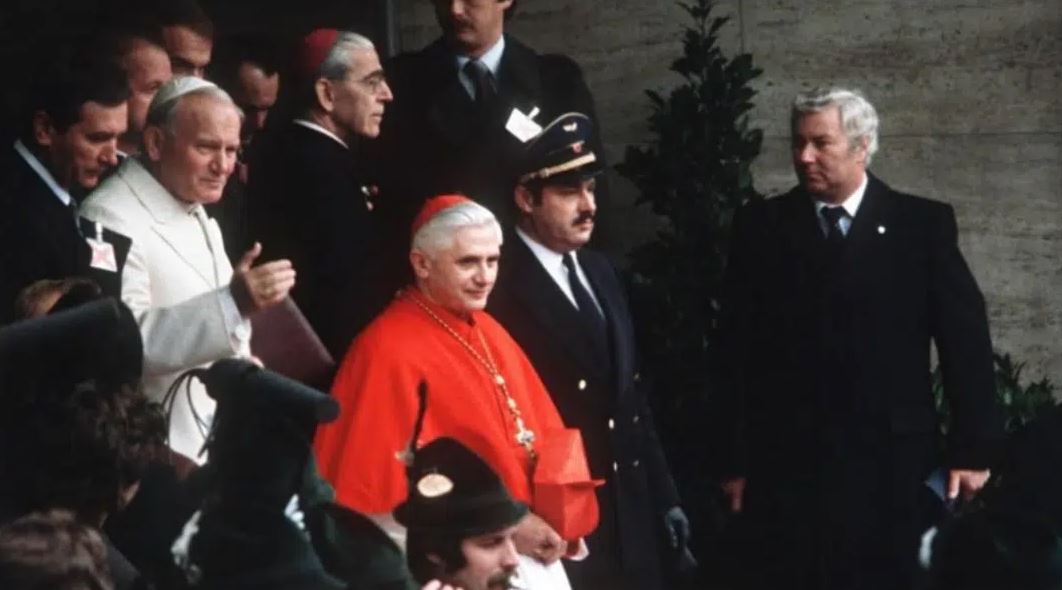
On the anniversary of the election of Joseph Ratzinger as Benedict XVI, which took place 21 years ago on April 19, we republish the following article (08.10.2025) from a Formerly Perplexed Catholic.
A good priest friend recommended the book by Dr. Peter Kwasniewski “Resurgence Amid Crisis: Sacred Liturgy, Traditional Mass, and Renewal in the Church” to me a few years ago. My priest friend knew that my return to the Catholic Church years earlier had gone hand in hand with Pope Benedict XVI, basically because of his defense of the truth, his theological depth, and his denunciation of the drift of the West.
He also knew that I not only did not fully understand what Summorum Pontificum meant, but that I was not giving the liturgy the central consideration it deserves, and that I would read Kwasniewski’s book because I am interested in the history of the Church and because the first thing that can be read in the work is the dedication to H.H. the Pope Emeritus Benedict XVI, “for having taught us, with his word and example, the spirit of the liturgy, and for having promoted the recovery of our hereditary patrimony”.
The reading of this work was one of the important moments in my journey toward the Tradition of the Church, both doctrinal and liturgical, due to the discovery it represented. Of Benedict XVI, Peter K (as my friend NSF calls him to simplify, due to his unpronounceable surname) says that Joseph Ratzinger participated vigorously in the Second Vatican Council and that, “although at first his sympathies leaned toward the liberal sector, he later regretted the way the Council’s teachings were manipulated and distorted by the spirit, antinomic, of a ‘virtual’ or ‘media’ Council. And he rightly asked, as any Catholic would have done, that the Council be read according to a ‘hermeneutic of continuity’ with everything that took place before it and with the clarifications made subsequently. In accordance with the essentially protective role – continues Kwasniewski – proper to the papal office, Benedict XVI sought to rectify some, or many, of the things that were done wrong in recent decades”.
Since then, I have followed Peter K closely and have learned much from him about liturgical Tradition. Including his own personal journey – he is a man who has not yet turned fifty – as he has continued to research, which is reflected in a later book, “The Roman Rite of Yesterday and Tomorrow. The Return to Traditional Latin Liturgy After Seventy Years of Exile”, published in 2023. The core of this work is a series of lectures and articles written around the fiftieth anniversary of the promulgation and entry into force of the Novus Ordo Missae in 1969. That is, it is a work ruminated over four years, during which the author does not cease to investigate the liturgy. At this point, the author seems to have reached, after years of study, a nuanced vision of what he expressed in the previously mentioned work, which had been published in 2014. In this second, more recent work, Peter K wants “to demonstrate that, in fact, there is only one Roman rite, and that this is not the Novus Ordo; or, put another way, that the Novus Ordo is not part of the Roman rite, but an entirely different rite”. Considering that the Novus Ordo Missae constitutes a break with the fundamental elements of all liturgies of apostolic origin and that, consequently, it violates the solemn obligation of the Church to receive, treasure, preserve, and transmit the fruits of liturgical development”.
On this issue, on the one hand, Kwasniewski explains that he is not bringing novelties: Klaus Gamber already proposed that the new rite could not be called “ritus romanus”, but should be called “ritus modernus”. And many others raised the issue in the same way, such as Michael Davies, Bryan Houghton, Roger-Thomas Calmel, Raymond Dulac, and Anthony Cekada, among others. In the same vein would have been the Breve Examen Crítico del Ordo Missae by Cardinals Bacci and Ottaviani. And he then returns to speaking about Joseph Ratzinger with the following words: “Joseph Ratzinger chose, diplomatically, a different way of expressing himself, but many of the things he wrote before becoming pope come very close to Gamber’s formula”.
He completes this statement with a footnote in which we can read the following: “It was Ratzinger’s writings that for the first time made me marvel at the mystery of the liturgy and awakened in me the desire to understand what has happened to it in our time, as well as the zeal to recover what was lost. Ratzinger initiated me on the path that began with ‘the true intentions of Vatican II’, continued with the Reform of the Reform, paused briefly on the ‘mutual enrichment’ of the ‘two forms’, and finally turned toward unmitigated traditionalism (or restorationism, if preferred). By the way, in this last stage of the journey, I left Ratzinger behind, who seems to have stayed in the third stage. But I will never stop thanking him for having ignited in my soul a tremendous enthusiasm, and for having accompanied me on the journey with his magnificent insights”.
That is, and here is the crux of the matter: Kwasniewski explains his own journey in four phases: 1) the “true intentions” of the Second Vatican Council, 2) the reform of the Reform, 3) the mutual enrichment of the two forms, and 4) the turn toward unmitigated traditionalism (or restorationism). It would be this fourth phase of the journey that, as the author says, separated him from Benedict, because the pope had stayed in phase three; and what Benedict XVI considered two forms (ordinary and extraordinary) of celebrating the same rite, Kwasniewski considers two distinct rites: one, the novus ordo, in rupture with the entire Tradition of the previous one, the vetus ordo or the Mass of all time.
The fact is that Joseph Ratzinger, as a theologian and as pope, has been an uncomfortable figure for almost everyone: for the progressives first of all, who tore their garments when he was appointed pope (“the saddest day of my life”, said Bishop Casaldáliga), because he was a “conservative” who was going to follow the line of his predecessor; as for the traditionalists, who consider him an unmitigated modernist and one of the great responsible for what happened at the Second Vatican Council. Regarding the conservatives, I am not entirely sure how they viewed Benedict’s papacy. I think they celebrated the continuity with John Paul II and his defense of non-negotiable principles; but on the liturgical issue, it seems that the majority of conservative institutes and movements decided to take a side, ignore, or directly not obey Summorum Pontificum; because in some of them the public celebration of the Traditional Mass was prohibited. The bomb-proof obedience of the conservatives to the pope clashed here with the taboo issue par excellence: the vetus ordo Mass. This will be interesting to discuss another day.
I have the feeling that this is a topic that would require more research, since Ratzinger / Benedict XVI’s contribution to the rehabilitation of the traditional Mass is not usually found among the works of the large number of scholars of the life and work of the German pope. So I would like to make a very humble contribution, briefly reviewing where Ratzinger came from and his evolution solely on the liturgical issue and his consideration of the Second Vatican Council, focusing today on a well-known work, “The Ratzinger Report”, published in 1985; and continuing next week with the same idea of letting him speak for himself, through his autobiography, “Milestones”, published in 1997 and covering from his year of birth (1927) to his appointment as archbishop of Munich and Freising (1977); and rescuing quotes from works that he has prefaced or to which he has contributed in various ways and that are much less known than these two books.
Let us remember, as Peter K said, that Joseph Ratzinger had participated in the Second Vatican Council when he was only 35 years old as an expert for Cardinal Josef Frings of Cologne, Germany, and was considered one of the progressive theologians. We will see what he himself says about those events. And how, forty-two years after the conclusion of Vatican II, he came to issue a motu proprio that earned him even more enemies than he already had, in which he liberalized the celebration of the traditional Mass, stating that it had never been prohibited and could never be prohibited, and which is surely the main legacy of his pontificate. Over the years, after the Council ended, Ratzinger, a personal friend of von Balthasar and de Lubac, said to be a disciple of Rahner, had been accused by the infamous Hans Küng of being something like a traitor to the progressive cause. Ratzinger, for his part, always affirmed that he had not changed, but that others had changed. But in a video from the channel “Know, love and live your faith”, by Luis Román, Fr. Charles Murr, in conversation with Msgr. Isidro Puente, made a very interesting statement: that Joseph Ratzinger had undergone a conversion from progressivism upon being appointed bishop of Munich in 1977 and moving from living in an intellectual bubble to living the reality of a diocese.
For me, who knows little about theology and little about liturgy as well (I already told you that I studied Religious Sciences at the ISCREB in Barcelona), but who returned to the Catholic Church by reading Joseph Ratzinger and, above all, after his election as successor of Peter in 2005, Benedict XVI was above all a man of deep faith and an honest man, who indeed underwent an evolution in his thinking about what happened at the Second Vatican Council and the subsequent liturgical reform and did not hesitate to express it with very clear words.
In the famous book-interview by Vittorio Messori with Cardinal Joseph Ratzinger “The Ratzinger Report”, published in 1985 and which caused so much uproar among ecclesial progressivism, both topics are addressed: the Second Vatican Council and the liturgy. Twenty years after the Council’s closure, Ratzinger defended his position that Vatican II “was in the strictest continuity with both Vatican I and the Council of Trent” and that it was supported by the same authority, the pope and the college of bishops in communion with him. For the German theologian, “it is not Vatican II and its documents that are problematic”, but the interpretations of the documents, which have led to many abuses in the post-conciliar period. Ratzinger already affirmed then how “despite seeking unity, a dissent had been reached that – in the words of Paul VI – had gone from self-criticism to self-destruction”. And he also said that “a true reform of the Church presupposes an unequivocal rejection of the wrong paths whose catastrophic consequences were already incontestable” in the 1980s. The then prefect of the Congregation for the Doctrine of the Faith maintained at that moment what he continued to affirm until the end of his life: that “defending the true tradition of the Church today means defending the Second Vatican Council (…), for there is a continuity that does not allow a return to the past nor a flight forward. For Ratzinger, one cannot speak of a ‘pre-conciliar’ Church and a ‘post-conciliar’ one, for there would be no rupture, but continuity.
Regarding the liturgical reform that followed the Council, Cardinal Ratzinger affirmed with conviction how it is not a peripheral issue in the Church, but that the liturgy is the very center of the Church, and that different conceptions about the liturgy imply different conceptions about the Church, God, and man. And he recalled how already in 1975 he had written about liturgical degradation, its banalization, and the lack of artistic quality in music, ornaments, and architecture. The cardinal states that many of those who in the mid-1970s showed themselves opposed to his words, ten years later were totally in agreement with him. At the time the interview was conducted that resulted in “The Ratzinger Report”, it had been a short time since the decision of St. John Paul II was published, signed on October 3, 1984, on the “indulgence” allowing priests to celebrate Mass according to the 1962 missal. The indulgence implied that those who received it accepted the Missal of Paul VI and would celebrate in temples designated by the diocesan bishops, and not in parishes. At that moment, Ratzinger saw the indulgence as a “legitimate pluralism” and not as a “restoration” to a pre-conciliar Church, a concept he denied.
Regardless of whether one agrees with him or not regarding the continuity or rupture that Vatican II represented, Ratzinger’s words on the liturgy are so luminous that they deserve to be quoted literally: the cardinal affirmed that “what needed to be discovered in a completely new way was the given, non-arbitrary, constant and unshakable character of liturgical worship (…). The liturgy is not a show that requires brilliant producers and talented actors. The life of the liturgy does not consist of pleasant surprises and attractive ideas, but of solemn repetitions. It cannot be an expression of what is transitory, because it expresses the Mystery of the sacred. Many people have said that the liturgy must be ‘made’ by the entire community if it is to belong to them. Such an attitude has led to measuring the ‘success’ of the liturgy by its effect and the level of entertainment. That is to lose sight of what is distinctive of the liturgy, which does not come from what we do but from the fact that something is happening there that all of us together cannot ‘make’. In the liturgy there is a power, an energy at work that not even the Church can generate: what it manifests is the Totally Other, coming to us through the community (which is therefore not sovereign but servant, purely instrumental). The liturgy, for Catholics, is the common home, the source of their identity. And another reason why it must be ‘given’ and ‘constant’ is that, through the ritual, it manifests the holiness of God. The revolt against what has been described as ‘the old rubricist rigidity’ has turned the liturgy into a patchwork of ‘do-it-yourself’ style and has trivialized it, adapting it to our mediocrity. That is why solemnity cannot be abandoned in liturgical celebration, because ‘in the solemnity of worship, the Church expresses the glory of God, the joy of faith, the victory of truth, and the light over error and darkness’.
Ratzinger laments the dreadful poverty that accompanies the abandonment of beauty in temples and the liturgy and its replacement by utilitarianism. “Experience has shown – he affirms – that taking refuge in intelligibility for all as the sole criterion does not make the liturgy something that is understood more, but impoverishes it. ‘Simple’ liturgy does not mean poor or cheap liturgy: there is the simplicity of the banal and the simplicity that comes from spiritual, cultural, and historical richness”. The change in the liturgy also implies practically an anthropological change. For the cardinal, beauty humanizes and, therefore, “if the Church is to continue transforming and humanizing the world, it cannot dispense with beauty in the liturgy, that beauty so intimately related to the splendor of the Resurrection.
Only by reading these words spoken by Joseph Ratzinger forty years ago and observing the trajectory of the Catholic Church after the Second Vatican Council does it seem like a miracle that Ratzinger, who went from being considered a progressive to being seen as a radical reactionary, was elected Pope in the 2005 conclave.