


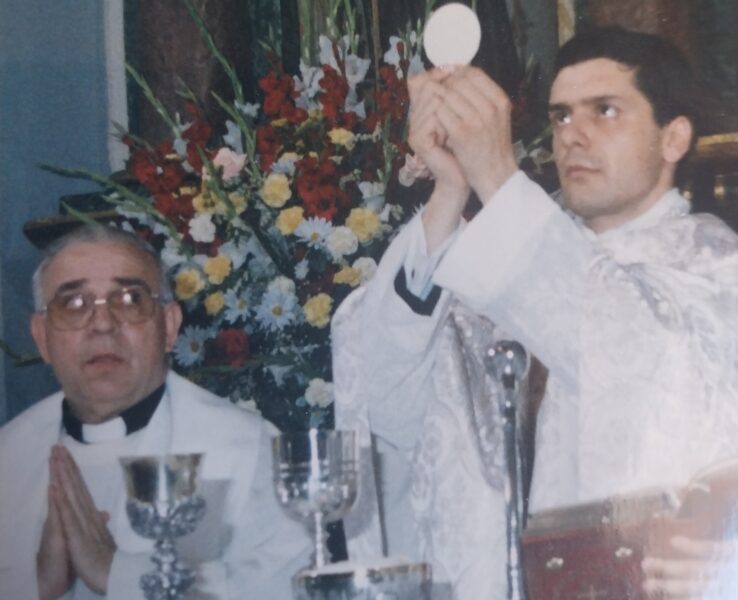
Don Miguel Ponce, priest of the Church in Mérida-Badajoz, has died at the age of ninety. Despite having treated him very closely and filially for forty-two years, I do not have the impression of a rupture, but of a fulfillment: more than leaving, his boat has arrived at the port. And it does not cost me to think—because he himself taught me to think this way—that that port has been the arms of the Lady, whom he loved so much, about whom he spoke so much and wrote so well; and that She has taken him to her Son, who, embracing him on his Heart, will have said to him: “Well done, good and faithful servant, enter into the joy of your Lord.”
Don Miguel has been, above all, a delightful person in his dealings: open, natural, deeply human and, at the same time, profoundly supernatural. Very intelligent, with a prodigious memory and a great conversationalist, with him one could talk about everything: culture, anecdotes, theology, spirituality, current events, art… And he always knew how to say the right word, without passions or partialities, with a serenity that did good to the soul. I remember his smile: sincere, peaceful, almost therapeutic.
He was a great theologian, a real one. With a Herculean capacity for work and an incorruptible discipline, he wrote manuals on practically all subjects: Mariology, anthropology, sacramentology, ecclesiology, eschatology, priesthood… leaving a solid theological synthesis, published by Edicep, BAC, and Herder. But if I had to point out an intellectual passion, I would say without hesitation that it was the Most Holy Virgin: he was a Mariologist in love. He had earned his doctorate with a thesis on the mystery of the Church in Saint Thomas Aquinas, but afterward he plunged into the mystery of Mary as a living theological science, interdisciplinary, harmonious. He was one of the first Mariologists on an international level, in the difficult balance of his time. He did theology “in the modern way,” but in the furrow of tradition: current presentation, integral vision, without ruptures, novelties, or pruritus of originality. With rigor. When a publisher asked him for a somewhat more “spicy” version of one of his books, he replied that they had the wrong person.
Every year, throughout September, in Rome he immersed himself in the library of the «Università della Santa Croce,» handling texts in various languages, to later prepare his substantial manuals. During my eleven years in the Eternal City, we saw each other frequently in that month. He loved eating «spaghetti alle vongole,» strolling through the Gianicolo, or going to Giolitti for an ice cream that we then savored around Piazza Navona and its surroundings. Those walks were a lesson in life, history, and Church.
But if his intelligence shone, his priesthood shone even more. A seminarian with Pius XII and ordained a priest in the pontificate of John XXIII (a month ago he marked 65 years), he was a living page of the history of the Church in the 20th century. He had been formed in the shadow of the Society of Jesus at the irreplaceable Pontifical University of Comillas, from which so many great Spanish clerics emerged. He remembered with affection those extraordinary Jesuits—the Fathers Nieto, Otaño, Regatillo, Rodrigo…—and he often spoke to me about the Schola Cantorum, where he was a tenor, and about the performance of Gregorian Masses and Victoria’s responsories during Holy Week.
After having been superior of the San Atón Seminary in his young years—an glorious era under the episcopate of Don Doroteo Fernández Fernández, when the Pacense Seminary remained as a flame in the vast and sudden darkness of Spain—he was for many years canon (also dean) professor, and chaplain and confessor of the Discalced Carmelites of Badajoz, then belonging to the Association of Saint Teresa, founded by Saint Maravillas de Jesús.
When I met him, I was 13 years old and he was 48. I can still see him every morning, during the choral Mass, in his confessional as penitentiary—by competition!—of the dark, small, and endearing Pacense cathedral, in front of the Tabernacle chapel: fixed, constant, tireless. I began to confess weekly with him, seeing that he was a man of reconciliation and spiritual direction. Later, as a seminarian, I began to deal with him much more. He attended to me slowly pacing around the cloister of the cathedral, dressed in his canonical choral habit: graceful cape with satin facings and half scapular of garnet velvet over the chest. He also received me at his home, where we talked without haste; at the end of the conversation, when I confessed to him, he would delicately place a cushion on the floor for me to kneel.
In his way of directing souls, there was no harshness or voluntarism; he did not impose unnecessary burdens or untimely demands. There was, rather, a deep trust in the person, whom he knew how to stimulate with finesse. Among so many things, he taught me something I have not forgotten: that our Lord looks at us “comprehensively,” in the global offering of our life, not in an atomized and meticulous way.
During my stay in Rome, we carried on spiritual direction by videoconference. They were friendly conversations, in which transparent sincerity was never lacking when he had to tell me something necessary for me, with extraordinary delicacy, but also a clarity and freedom that arose from love for the truth and for the person.
He joyfully and convincedly belonged to the Priestly Society of the Holy Cross. And his loyalty was admirable: he did not want to abandon that belonging when, in exchange for renouncing it, episcopal “pressures” proposed paths of greater ecclesiastical prominence. He preferred fidelity, coherence. And yet, he was extremely respectful: he never hinted to me to belong to Opus Dei, even though he loved it so much. That did not matter: we loved each other as brother priests, though always with a paternal-filial relationship. It was very important to me that he traveled to my priestly ordination in Toledo with several other priests from Badajoz, and that he was at my right during my first Mass at the Discalced Carmelites in the Pacense capital. His priestly reference has been indispensable to me throughout my now three decades as a presbyter.
In recent years, we have talked a lot, a lot, during meals, at least every two weeks, at my house. The last one, on Palm Sunday, a few days ago. He enjoyed and appreciated the dishes, with kind gratitude. And during the after-dinner, savoring the hierbaluisa with star anise and the small glass of Pedro Ximénez with the bonbon, the theological conversations were juicy. And the mutual confidences, heart to heart. Lately, he has suffered a lot because of the situation of the Church, but he has lived it with an impressive and edifying supernatural obedience for me, much younger but, alas, less optimistic than he. When we talked about current circumstances, so painful, he evoked his first priestly years with Paul VI and the bleeding confusionism he had to go through: the sadly famous Joint Assembly, the incessant secularization of priests, the emptying of seminaries, the ruin of so many religious congregations, doctrinal apostasy… In short, the «Three Peals» of Saint Josemaría Escrivá. He told me that, in another way, what was happening today was a revival of that, but he never meant it from bitter criticism or defeatism, but from a faith full of theological hope. Priests hurt him deeply, and he repeated to me with a conviction that still resonates in me: “Never abandon them! That is what I have tried to do all my life. Helping just one is worth everything.” He also told me, with humility: “I already have my priestly trajectory made, but the young priests, with life ahead of them… how they hurt and worry me, especially if they get tired, if they isolate themselves, if they do not pray. They must be cared for. They are so alone and sometimes so disoriented”…
He encouraged me a lot in the preparation of my book «Mary, Mediatrix and Co-Redemptrix,» and he valuably guided me on its approach. Three weeks ago, he showed me, excited, some unpublished notes of his on grace and on Mary’s cooperation in redemption. They seemed so interesting to me that I made him promise to publish them…
Three or four months ago, he was diagnosed with colon cancer. He told me about it with disarming naturalness. I have had the grace to accompany him to the doctor several times, and I remember his lightheartedness, without the slightest hint of tragedy: the same when going to the consultation as when picking up his things in the room when they discharged him. He has borne the radio and chemotherapy treatments admirably; they seemed to be going very well, even hardly affecting him, until, in just over a week… everything precipitated.
Don Miguel has been, above all, a priest in love with Jesus Christ, faithful to prayer, to the Holy Mass, and to the confessional. His two great passions, Mary and the priesthood, merged into one: the Church of Jesus Christ, always young, against which the gates of hell will not prevail.
Without making noise, without imposing himself, Don Miguel has left a deep mark. Many of the good ones, the «patanegra,» the «last of the Philippines,» are leaving us alone. They gave us everything, and upon leaving they seem to say to us: «Now it’s your turn to carry on. You already know the way.»
May Don Miguel Ponce rest in peace, father, teacher, and friend. Or better: may he already intercede for us. Because men like that are not lost; they are transformed into silent, faithful, constant help. And from the Maternal port to which he has arrived, he will continue doing what he did all his life: helping priests, one by one.