


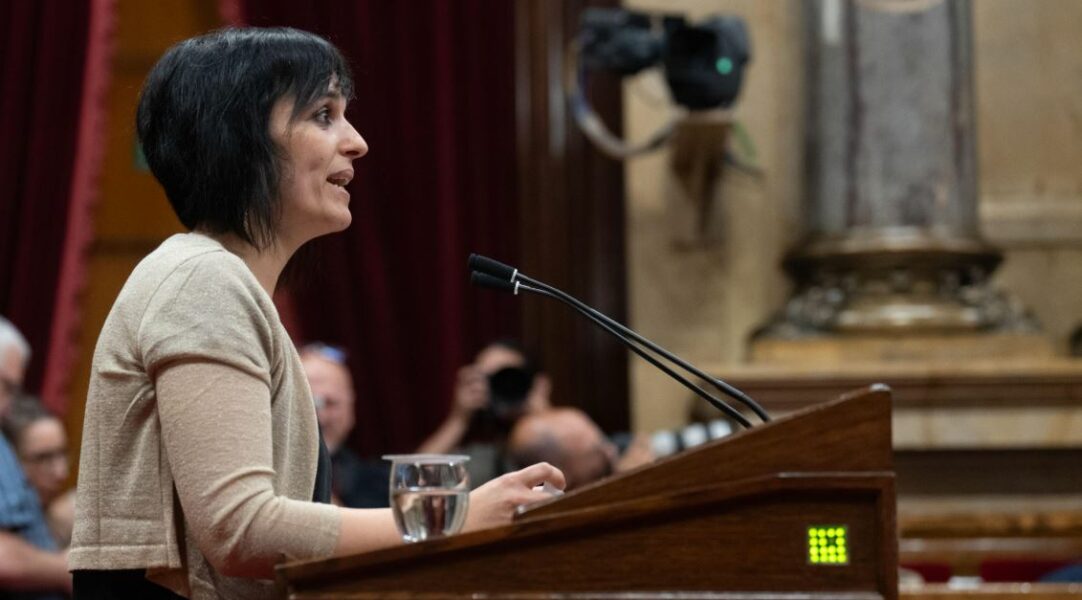
The deputy of Aliança Catalana in the regional Parliament, Sílvia Orriols, has openly defended euthanasia as an “individual right” that must be imposed over “religious or moral dogmas”, in a speech delivered on April 16 and later disseminated on her X account.
Just three weeks ago, Noelia’s euthanasia, a 25-year-old young woman, was finally carried out after a long judicial battle, despite the opposition of her father and various associations. The decision was endorsed by multiple judicial instances and provoked strong controversy, as well as the “profound pain” expressed by the Spanish bishops.
“The right to say enough” against moral limits
During her intervention, Orriols stated that her party defends “without complexes or euphemisms the right of every adult, conscious, and free person who suffers unbearable, chronic, or irreversible pain, to say enough and to voluntarily opt for a dignified, painless, and assisted death”.
In that vein, she argued that “just as we choose how we live, we must also be able to decide the times and circumstances of our death”, emphasizing that in a democracy “individual sovereignty must be imposed over religious or moral dogmas”.
This approach places the decision about the end of life exclusively in the realm of personal will, relegating to the background any objective ethical consideration about the value of human life.
Implicit references to recent cases
Although Orriols avoided mentioning proper names, several of her statements clearly refer to recent situations that have gone through the courts, such as the case of Noelia in Barcelona.
The deputy denounced that “some appeals have been delayed for more than a year with precautionary suspension measures to generate additional and prolonged suffering for people who have already actively and voluntarily expressed their willingness to receive euthanasia”.
Likewise, she warned that “judicial oversight cannot become an automatic extension of life against the express will of the affected person”, in a criticism that coincides with the arguments put forward in that type of judicial proceedings.
“Dignity” linked to the decision to die
Orriols directly linked euthanasia to human dignity, stating that “it is from this dignity that the right emanates not to artificially and forcibly prolong situations of extreme suffering or irreversible loss of autonomy”.
This interpretation identifies dignity with the capacity to decide about one’s own death, a conception debated from perspectives that hold that dignity does not depend on autonomy or physical state, but is inherent to every person.
Criticism of legal hurdles and support for the initiative
The deputy demanded that the State “safeguard this freedom” with guarantees, but “without unnecessary bureaucratic obstacles that delay the last will”, insisting that “no hurdles are needed, but judicial oversight and medical guarantees” before a decision she described as “transcendental” and “irrevocable”.
In the final part of her intervention, Orriols questioned the Catalan Parliament debating a proposal that affects state legislation, pointing out that the regional chamber “has no legislative competence” in this matter and describing it as “indecent” not to be able to fully legislate on these issues.
Despite these reservations, she announced the favorable vote of her party, stating that they do so “with the conviction that we are defending life and, above all, human dignity”.
The contradiction becomes even more evident in the very message with which she accompanied her intervention: “I am Christian, yes, but I want to live in a country where, in cases of extreme suffering or irreversible degenerative illness, you are allowed to die in peace and in bed and not condemned to throw yourself out the window”-
The Christian conception of dignity, which does not justify provoking death, but rather accompanying and caring for the sufferer, precisely reminds us that no life loses its value because of pain, illness, or dependence.