


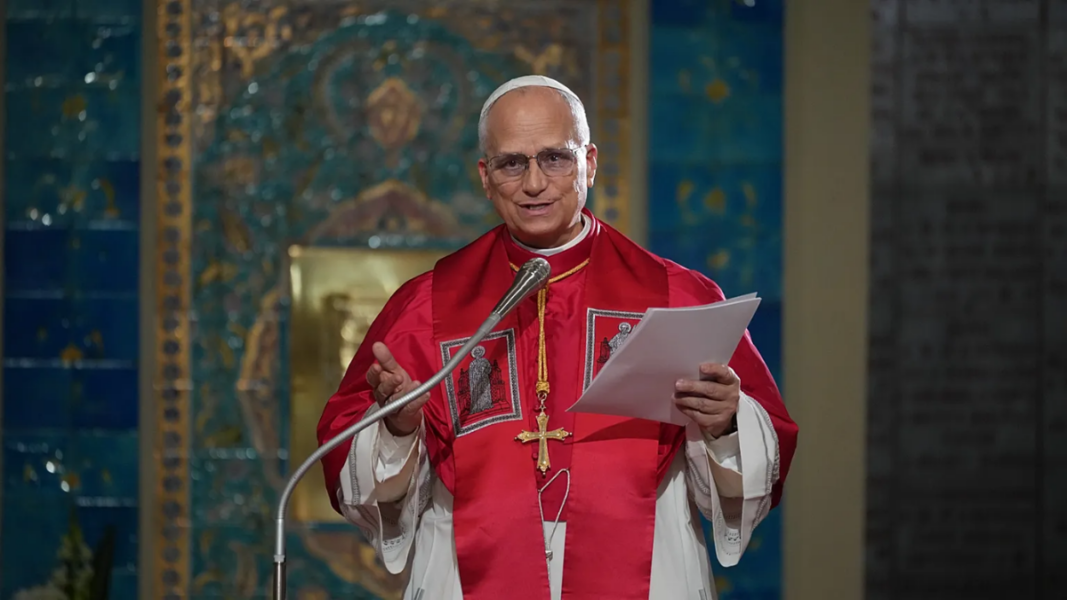
From the plane, even before landing in Algiers, Leo XIV dropped the phrase that was to structure the entire narrative of his trip: «Saint Augustine offers a very important bridge for interreligious dialogue because he is greatly loved in his land.» The image was perfect for immediate consumption: the first Augustinian pope in history, returning to the land of the Bishop of Hippo, building bridges between Christianity and Islam, between the West and Africa, between the turbulent present and a noble and venerable antiquity. The progressive Catholic press received it with enthusiasm. International analysts spoke of a strategic gesture, a historical milestone, a «new epicenter of Catholicism.» All very clean, very photogenic, very much in line with what is expected of a pontiff in 2026.
The only problem is Augustine.
Because the real Augustine, the one who lived in that land, the one who wrote in that land, the one who died in that land while the Vandals besieged Hippo, was not a builder of interreligious bridges. He was the most formidable polemicist that the history of the Latin Church has ever produced. A man who devoted decades of his episcopate not to soft dialogue, but to the systematic and uncompromising refutation of everything he considered error. He confronted Manicheans, Donatists, Arians, Pelagians, Priscillianists, and skeptical Academics. He presided over councils, wrote tirelessly, and polemicized with whoever was necessary in defense of orthodoxy. There is not a single text in his work that can reasonably be interpreted as an invitation to theological coexistence between Christianity and Islam, among other reasons because Islam did not yet exist when Augustine died, in the year 430.
This needs to be emphasized because there is a tendency, when it comes to retroactively appropriating great saints, to project onto them the sensibilities of the present. Augustine lends himself poorly to that operation. Philip Schaff, one of the most rigorous historians of Christian dogma, wrote that Augustine «is the Doctor of the Church par excellence,» whose activity extended over ecclesiology, sacramental theology, and the doctrine of grace with a precision that no one before or immediately after achieved. That Doctor left no room for ambiguity about revealed truth. He sought it for years, with authentic anguish, and when he found it, he defended it with all the instruments available: reason, scripture, conciliar authority, and when necessary, imperial coercion.
This last point deserves pause because it is uncomfortable. In Letter 93, written in the year 408, Augustine openly confesses that he changed his mind about the method to employ with the Donatists, moving from intellectual persuasion to approval of the state’s coercive laws, precisely because «the ineffectiveness of dialogue» had convinced him that something else was needed. His argument was that fear had made many Donatists reflect and had made them «docile.» The same man whom Leo XIV turns into a symbol of interreligious dialogue was the principal doctrinal architect of what historians call the first Christian theorization of legitimate religious coercion. He cannot be reproached with anachronism: it was the fifth century, the context was a violent schism, the Donatist Circumcellions had attacked and mutilated several Catholic bishops. But neither can he be cited as a model of amicable encounter between diverse faiths without falsifying his figure.
The paradox is deeper when examining what Augustine was actually doing in Hippo. He confronted skepticism as a philosopher, Manichaeism and Pelagianism as a theologian, and Donatism as a bishop. Three different fronts, three different ways of combating error. In all cases, the underlying attitude was the same: truth exists, it is knowable, and the one who possesses it has the obligation to defend it. Theological relativism, the peaceful coexistence of contradictory truths, the idea that every spiritual search leads to the same place, would have seemed to Augustine not an act of openness but a betrayal of Christ. The *Confessions* are the autobiography of someone who did not find peace in eclecticism, but in unconditional surrender to a specific and irreducible truth. «You have made us for yourself, O Lord, and our heart is restless until it rests in you»: not in a truth among others, but in you.
Donatism, the heresy that occupied the best years of Augustine’s episcopate, was the last episode in the controversies of Montanus and Novatus that had agitated the Church since the second century, and its core was the question of the holiness of the Church and the validity of sacraments administered by unworthy ministers. Augustine responded by constructing a complete and coherent ecclesiology: the visible Church contains wheat and tares, grace does not depend on the purity of the minister but on Christ, unity is an irrevocable good that justifies drastic measures against schism. That is not a bridge. It is a doctrinal wall built with the precision of an architect. That this wall is today the heritage of the entire Church, that it inspired the Fathers of Vatican II and the great medieval theologians, is exactly the reason why Augustine matters. Not because he is a comfortable interlocutor, but because he is a rigorous thinker.
Augustine distinguished 88 heresies in his treatise *Heresies*, and the four with which he had to deal mainly were Manichaeism, Donatism, Pelagianism, and Arianism. Each of those battles cost him years of writing, public controversy, and personal wear and tear. Each ended with a doctrinal victory that fixed forever the limits of what the Church can believe. Pelagianism, which held that man can achieve salvation through his own efforts without the need for grace, was condemned by the council of African bishops in the year 418 and by Pope Zosimus, thanks in large part to Augustine’s tenacity. It was not a process of mutual listening or reciprocal enrichment: it was a condemnation.
None of this means that Leo XIV is wrong to pilgrimage to Hippo. The visit has genuine spiritual sense: an Augustinian returning to the land of his foundational father, who prays over the ruins where that father preached, who recognizes the debt of his entire life to that thought. That is legitimate and has its own dignity. The problem is not the trip. The problem is the discursive operation that turns Augustine into the patron of interreligious dialogue with Islam, when the only Islam Augustine would have known was the one that arrived decades after his death, and when his entire intellectual life revolved around the affirmation that there is one truth, one Church, one baptism, one grace, and that everything that deviates from it deserves refutation, not diplomatic courtesy.
Analysts have pointed out that the Basilica of Saint Augustine in Annaba attracts thousands of visitors every year, including Muslims who feel a devotion of their own toward the saint. That fact is real and beautiful. Augustine belongs in some way to that land in a manner that transcends confessional boundaries, and the fact that there are Muslims who venerate him says something about the quality of his human figure. But popular veneration of a saint is not the same as his theology. One can admire Augustine without reading Augustine. One can go on pilgrimage to his ruins without assuming what he defended. Leo XIV can do both things at the same time, and probably does. The question is whether the Church he leads can afford to continue citing Augustine as a symbol of openness without explaining what Augustine really thought needed to be opened, and before what one had to remain closed.
There is a phrase in the *Confessions* that defines better than any other what Augustine was and what he sought: *»You have made us for yourself, O Lord, and our heart is restless until it rests in you.»* Not in dialogue. Not in encounter. Not in indefinite search. In the rest that comes only from the encounter with Christ. That restless heart that found peace not in the plurality of paths but in one alone is the same heart that then spent decades telling others they were wrong, with all the charity in the world, but telling them so.
Leo XIV is right about one thing: Augustine is greatly loved in his land. What is not certain is that this love implies agreement with what Augustine taught.