


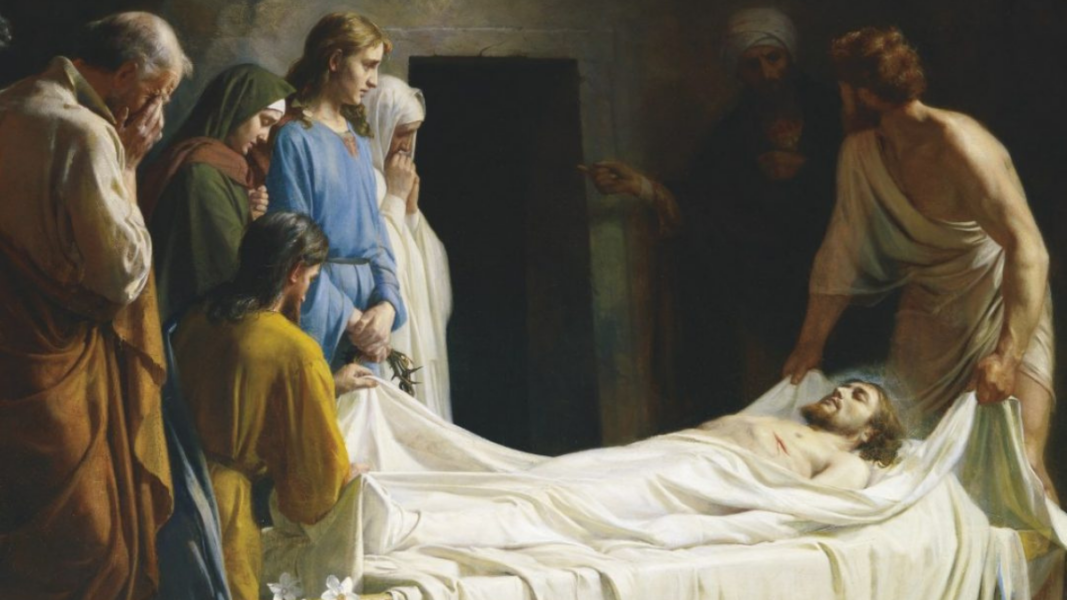
Calvary has been left alone. The voices that blasphemed have fallen silent, hoarse. The Master has died. His Mother, John, Mary Magdalene, a handful of little women, weep, exhausted. And then two figures emerge whom the Gospel does not present as noisy heroes, but as men of serene courage and punctual, discreet efficacy, without fanfare. Joseph of Arimathea and Nicodemus do not belong to the group of the Twelve; they have not publicly followed the Lord, but they have believed. And now, when the world flees or mocks, they act.
With a courage born of love, Joseph of Arimathea, noble counselor, who also awaited the Kingdom of God, going to Pilate, asked for the body of Jesus, audacter, a Latin word that contains an entire theology of Christian courage. It is not recklessness, but bravery that springs from friendship when there is nothing left to lose. Joseph exposes himself: he identifies and commits, because asking for the body of one executed for sedition was to declare oneself, taking the side of the condemned, risking honor and position.
And Nicodemus, the one who went at night to speak with Jesus, now also knows how to appear in the light of deeds. With his fidelity matured in the shadows, he appears carrying the whopping hundred pounds of a mixture of myrrh and aloes. Regal excess: a hundred pounds; weight of loving reparation. Nicodemus’s night has turned to dawn: his faith, which began trembling and fearful, has matured into an unconditional surrender.
Two men and three domestic and urgent services, three delicacies full of manly tenderness: ladder, shroud, and tomb. To un-nail the Body, one had to climb and hold the dead weight of the crucified Love, with reverence and trembling care. Then they wrap it in linens with the spices, as was the custom among the Jews to bury. With decisive and gentle hands they touch the sacred Body, perfume it, honor it, in an almost liturgical gesture. And afterward, Arimathea places it in his new tomb, which he had hewn in the rock. Joseph does not give what he has in excess, but the best: he renounces what he had prepared for himself, so that his Lord may rest.
And behold then, the Lady, the Virgin Mother, consoled by valiant hearts. In receiving her dead Son, beside Her these two men act as knights of sorrow. What do they say to Her? The Gospel is silent on their words but highlights their actions: they support Mary with their service, comfort her with their presence, and offer Her what they have. When so many have fled, these founders of the Order of the Holy Sepulcher, Joseph of Arimathea and Nicodemus, are, in a certain way, the first Christian knights, not of sword or plumes, but of fidelity and decision. They are brave when no one steps forward, generous when all seems lost. Delicate, discreet, firm, decisive, they are men of Marian soul: their service is ordered to Mary, to console the Lady of the Greatest Sorrow. Without speeches, they teach a form of virile, elegant, chivalrous Christianity.
When it arrives, in the life of the Church and in that of each one, that night when Christ seems defeated, forgotten, silenced, more than speeches, gestures of men like them are needed: men who, audacter, step forward; who, even if it costs, ask for the Body of Christ, and care for it, and honor it, accompanied by His Mother.