


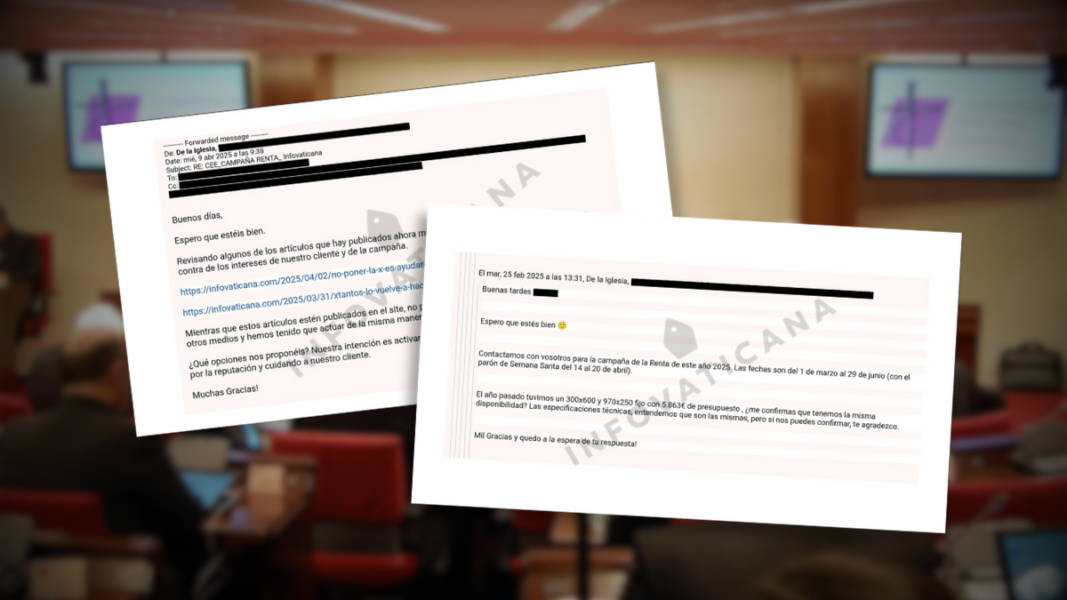
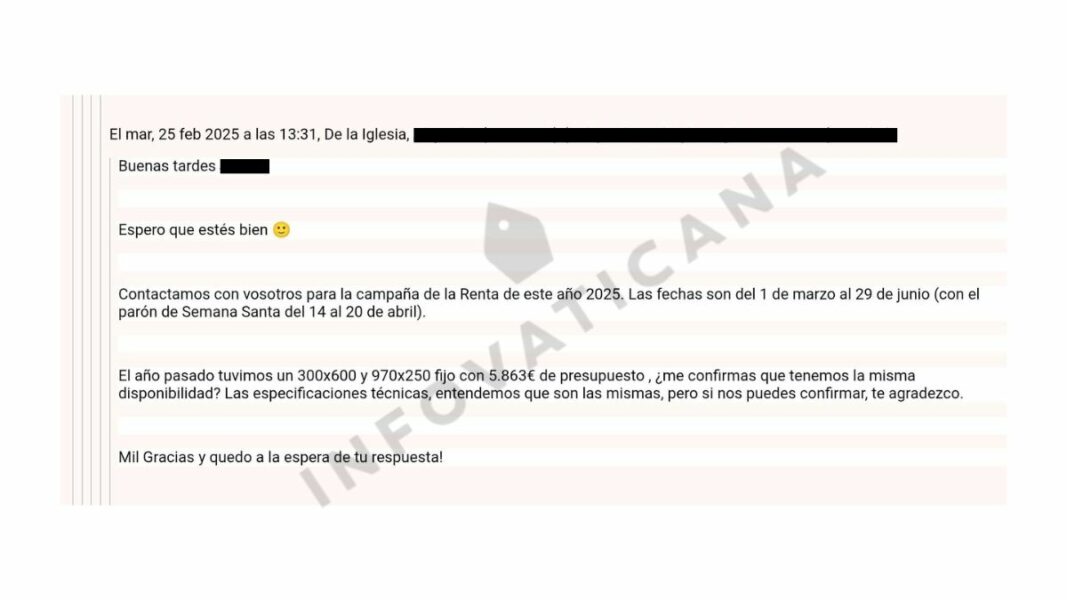
In February 2025, the media agency that manages the digital advertising of the Spanish Episcopal Conference contacted Infovaticana, the leading online media in audience for ecclesial information in Spanish, to offer an advertising campaign. The initiative did not come from Infovaticana, but from the Episcopal Conference’s own advertising structure. In that first contact, no objection was raised to the editorial contents, and the exchange was strictly commercial: dates, formats, and economic conditions for a fixed amount of 5.683 euros. However, weeks later, in April, that proposal turned into an explicit demand: withdraw critical articles as a prerequisite to activate the payment. That was the price set for censorship.
February and April 2025: economic pressure as a method
The proposal included standard formats and a schedule planned between March 1 and June 29, 2025. Nothing suggested at the time that the offer would end up becoming an attempt to condition the media’s editorial line through economic pressure.
From the advertising offer to the editorial ultimatum
In April 2025, the agency wrote back to Infovaticana after “reviewing” articles published in the media. In that communication, two texts critical of recent actions by the Episcopal Conference were explicitly pointed out, and it was stated that such contents “go against the client’s interests and the campaign.”
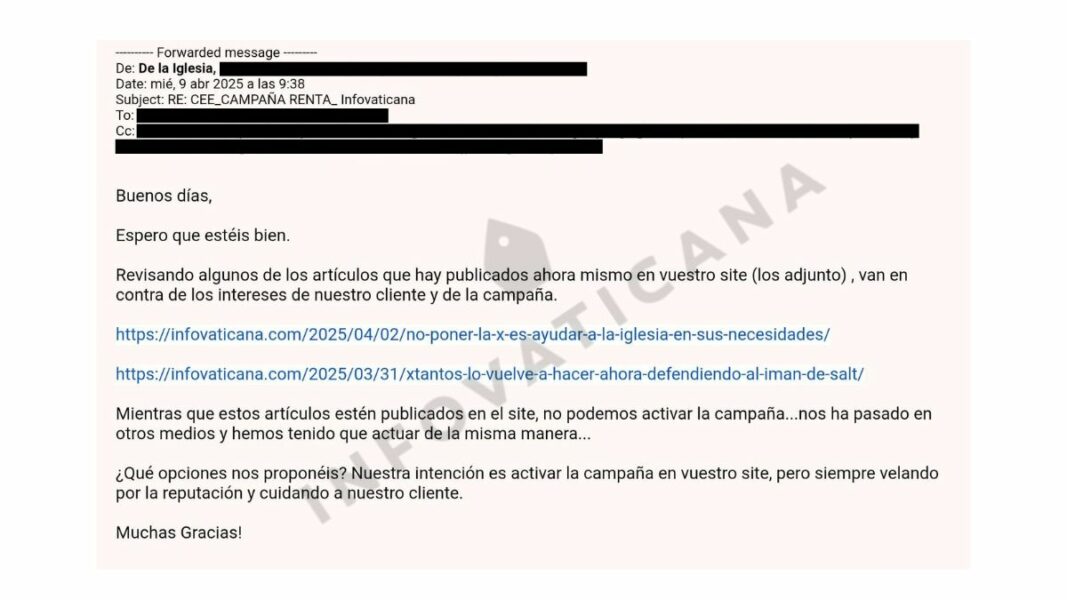
Subsequently, the demand was formulated without ambiguity: as long as those articles remained published on the web, the campaign would not be activated. The withdrawal of the texts thus became the prerequisite to unlock the offered 5.683 euros. It was not a legitimate decision not to advertise in a certain media outlet, but a direct attempt to force the elimination of journalistic content in exchange for money.
Read also: Not putting the X is helping the Church in its needs
The Episcopal Conference’s agency even normalized this behavior by stating that it had already acted “in the same way” in other media, presenting as habitual practice what in reality constitutes a form of economic censorship and a serious deviation from institutional ethics. Advertising is not a tool to erase uncomfortable content from free media.
Read also: Xtantos does it again: now defending the imam of Salt
When money is used to erase opinions
The core of the problem is not the amount, although the figure is revealing: 5.683 euros was the price set for the withdrawal of critical articles. The problem is the method. Conditioning an advertising investment on the suppression of already published content means crossing a very clear line: that of using economic power to try to shape the information available to the public. In our case, they did not succeed, but the way of operating can serve to understand how the ecclesial media landscape works.
We are not facing a debate on editorial affinity nor a technical exercise in brand protection. We are facing an “delete and I’ll pay you”. Facing an attempt to buy silence. Facing explicit pressure to eliminate legitimate criticisms instead of refuting them with arguments.
Infovaticana does not delete what is uncomfortable
Infovaticana is a plural forum within the ecclesial sphere. It publishes information, analyses, and diverse opinions always within doctrine and magisterium, even when they are uncomfortable for the hierarchy. That is precisely its function. It is not a subordinate media nor an institutional mouthpiece. It does not accept directives, prior censorship, nor economic conditions that interfere with its editorial independence.
Accepting the proposed demand would have meant renouncing an essential principle: that contents are published, corrected, or rectified based on journalistic or editorial criteria, not external economic pressures. Therefore, Infovaticana will not censor uncomfortable articles for the Episcopal Conference in exchange for any amount.
A Church without criticism and without freedom
The episode reveals a worrying drift. Diversity of opinion is tolerated in «Catholic» media on dogmatic and magisterial matters, while uniformity and silence are sought to be imposed on those opinions that legitimately question structures, campaigns, or institutional strategies that are entirely debatable. There is an alarming lack of freedom for criticism and, at the same time, a growing confusion between what is debatable and what is dogmatic.
A Church that does not admit public criticism impoverishes itself. An Episcopal Conference that tries to manage dissent through economic pressure damages its moral credibility. And a system in which advertising is used to erase opinions is incompatible with any serious notion of press freedom.
Donors, the only real guarantee
Faced with these practices, there is only one effective guarantee of independence: readers and donors. It is they who allow a media outlet to remain free, even when that freedom is uncomfortable for those who would prefer to buy silence for 5.683 euros.
Thanks to them, Infovaticana does not depend on conditioned campaigns or institutional favors. And thanks to them, it will continue to publish what it considers relevant, truthful, and necessary, even if it bothers. Because freedom is not rented, and much less sold.