


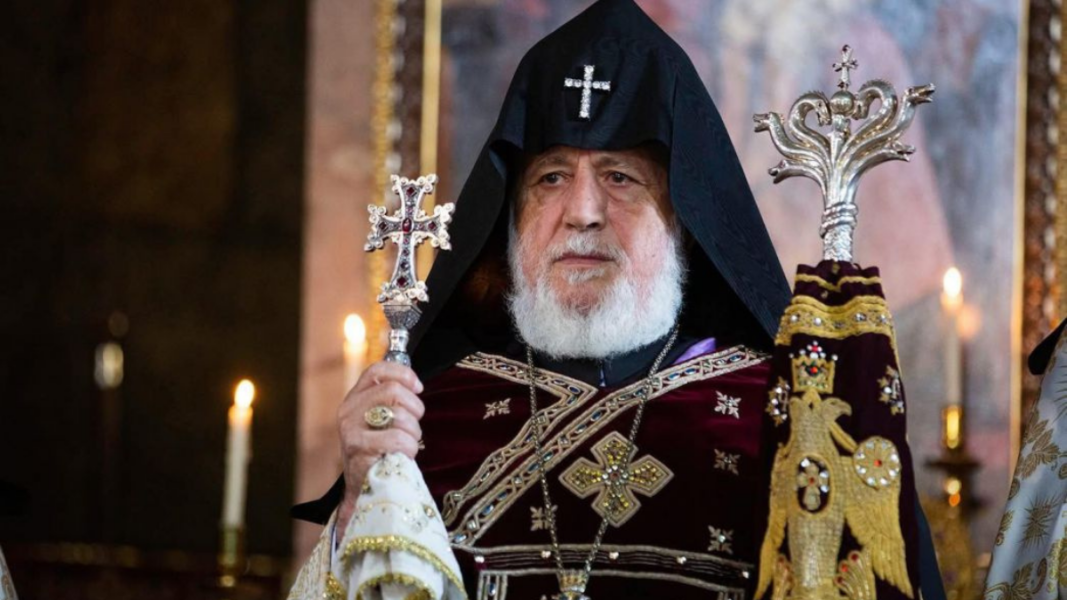
A deep institutional crisis has erupted in Armenia between the government of Nikol Pashinyan and the Armenian Apostolic Church, the country’s oldest and most respected religious institution, threatening the nation’s spiritual and cultural unity. The conflict, which combines personal accusations, reform attempts, and political pressure, has shaken a country where faith and national identity are closely intertwined.
Prime Minister Nikol Pashinyan has intensified his attacks against the Catholicos of All Armenians, Karekin II, in recent months, openly requesting his resignation and proposing structural changes in the Church. According to Pashinyan himself, the spiritual leader would have violated his vows of celibacy and has become an obstacle to the country’s modernization, although he himself denies that there is a conflict between State and Church.
A Millennial Church Facing Political Power
The Armenian Apostolic Church is an institution with more than 1,700 years of history, cradle of the Christianization of the first officially Christian country in the world. Its influence transcends the merely religious: it is a pillar of Armenian cultural, moral, and national identity. The Armenian Constitution recognizes this «exceptional» role and formally protects it.
But Pashinyan, a firm defender of a secular Armenia oriented toward socioeconomic modernization, sees the Church as a paralyzing power. He has promoted a «roadmap» to reform the Apostolic Church, including a new ecclesiastical governance law, greater financial transparency, and the eventual election of a new Catholicos according to revised norms.
Political Escalation and Personal Attacks
The dispute has crossed institutional boundaries and has become deeply personal. The premier has publicly accused Karekin II of violating his vow of celibacy and has pointed to him as an agent who obstructs the interests of the State, even going so far as to claim that his continued tenure in office represents «damage to national security.»
These claims have been amplified by members of his entourage, such as his wife, who compared some clerics to «pedophiles» and described the Catholicos in highly derogatory terms, triggering a wave of popular indignation and a deep internal division.
The Church’s Response and External Support
From the Etchmiadzin Patriarchate, the response has been firm. The Supreme Spiritual Council denounced what it described as «repression» and violations of the Church’s canonical autonomy, including the forced omission of the Catholicos’s name in official liturgies.
In addition, leaders of other Christian Communions, such as the Syriac Orthodox Church, have expressed their solidarity with the Armenian Apostolic Church in the face of what they consider an unacceptable interference by the State in religious affairs.
The Tension Intensifies on the Eve of Elections
As the 2026 parliamentary elections approach, the tension has escalated further. Pashinyan has launched campaigns to «return the Church to the people,» which include arrests of priests, searches of properties, and even the exclusion of the Church from access to certain historic monasteries.
Some analysts warn that this confrontation could deepen social divisions in Armenia even further, putting at risk not only internal stability but also national cohesion in a country that has made its Christian faith a central element of its identity for centuries. In a context where the Armenian Apostolic Church continues to have between 80% and 90% of the faithful in the population, minimizing its political and social role could generate a fracture with unpredictable consequences.
A Conflict with Cultural and Civil Ramifications
This clash between State and Church is not just a confrontation between two institutions, but a deeper symptom of an Armenia seeking to redefine its future after years of crisis, military defeat against Azerbaijan, and geopolitical challenges. The Church, for its part, claims its role as the guardian of the historical, moral, and spiritual memory of a people that has recognized itself in its faith for seventeen centuries.
The way this conflict evolves will mark not only the relationship between Church and State in Armenia, but also the way a deeply religious society interprets its national identity in times of trial.
Source: FSSPX News