


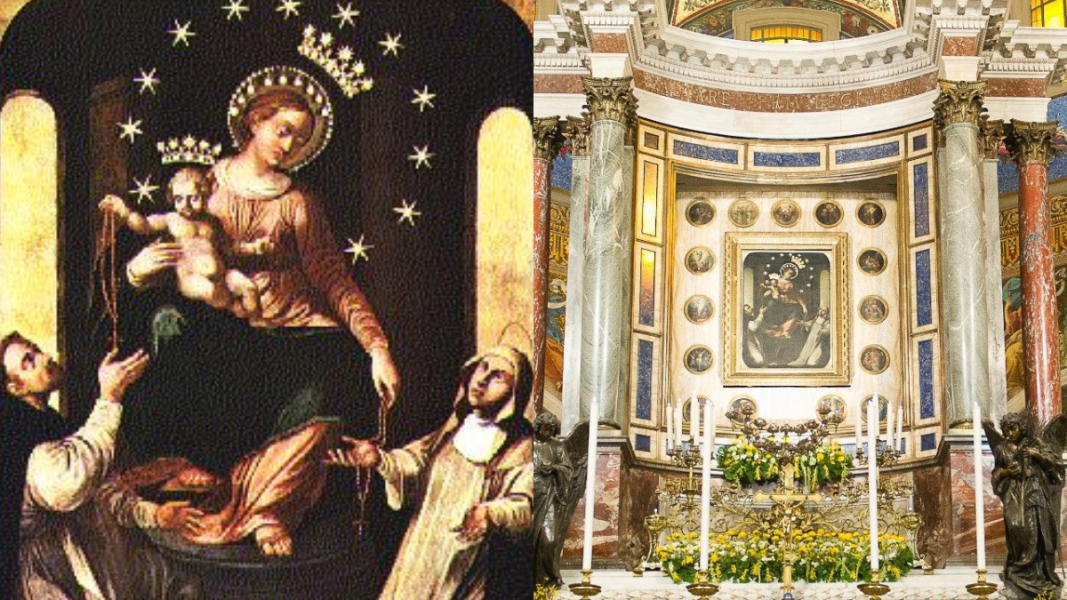
A Simple Painting for a Great Work
In 1875, Bartolo Longo was seeking an icon of Our Lady of the Rosary to preside over the small oratory he had begun to build. A priest friend, the canon from Naples Alberto Radente, offered him an abandoned and deteriorated painting that had been stored in a Dominican convent. The modest painting, by an unknown author, showed Our Lady of the Rosary handing the rosary to Saint Dominic and Saint Catherine of Siena.
Despite its poor condition—the canvas was torn, blackened by smoke, and with faces almost unrecognizable—Bartolo accepted the image with devotion. On November 13, 1875, the icon was carried by cart to the Valley of Pompeii. During the journey, the peasants received it with curiosity and skepticism: “Is that the painting that will work miracles?”, they asked. Bartolo responded with faith: “The Virgin wants it this way”.
The painting was restored in 1879 by the Neapolitan painter Federico Maldarelli, who respected its original features without removing its ancient and simple character. In the following years, that icon would become the focus of countless conversions, thanks to the spiritual and material prodigies that began to be attributed to its intercession.
The Miracle That Founded a Sanctuary
On May 8, 1876, during a novena of prayer to the Rosary organized by Bartolo Longo, the first miracle attributed to the Virgin of Pompeii occurred: the sudden healing of a terminally ill young woman, Fortunatina Agrelli. The news spread throughout Italy, attracting pilgrims to the humble oratory in the Valley. Soon, the faithful began to speak of the place as “the new Pompeii”, a symbol of the resurrection of faith over the ruins of ancient paganism.
The devotion grew so rapidly that in 1883 the construction of the current Sanctuary of the Virgin of the Rosary of Pompeii began, thanks to donations from faithful around the world. The project was driven by Bartolo and his wife, Countess Marianna De Fusco, who consecrated their lives and fortune to this Marian work. In 1891 the sanctuary was consecrated and in 1901 it received pontifical recognition, being elevated by Pope Leo XIII—author of the encyclical Supremi Apostolatus Officio on the Rosary—to the rank of pontifical basilica.
Since then, Pompeii has become one of the most important pilgrimage centers in Italy, a place where the prayer of the Rosary is continually renewed as a source of grace.
The Spiritual Message of the Icon
The canvas of Our Lady of the Rosary of Pompeii is, theologically, a visual catechesis on Mary’s mediation in the mystery of salvation. In the scene, the Virgin hands the rosary to Saint Dominic and Saint Catherine, symbols of the militant Church and contemplative life. In the center is the Child Jesus, who blesses the world with one hand while holding the rosary with the other: it is Christ who grants grace, but He does so through His Mother.
Each bead of the Rosary is, in this sense, a thread that unites the prayer of the Church with the heart of God. That is why the Sanctuary of Pompeii has become a place where prayer is offered not only for the living, but also for the souls in purgatory, in fulfillment of the reparative mission that Bartolo Longo himself received: to spread devotion to the Virgin and pray for sinners.
The main feast of the sanctuary is celebrated on May 8, with the solemn “Supplication to the Virgin of the Rosary”, a prayer composed by Bartolo Longo and approved by Pope Pius X. Each year, thousands of faithful gather to recite it in unison, asking for the intercession of the Mother of God for all humanity.
From the Ruins of Paganism to the Glory of the Rosary
The icon of Our Lady of the Rosary of Pompeii embodies the power of the Rosary as an instrument of spiritual restoration. If in the 16th century the Virgin at Lepanto gave victory to Christendom over the Muslim threat, in the 19th century the Rosary restored faith to a Europe weakened by secularism and indifference. Saint Bartolo Longo, former enemy of the Church, thus became a new apostle of the Rosary, demonstrating that there is no ruin so deep that it cannot be rebuilt by grace.