


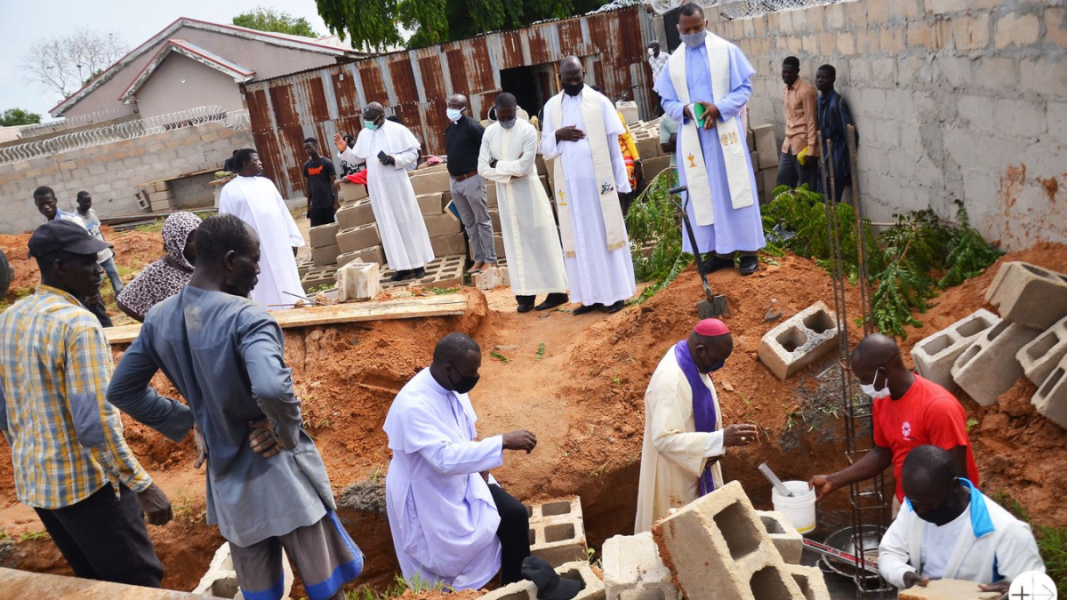
The president Donald Trump has once again focused on the systematic persecution of Christians in Nigeria, a drama that, despite its magnitude, continues to be silenced by much of the international community and Western media. In a message disseminated on November 5 through his social network Truth Social, Trump warned that Christianity “faces an existential threat” in the African country, where “thousands and thousands of Christians are being killed” by “radical Islamists.”
His words—reported by the National Catholic Register—have been welcomed by numerous Catholic organizations and human rights groups, although experts on the ground recall that the root of the problem is deep and complex: a mixture of religious fanaticism, political corruption, and social decay that has turned Africa’s most populous country into the epicenter of violence against the faithful.
Read also: Parolin downplays the blood of Nigerian martyrs
A declaration with consequences
Days earlier, Trump had announced the inclusion of Nigeria on the list of “Countries of Particular Concern” (CPC), a category reserved for governments that commit or tolerate serious violations of religious freedom. The decision is supported by the International Religious Freedom Act of 1998 and opens the door to economic sanctions and diplomatic restrictions.
Read also: Trump denounces the “Christian genocide” in Nigeria
“The United States cannot stand idly by while atrocities are committed against Christians,” the president said, even warning that he could impose coercive measures if the Nigerian government does not act. He also announced the creation of a commission led by Congressman Riley Moore to investigate the extent of the religious genocide.
A Church that suffers and resists
The figures are harrowing: in 2025 alone, more than 7,000 Christians have been killed, at a rate of about 30 victims per day, according to data cited by National Catholic Register. The perpetrators are mostly Fulani Islamist militias, the terrorist group Boko Haram, and the regional affiliate of the Islamic State.
The Vatican’s Fides Agency confirms that between 2015 and 2025, 145 priests have been kidnapped and 11 killed. In September, Father Emmanuel Asadu, from the diocese of Nsukka, was shot dead while returning from a pastoral mission.
Despite the tragedy, the Church in Nigeria continues to be one of the most vibrant in the world: 94% of Catholics attend Mass every Sunday, the highest rate on the planet. “The Church has not stopped being active, nor have the faithful stopped professing their faith,” states Edward Clancy, spokesperson for Aid to the Church in Need (ACN-USA).
Bishops divided over Trump’s initiative
Trump’s measure has been celebrated by part of the Nigerian episcopate, while other prelates call for caution. Bishop Wilfred Anagbe, bishop of Makurdi, a region ravaged by attacks, considers the designation “necessary and awaited.” In contrast, Bishop Matthew Hassan Kukah, of Sokoto, fears that the gesture “will harden divisions” and hinder interreligious dialogue.
The Nigerian government denies religious persecution
President Bola Tinubu, a moderate Muslim of Yoruba ethnicity, rejected the accusations of religious genocide and attributed the violence to security problems and widespread criminality that affect both Christians and Muslims. However, ecclesiastical sources in the country point out that the real evil is the endemic corruption that has disintegrated the State.
A Nigerian Catholic leader, quoted anonymously by the National Catholic Register for security reasons, stated that the country lives with a “monstrous level of corruption” and a “total dysfunction” that allows militias to act with impunity. “At first it was Islamist violence—he said—but now it’s something much more chaotic and uncontrolled.”
A political hope, a spiritual clamor
For Nina Shea, an expert at the Hudson Institute, Trump’s decision “finally recognizes the persecution of Christians in the central belt” and can force the Nigerian government to act. Similarly, Catholic intellectual Robert Royal, president of the Faith and Reason Institute, emphasized that “it is evident beyond any doubt that thousands of Christians are attacked for their faith” and called on the international community to pressure Nigeria to protect believers.