


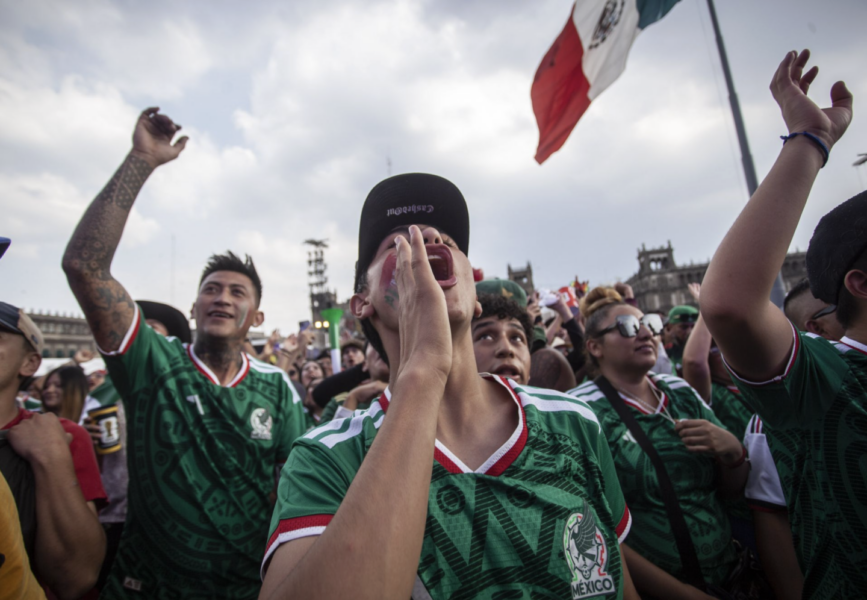
El Semanario de Guadalajara.- With the first phase of the World Cup now over, it is essential to assess what an event like this leaves in the masses who ‘die’ for their team.
Millions of people, different in language, class, and culture, beat to the rhythm of a ball. What happens there is not just sport; it is a phenomenon of mass psychology that reveals the best and worst of us as a collective.
Some positive aspects of this tournament deserve to be highlighted:
Identity and social cohesion. The World Cup functions as a ritual that suspends everyday differences. Wearing the same jersey creates what Emile Durkheim would call collective effervescence: a state in which the individual feels part of something greater. Families divided by politics embrace over a goal. In 1998, for example, France used its victory to symbolically integrate a nation fractured by racism; the famous “black-” showed that national identity can be rebuilt from the pitch.
Catharsis and shared joy. Sigmund Freud spoke of catharsis as the release of tensions. The World Cup allows people to shout, cry, and jump without judgment. For countries in crisis, those 90 minutes are an emotional truce. Uruguay 1950 or Morocco 2022 showed—or at least that is how it was felt—that football gives dignity and hope to entire peoples.
Global solidarity: The World Cup crowd also organizes and makes causes visible. Campaigns against racism, homophobia, or war use the World Cup spotlight because they know the world is watching.
But there are also negative aspects we must not overlook:
Loss of individuality and violence. When the crowd feels anonymous, personal responsibility dissolves. Psychologist Gustave Le Bon spoke of crowds in which “by the mere fact of forming part of a multitude, man descends several rungs on the scale of civilization.”
The death of a Colombian in Guadalajara is a terrible example. The opponent ceases to be human and becomes a symbol to be destroyed.
Exacerbated nationalism. Without reasoning, people give their lives against the lives of those from another country.
Manipulation and alienation. Governments use the World Cup as “bread and circuses.” The more spectacle there is, the less the population thinks; it only wants to be entertained.
Argentina 1978, under a military dictatorship, is the most cited case; while people were being tortured 30 meters from the Monumental stadium, the crowd sang goals. Or the event is used to win voters. Citizens believe their government gave them a World Cup. The party anesthetizes social criticism.
Consumerism and fanaticism. The World Cup crowd is also a consumer crowd—and a big one. People go into debt to travel, buy what advertising dictates, and elevate players to demigod status. This, FIFA knows very well, has been the biggest winner of the fanaticism of many fans, inside and outside the stadium.
The World Cup lays bare an uncomfortable truth: we are deeply tribal beings. The crowd can be the satisfying embrace (people feel like “friends” in the stadium) or the cruelest lynching.
As Ortega y Gasset said: “Mass-man is the one who demands nothing of himself, but is content with what he is and applauds himself.”